
You parked a car that ran fine yesterday, and now it barely cranks. What can drain your car battery comes down to three suspects. The timing of the failure usually names the guilty one.
This guide works like a decision tree, not a flat list of parts.
Here’s the number that anchors everything. A healthy car should draw only 20 to 50 milliamps after its computers fall asleep. Anything stuck above roughly 100 milliamps flattens even a fresh battery within a week or two.
So we’ll start with the short answer, then work through the full decision tree.
What Can Drain Your Car Battery
What can drain your car battery? Three groups cover nearly every case: the battery, charging system, and parasitic draw. Parasitic draw means something keeps pulling current after you shut the car off.
Common culprits include trunk lights, stuck relays, dashcams, and aged batteries. How fast the battery dies tells you which group is guilty.
When the Battery Died Tells You What Killed It
Match your situation to a row below. The first column is the clock, and the second column is your shortlist.
| When the battery dies | Most likely culprit | Typical draw |
|---|---|---|
| Overnight or by the next morning | Stuck light, shorted cell, failed alternator diode | 1 to several amps |
| After 3 to 10 days parked | Sustained key-off draw above 100 mA | 100 mA to 1 amp |
| After a month or more of sitting | Normal draw wearing out an aged battery | 20 to 50 mA |
| Only while driving | Charging system failure, not a drain | N/A |
| Slow cranks that improve by afternoon | Charging deficit from short trips | Not a true drain |
Notice what’s missing from the fast rows. A battery that dies overnight rarely suffers from slow sulfation. It’s bleeding amps right now, which means you can catch it with a test the same day.
The slower rows point to smaller loads or a battery that has lost capacity.
Before anything else, confirm the state of charge. Compare your reading against what a healthy battery should read at rest, because a “dead” battery is sometimes just a discharged one.
Why Your Car Battery Keeps Dying: The Cause Depends on the Pattern
Most drain guides hand you the same five-item list. Headlights left on, old battery, extreme heat, done. That approach fails because it ignores the most useful clue you already have.
When the battery died tells you almost as much as what killed it.
A dead battery is a symptom, not the disease. The same culprits produce different failure patterns depending on how much currenteach one pulls and how long it stays awake. Current is the whole game here.
A trunk light pulling half an amp kills a battery overnight, while a sleeping module pulling 40 milliamps takes weeks.
The math is simple once you see it. A typical 60 amp-hour battery holds roughly 1,200 hours of 50 milliamp draw, which works out to several weeks before voltage sags too low to crank. Push the draw to 1 amp and that window collapses to about two days.
Stack several amps, like a headlight left on, and one night finishes the job.
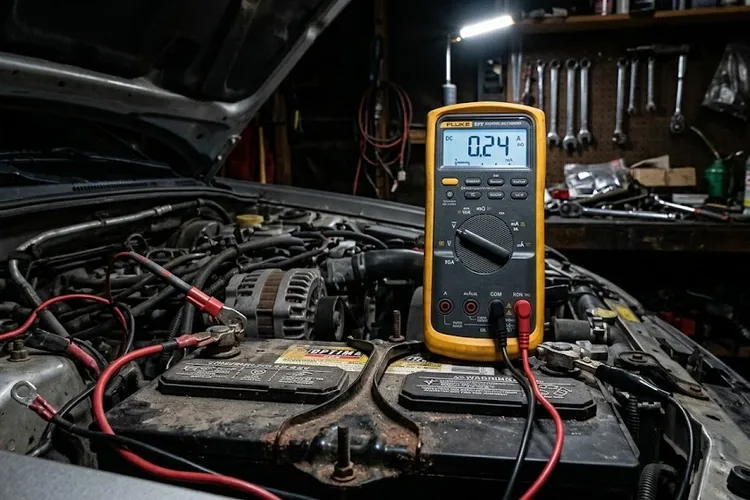
Image source: Bing (Web (fair-use with source credit))
Here’s the pattern rule we keep coming back to in our research. The faster the battery dies, the bigger the current drain. The slower it dies, the closer you are to simply needing a new battery.
Keep that in mind as we walk the tree, because it tells you where to spend your first hour of testing.
The Three Suspects: The Battery Itself, the Charging System, and Parasitic Draw
Every dead-battery story lands on one of three suspects. Once you can tell them apart, you stop guessing at parts.
Suspect 1: the battery itself. A battery fails internally in a few ways. Age and heat shed plate material, deep discharges cause sulfation, and a shorted cell drops the resting voltage permanently. The signature is simple.
Even after a full overnight charge, it tests weak or dies again quickly under modest load. Start by checking the resting voltage against normal key-off readings, then get a conductance test. Most US parts stores run this test free.
Suspect 2: the charging system. The alternator, its voltage regulator, and the drive belt keep the battery topped up while you drive. A failed diode, worn brushes, or a slipping belt starve the battery during every trip. The signature is a car that dies while running, often with the battery warning light glowing.
Manufacturer specifications indicate healthy charging voltage runs 13.5 to 14.7 volts with the engine on.
Suspect 3: parasitic draw. This is any current the car pulls after you shut it off. Some draw is normal, because as of 2026 even base-trim cars run dozens of control modules that need standby power. The problem shows up when a stuck light, relay, or module keeps pulling 10 times the normal amount.
| Suspect | Signature symptom | First test |
|---|---|---|
| Battery itself | Weak even after a full charge | Conductance test after charging |
| Charging system | Dies while driving, warning light | Running voltage check |
| Parasitic draw | Fine until parked, then dead | Key-off milliamp draw test |
The order matters too. Always clear suspects 1 and 2 before hunting a drain, because a draw test on a bad battery just wastes your afternoon.
The Battery Drain Decision Tree: Find Your Exact Scenario
Work down the branches until one matches your car. If a branch fits, follow its action. If it doesn’t, move to the next one.
Dead Overnight or After One Day: Fast, Heavy Drain
If the car ran fine at 10 p.m. and cranks dead at 7 a.m., you’re looking at amps, not milliamps. First, confirm the battery is genuinely dead rather than just weak with a proper voltage check. Then hunt for a light that stays on, because trunk and glovebox lamps are the classic overnight killers.
Jump it, then test the alternator, since a shorted diode drains the car parked and sabotages charging while you drive.
Dead After a Week or Two of Sitting: The Slow Leak
If Sunday drives fail by Friday, something is pulling a sustained 100 milliamps or more. Prime suspects include a dashcam running parking mode, a stuck relay, or a module refusing to sleep. If the car only dies after several weeks, the draw may be normal and the battery may simply be worn out.
That’s why the timeline matters more than the symptom.
Dies While You’re Driving: Point the Finger at the Alternator
If the car dies at speed or while idling at a light, forget drains entirely. The charging system failed, and the car ran on battery until it emptied. Check the running voltage against normal alternator output first.
This one deserves urgency, because NHTSA notes electrical failures can strand you in traffic. Fix it before your next commute, not next weekend.
Slow Cranks Every Morning, Fine by Afternoon: Short-Trip Syndrome
If cranks feel weak on the first start but every later start is crisp, you have a charging deficit, not a drain. One start costs real capacity, and 20 to 30 minutes of driving replaces it. Errand-hopping never gets there.
Find out whether driving actually recharges the battery in your case, because short trips usually don’t.
Random No-Starts You Can’t Reproduce: The Intermittent Draw
If it dies monthly with no pattern, suspect an intermittent fault. Sticky glovebox switches, damp door switches, and modules with buggy sleep logic all hide during a test. Write down dates and conditions before your shop visit.
That log often cracks the case faster than any meter.
The Real Culprits, Ranked: From Trunk Lights to Stuck Relays
Now meet the offenders themselves, ranked by how often they show up in real diagnostic work.

Image source: Web (Bing) / walmart.com
- Trunk light stuck on. The undisputed champion. A misaligned latch or worn pin switch leaves the lamp burning behind a lid you can’t see into.
- Glovebox and under-hood lights. Same failure mode, worse hiding spots. An under-hood lamp sits above a hot engine where nobody looks.
- Dashcams wired for parking mode. A hardwired kit pulling 300 to 500 milliamps will flatten a battery in three to five days.
- Miswired aftermarket gear. Remote starters, alarm modules, and subwoofer amps tapped into always-hot circuits instead of switched power.
- Stuck relays. A fuel pump or blower relay welded closed runs its load any time it wants, sometimes drawing several amps.
- Failed alternator diode. The sneaky one. It drains the battery parked, then hides behind a passing charge test.
- Modules that won’t sleep. A faulty door switch or body control module keeps the CAN bus awake for days.
- Live accessory outlets. Phone chargers and radar detectors plugged into unswitched 12V ports sip power around the clock.
- An aged battery with normal draw. Technically not a fault at all. Four to six years of heat cycling leaves it too weak to survive a month parked.
One honorable mention deserves caution. Corroded terminals don’t actually drain anything, but that crusty buildup on the posts mimics every classic drain symptom, from slow cranks to sudden no-starts. Clean the connections before you blame anything else, because it’s a five-minute fix that often ends the mystery.
Found a suspect on that list? Now prove it before you spend a dime.
How to Test for a Battery Drain at Home: The Complete Multimeter Workflow
You can hunt a drain yourself with a $20 multimeter and about an hour of patience. The test sounds intimidating, but it’s really just careful fuse pulling while the meter watches the current.
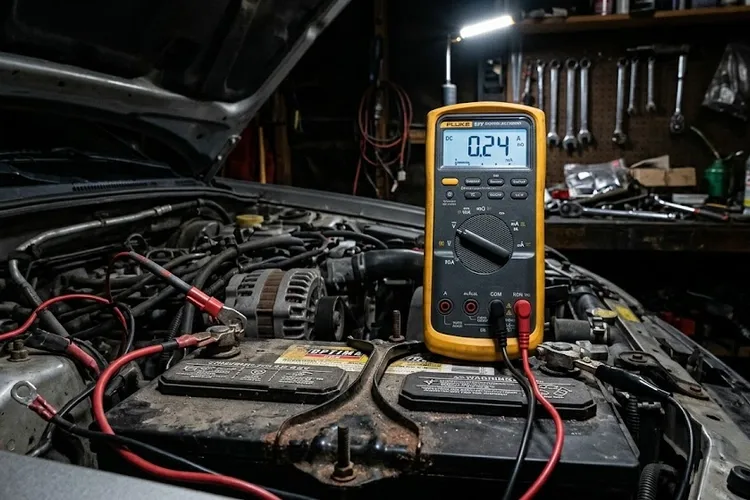
Image source: Web (Bing) / carcaretotal.com
| Tool | Job | Typical cost |
|---|---|---|
| Digital multimeter | Reads the milliamp draw | $15 to $60 |
| Memory saver | Preserves presets during the test | $10 to $30 |
| Small wrench | Loosens the negative clamp | In your toolbox |
| Hood shim | Keeps the under-hood light switch closed | Free |
Step 1: Rule Out the Battery and Charging System First
If the battery fails after a full charge, a draw test is pointless. Run a quick voltage check at home and compare the resting number against normal key-off readings. Then start the engine and verify charging output.
If the alternator can’t hold 13.5 volts, fix that before chasing a drain.
Step 2: Set Up the Parasitic Draw Test
Park the car, pull the key, and close everything. Set the meter to its 10-amp DC range first. Loosen the negative clamp and lift it off the post.
Connect the meter in series: one probe on the freed clamp, the other on the bare post. Current now flows through the meter instead of the cable.
Warning: never touch the amp-mode probes to both battery posts at once. That’s a dead short through the meter, and it can pop fuses instantly.
Step 3: Wait for Sleep Mode, the Step Everyone Skips
Modern cars stay awake 30 to 60 minutes after shutdown. During that window you’ll see several hundred milliamps that mean absolutely nothing. Close the doors, latch the hood, and walk away.
Don’t reopen anything, because a door chime wakes every module back up.
Step 4: Pull Fuses One at a Time Until the Numbers Drop
A settled reading above 100 milliamps confirms a real drain. Now pull fuses one by one, noting each slot. When the number collapses, you’ve found the guilty circuit.
If the draw survives every fuse, suspect the alternator, starter wiring, or a feed straight off the battery.
Step 5: Trace the Guilty Circuit to the Actual Cause
Check the owner’s manual to identify that circuit. Then inspect its lights, relays, and modules. If a dashcam or amp shares that fuse, unplug it and retest.
If the circuit feeds something you can’t repair yourself, that’s your shop conversation, and you’ll walk in holding real data.
What Each Fix Costs: Free Repairs, $30 Fixes, and When a Shop Earns Its Fee
The diagnosis usually costs less than the guesswork. Here’s the realistic price ladder, as of 2026 US rates.
| Fix | Typical cost |
|---|---|
| Unplug a dashcam, charger, or radar detector | Free |
| Clean corroded terminals | $5 to $15 in supplies |
| Replace a trunk or door jamb switch | $10 to $40 parts, DIY-friendly |
| Swap a stuck relay | $15 to $60 |
| Professional draw diagnosis | $100 to $200 per hour, often 1 to 2 hours |
| Alternator replacement | $150 to $600 installed |
| Body control module repair | $300 to $900 |
| Replacement battery if the old one cooked | $120 to $250 flooded, $200 to $400 AGM |
Use the free stuff first. Most US auto parts chains test batteries and charging systems at no charge, and AAA members can get mobile battery service on the driveway.
When does a shop actually earn its fee? Three situations. First, when the draw hides inside a module or factory wiring that needs diagrams you don’t own.
Second, when the guilty circuit touches the airbag system, which you shouldn’t probe casually. Third, whenever the drain is intermittent and refuses to repeat during your hour of testing.
One money note matters here. If the drain ran long enough to kill the battery, budget for a new one regardless of the repair. Lead-acid cells that sit deeply discharged for weeks sulfate hard, and many never recover full capacity.
Mistakes That Turn a Small Drain Into a Dead Battery
These are the errors we see over and over in repair-forum threads and shop complaints.
- Jump-start after jump-start instead of recharging. Every jump deep-discharges the cells a little more. Charge it properly on a real charger after each failure, and mind federal jump-start safety guidance, because dead batteries vent hydrogen gas.
- Installing the new battery first. If the drain is still there, your $250 battery dies in the same pattern within days. Diagnose before you spend.
- Reading the meter during the wait. A 400 milliamp reading at minute five is normal. Panic at minute 70, not minute five.
- Opening a door mid-test. The jamb switch wakes the dome light and every module at once. Your clean reading vanishes, and you start over.
- Blaming corrosion. That green crust on the posts mimics every drain symptom but draws zero current. Clean the connections before anything else.
- Skipping battery registration on European cars. New batteries in BMW, VW, and some Mercedes models must be registered to the car, or the charging system manages them wrong and shortens their life.
The registration one bites people hard. They fix the drain correctly, install a quality battery, and then wonder why it fades in eighteen months. Manufacturer documentation confirms the charging profile adapts to the battery’s serial data, so skip that step and you’ve built a new problem.
Preventing the Next Drain: Maintainers, Storage Habits, and Short-Trip Fixes

Image source: Web (Bing) / dynamicsounds.co.uk
For stored vehicles. A plug-in maintainer beats an old-school trickle charger every time. Smart multi-stage units hold a safe float voltage indefinitely without boiling the electrolyte. No outlet available?
Disconnect the negative terminal instead, and expect a flooded battery to self-discharge about 4 to 6 percent per month anyway.
For short-trip drivers. Remember the math from earlier: one start takes 20 to 30 minutes of driving to repay. If your week is all errands, whether driving actually recharges the battery becomes the real question, and the answer is usually no. Add one longer weekly drive or keep a maintainer on overnight.
For hot climates. Heat, not cold, is what actually kills batteries. Garage parking or a shaded spot buys real lifespan. Check the terminals each spring and clean any crust before it spreads into the cables.
For aging batteries. Past the four-year mark, test before winter instead of trusting it. Cold mornings punish marginal cells, and the typical replacement window runs 3 to 5 years in most climates. Testing costs nothing at most parts stores.
For aftermarket gear. Wire accessories to switched circuits, or choose dashcam parking modes with low-draw settings. A properly wired dashcam should pull well under 100 milliamps in guard mode.
Battery Drain FAQs
How long does it take a drain to kill a battery?
It depends entirely on the draw size. A stuck trunk light pulling 2 to 5 amps can kill a battery overnight. A sustained 100 milliamp drain takes one to two weeks.
The normal 20 to 50 milliamp standby load takes a month or more, which is exactly why aged batteries fail during long-term parking.
Can a bad alternator drain a battery when the car is off?
Yes. A shorted diode lets current leak backward through the alternator while parked, often enough to flatten a battery overnight. It also undercharges during every drive, so the battery starts each day weaker than the last.
If a ripple test fails, replace or rebuild the alternator.
Will disconnecting the battery stop a drain?
Yes, pulling the negative terminal stops all current flow, but it’s a workaround, not a repair. You’ll lose radio presets, the clock, and window auto-up calibrations. Some cars need throttle relearns afterward.
Use a memory saver if you disconnect often, and expect the drain to return the moment you reconnect.
How many milliamps should a car draw when off?
Most service manuals accept 20 to 50 milliamps after the modules sleep. Tech-heavy cars briefly read higher until everything settles, which is why the 30 to 60 minute wait matters. Anything steady above 100 milliamps after a full hour points to a real problem worth hunting down.
Can a completely dead battery be recharged?
Sometimes. If voltage stayed above roughly 10.5 volts, a slow overnight charge usually recovers most capacity. Below that, deep discharge often damages the plates permanently.
Charge it, run a conductance test, and judge honestly. If it fails, recycle the old battery, since EPA rules keep lead-acid units out of landfills.
Why does my battery only die in cold weather?
Cold doesn’t drain a healthy battery. It exposes a weak one. Charging capacity drops while thickened oil makes the engine harder to crank, so demand rises exactly when supply falls.
A battery that fails on the first cold morning was already marginal back in August, and summer heat did the damage.

Leave a Reply