
Few things are as frustrating as turning the key and hearing nothing but a slow, struggling crank. The battery is the heart of your car's electrical system, but many drivers never think about it until it fails. One of the simplest and most revealing checks you can perform is measuring the voltage while the engine is running. That single number tells you whether your battery is charging properly, whether your alternator is doing its job, and whether a breakdown is looming. This guide explains what normal running voltage looks like, how to measure it accurately, and what to do when the readings are off.
Why Voltage Matters: The Battery, The Alternator, and You
Your car's battery provides the initial burst of power needed to start the engine. Once the engine is running, the alternator takes over. It generates electricity to power everything from the headlights to the infotainment system, and it sends excess energy back to the battery to keep it topped up. You can also read our guide on what voltage is a car battery.
Voltage is the measure of electrical potential that drives this flow. Think of it as the pressure in a water pipe. Too little pressure and nothing works; too much pressure and the pipes can burst. In a car, a voltage that is too low means the battery is being drained faster than it is replenished. A voltage that is too high means the alternator is overworking, which can literally cook a battery, causing it to overheat, swell, or leak acid.
Understanding the normal range for your specific vehicle is one of the most valuable pieces of preventive maintenance knowledge you can have. It allows you to diagnose problems early, avoid costly repairs, and extend the life of your battery. For more on this, see our guide on normal battery voltage when car is off.
What Is Normal Battery Voltage When The Car Is Running?
When the engine is off and the battery is at rest, a healthy, fully charged unit should read approximately 12.6 volts. Once you start the car, the alternator kicks in and the voltage should rise significantly.
For the vast majority of gasoline and diesel vehicles, the normal battery voltage whenthe car is running is between 13.7 and 14.7 volts.
This range tells you the alternator is actively charging the battery while also supplying power to the car's electrical loads. Readings can drift slightly within that window depending on engine speed, temperature, and how many accessories are switched on — that's normal. What isn't normal is voltage that sits below 13.7 volts or pushes past 14.7 volts for more than a few seconds.
Here is a quick reference worth keeping in the glovebox:
| Condition | Expected Voltage |
|---|---|
| Engine off, fully charged battery | 12.6 volts |
| Engine running, healthy charging system | 13.7–14.7 volts |
| Engine running, weak alternator | Below 13.7 volts |
| Engine running, overcharging alternator | Above 14.7 volts |
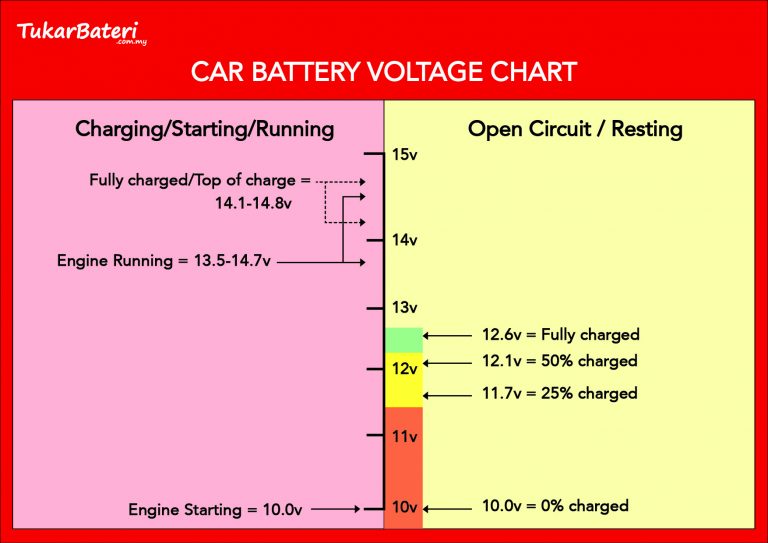
Credit: www.tukarbateri.com.my
This chart shows how much the voltage rises once the alternator starts charging.
Some newer models with smart charging systems run slightly different targets, but they should stay close to this band. If your meter shows 15 volts or more, shut the engine down and investigate before something gets damaged.
Why This Voltage Range Matters
The running voltage is a conversation between the battery and the alternator. When it sits in the 13.7–14.7 volt range, the alternator is producing enough power to run every electrical system and still send charge back into the battery.
If voltage is too low — consistently under 13.7 volts — the battery is slowly being drained while you drive. At first, the car may still start because the battery has some reserve. Over time, that reserve runs out, and you're left with a no-start situation at the worst possible moment.
If voltage is too high — above 14.7 volts — the alternator is overcharging. The excess energy turns into heat inside the battery, which accelerates corrosion, boils off electrolyte, and can cause the case to swell or crack. An overcharged battery is a safety hazard and usually needs replacing.
There's also a less obvious consequence. Your car's computers, sensors, and infotainment system depend on stable voltage. Fluctuating voltage can trigger false error codes, make dashboard lights flicker, or cause the radio to cut out for no reason. Bulbs and fuses also wear out faster when voltage is erratic. If you notice strange electrical behavior alongside an out-of-range reading, the charging system is the first place to look.
How To Measure Battery Voltage
You don't need a scan tool or a trip to the mechanic for this. A basic digital multimeter is enough.
- Set the meter to DC voltage, using the 20V range if your meter has one.
- Connect the red probe to the positive battery terminal.
- Connect the black probe to the negative battery terminal.
- Read the number on the display.
Wait about 30 seconds after starting the engine before taking the running measurement. Voltage often spikes briefly at startup, then settles into its normal range. A common mistake is reading too soon and panicking over a number that would have stabilized on its own.
Here's what a typical set of readings looks like:
| Condition | Reading |
|---|---|
| Engine off, overnight rest | 12.5 volts |
| Engine running, no accessories | 14.2 volts |
| Engine running, AC on | 14.1 volts |
| Engine running, headlights on | 14.0 volts |
| Engine running, all loads on | 13.8 volts |
Every number in that table is healthy. The key is to take several readings under different conditions. If voltage swings wildly — jumping from 14.5 volts to 13.4 volts while idling — there's likely a problem with the alternator's voltage regulator or a loose connection.
The procedure is the same across virtually every vehicle, and professional battery care resources from major manufacturers describe it in the same terms. If your battery is tucked away or hard to reach, check the owner's manual for remote test points under the hood — some vehicles provide a dedicated post and ground point that read the battery voltage directly.
Factors That Affect Battery Voltage While Running
Several variables can push a perfectly good charging system toward the edges of the normal range. Knowing these prevents unnecessary panic and helps you diagnose problems accurately.
Temperature
Cold weather slows the chemical reaction inside a battery, so you may see readings closer to 13.8 volts even with a healthy alternator. Hot weather can push readings toward the top of the range. Extreme heat is also harder on the battery itself — it accelerates internal corrosion and shortens service life.
Electrical Load
Every electrical device you switch on — headlights, wipers, heated seats, the rear defroster — increases the load on the alternator. With everything running, voltage can dip slightly. If it drops below 13.7 volts under heavy load, the alternator may be underpowered for your car or failing.
This also matters if you regularly power accessories from the 12V socket. Running something like a handheld interior cleaner can tax the charging system just like any other electrical load. And if you're in the market for one, it pays to match the right cleaning strength to your car's interior — a model that's too weak simply runs longer and draws more power.
Battery Age
Most conventional car batteries last three to five years, though heat and driving habits can shorten that. An aging battery can't accept a charge as efficiently, so running voltage may sit at the low end even when the alternator is fine. If your battery is approaching four years old and the numbers are drifting down, plan for a replacement soon.
Alternator Condition
Alternators typically last five to ten years, but heavy electrical usage, towing, or a slipping belt can kill them early. A failing alternator often shows up as voltage that flickers between 13.5 and 14.5 volts, a glowing charge warning light, or readings that slowly decline while you drive.
Cable And Terminal Connections
Corroded or loose terminals add resistance to the charging circuit, and that resistance drops the voltage that actually reaches the battery. White or greenish powder around the terminals is a classic sign of corrosion. In practice, cleaning the terminals with a wire brush and tightening the connections brings an "abnormal" reading back to normal in minutes.
Signs Of Battery And Alternator Problems
Even before you break out the multimeter, your car usually tells you something is wrong. Watch for these:
- Headlights that dim while idling and brighten when you rev the engine
- The battery warning light glowing on the dashboard
- Slow, reluctant engine cranking
- Interior lights that flicker or dim when you use power windows
- Needing jump-starts more often than you used to

Credit: www.reddit.com
The battery warning light is the dashboard's first alert to a charging system fault.
Don't ignore these signs just because the car still starts. Charging problems get worse with time, and the repair bill only grows when a failing alternator takes a good battery down with it.
Voltage problems can affect even minor systems. Something as ordinary as a confusing stereo interface that keeps resetting can trace back to unstable voltage rather than a faulty radio. If multiple electrical accessories act up at the same time, suspect the charging system first.
Battery Voltage In Modern Cars
Modern vehicles run more electronics than ever — advanced driver aids, infotainment screens, cameras, and sensors. To manage all that demand, many newer cars use smart alternators that adjust voltage based on driving conditions. You might see 14.5 volts while accelerating and 13.8 volts when coasting. That's by design, not a fault.
Vehicles with stop-start technology are similar, except the charging system does more of its work during deceleration and braking. If you own one, a reading taken right after the engine restarts may look different from one taken a minute later.
| Vehicle Type | Normal Running Voltage (12V System) |
|---|---|
| Gasoline/Diesel | 13.7–14.7 volts |
| Hybrid (12V accessory battery) | 13.7–14.7 volts |
| Electric vehicle (main battery) | Varies — not a 12V system |
The 13.7–14.7 volt range still applies to the conventional 12-volt battery found in hybrids and EVs, even though the main traction battery operates at hundreds of volts. And if you routinely plug in accessories like compact vacuum models, the added draw gives a smart alternator even more to juggle.
Common Mistakes When Checking Battery Voltage
Plenty of DIY diagnosis goes wrong because of simple test errors. Avoid these:
- Testing only with the engine off. You need both resting and running readings to understand the charging system.
- Reading too soon after startup. Wait 30 seconds so the voltage stabilizes.
- Ignoring electrical load. Always test with headlights or AC on, not just at idle with everything switched off.
- Using a cheap or inaccurate meter. A quality multimeter costs little and gives trustworthy numbers.
- Forgetting about temperature. A cold-morning reading isn't directly comparable to one taken on a hot afternoon.
- Measuring at the wrong points. Loose probe contact or probing corroded terminals produces false low readings.
One last caution: never let the two probes touch each other while connected to the battery. That creates a short circuit, which can spark and damage both the meter and the battery.
What Happens If Voltage Is Not Normal?
Low voltage while running means the alternator isn't keeping up. The car runs off the battery until the battery is drained. Eventually, the engine stalls or won't restart, and you're looking at a jump-start or a tow.
High voltage is just as serious. An overcharging alternator forces excess current through the battery, generating heat and hydrogen gas. The battery may swell, leak, or vent violently in extreme cases. This can damage the battery, the alternator, and sensitive electronics at the same time.

Credit: www.reddit.com
A reading above 14.7 volts suggests the alternator may be overcharging the battery.
If you measure abnormal voltage:
- Don't keep driving long distances, especially if the voltage is high.
- Have the battery and alternator load-tested by a professional.
- Check and clean the battery terminals and cables first — it's the cheapest fix.
- Replace the battery or alternator if a test confirms the fault.
Acting quickly usually limits the damage to one component. Ignoring the problem often means replacing both.
How To Keep Your Battery Healthy
Regular attention keeps your battery and charging system reliable for years. These habits make the biggest difference:
- Check the voltage every few months with a digital multimeter
- Clean corrosion off the terminals with baking soda and water
- Tighten any loose cable connections
- Make sure the alternator belt isn't worn or slipping
- Avoid short-trip driving all the time — take a longer drive weekly so the battery gets a full charge
- Park out of extreme heat when possible
- Replace the battery before it reaches the five-year mark if you want zero surprises
Industry guidance from the Battery Council International reinforces the same message: regular testing and proper maintenance are what get you the full life out of a battery. Most charging problems, in practice, come down to simple connection issues rather than failed components.
Frequently Asked Questions
What is the normal voltage of a car battery when the engine is running?
For most cars, 13.7 to 14.7 volts with the engine running is normal. It means the alternator is charging the battery and powering the electrical system.
Why does my battery voltage drop when I turn on the AC or headlights?
Those accessories draw current, so the alternator output dips slightly to meet the extra demand. A small drop is normal. If the voltage falls below 13.7 volts under load, the alternator may need attention.
Can I check battery voltage without a multimeter?
Some cars display battery voltage in the instrument cluster, but those readings aren't always precise. A digital multimeter remains the most reliable way to check.
How often should I check my battery voltage?
Every three to six months is reasonable, plus any time you notice slow cranking, dim lights, or unusual electrical behavior.
What happens if battery voltage is too high?
Above 14.7 volts, the alternator may be overcharging. That can overheat the battery, speed up internal damage, and cause leaks. Have the charging system checked promptly.
Conclusion
Knowing the normal battery voltage when your car is running — roughly 13.7 to 14.7 volts for most vehicles — is one of the simplest diagnostic skills a driver can learn. A multimeter costs little, the test takes two minutes, and the reading tells you whether your battery, alternator, and connections are all working together or quietly failing.
Make it a habit this week: check the voltage with the engine off, again while running, and once more with the headlights on. If the numbers stay in the healthy range, you can drive with confidence. If they don't, get the system tested before a dead battery strands you at the worst possible moment. For more hands-on advice on keeping your car in great shape, browse our car care archive.

Leave a Reply