
If you've ever typed "how often should I replace the battery in my car" into a search bar, you've probably noticed the answers conflict. The textbook response is every 3 to 5 years, and that's a reasonable baseline — but it's only a baseline. Your climate, driving habits, battery chemistry, and even how your car's charging system behaves can move that number up or down by two full years.
This guide settles the question properly. You'll learn what actually wears a battery out, the warning signs most drivers miss, how a load test answers everything in 30 seconds, what a replacement should cost, and whether to do the swap yourself. By the end, you'll know exactly where your own battery sits on that spectrum — and what to do next.
The Quick Answer
Replace most car batteries every 3 to 5 years. That's the realistic window for a typical flooded lead-acid battery in mixed conditions. But factors stack fast, and they push that number in both directions:
- Heat shortens life dramatically. Sustained 90°F+ weather can push failure toward year 2 or 3.
- Cold exposes weakness. A marginal battery usually dies on the first hard freeze, not in July.
- Battery type matters. AGM batteries routinely outlast flooded ones by 1 to 2 years.
- Testing beats guessing. After year three, an annual load test is the most useful five minutes in car maintenance.
Here's how the interval shakes out by situation:
| Your situation | Realistic replacement interval |
|---|---|
| Moderate climate, mixed driving | 4 to 5 years |
| Hot climate (regularly 90°F+) | 2 to 3 years |
| Mostly short trips under 20 minutes | 3 to 4 years |
| Start-stop vehicle with AGM battery | 5 to 7 years |
| Garage-kept, driven regularly | 5 to 7 years |
Whichever row you land in, the actual decision should come from a load test — not a calendar date. More on that below.
Why Car Batteries Wear Out
A car battery isn't a storage box — it's a chemical reactor. Lead plates sit in a sulfuric acid electrolyte, and cranking the engine releases electrons that flow to the starter motor. While you drive, the alternator pushes current back in, reversing the reaction.
That back-and-forth wears the battery out. Every cycle sheds a little plate material, which settles as sediment at the bottom of the case. Eventually the plates can't deliver the high burst of cold cranking amps your starter demands — and that's the natural end of a battery's life.
Heat: The Real Lifespan Killer
Heat accelerates every destructive process inside the case. High temperatures speed up the chemical reaction, which sounds like a benefit until you realize it also speeds plate corrosion and water loss from the electrolyte. A widely used service rule of thumb holds that a battery living in sustained 90°F+ conditions lasts roughly half as long as one in a temperate climate. That's why batteries in Phoenix or South Florida commonly die at the 2-year mark while identical batteries in Seattle see six.
Cold: The Revealer
Cold doesn't destroy a battery directly — it exposes one that's already weak. At 32°F, a battery can lose roughly 35% of its cranking power; at 0°F, around 60%. The chemistry slows, engine oil thickens, and a battery at 70% health that started fine in October suddenly can't turn the engine in January. In practice, most "sudden" cold-weather failures were months in the making.
Corrosion: The Resistance You Can See
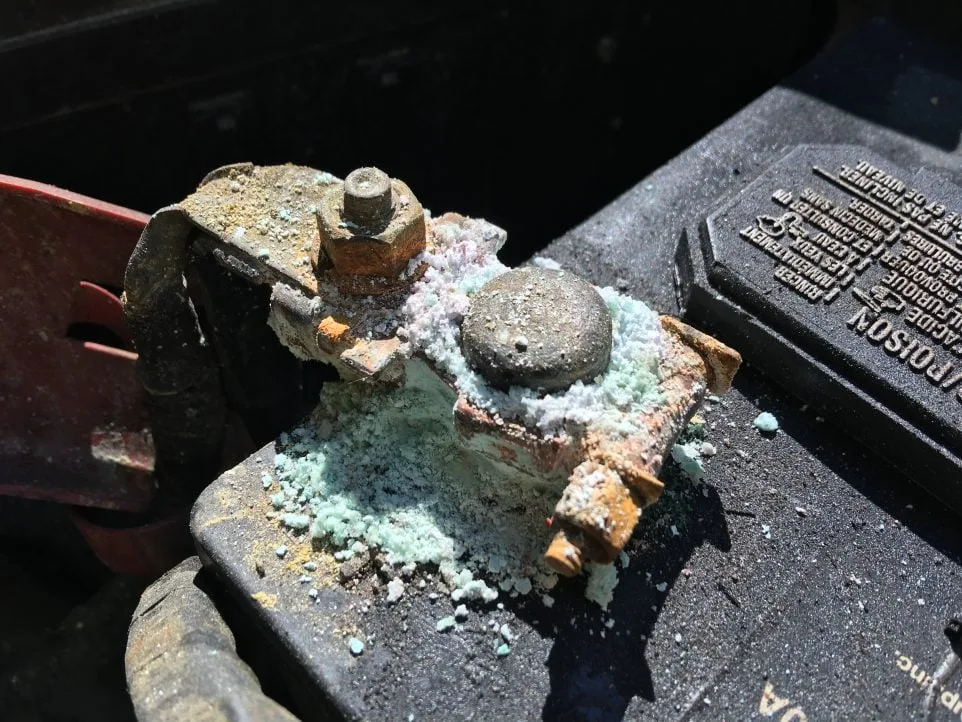
That crusty buildup is oxidized terminal metal — it adds resistance exactly where you need current flow most.
Image source: Web (Bing) / storage.googleapis.com (Web image (fair-use with source credit))
The white or green crust on battery posts adds electrical resistance, meaning less current reaches the starter. It also signals the battery is venting gas — normal in small amounts, but excessive buildup suggests overcharging or a battery nearing the end of its life. Clean it off; never ignore it.
6 Warning Signs Your Battery Is Failing
Batteries rarely die without notice. They telegraph the failure — most drivers just don't recognize it:
- Slow cranking. The engine turns over lazily for 2 or 3 seconds instead of firing in half a second. This is usually the first sign, and the easiest to dismiss.
- Dim headlights at idle. If the lights dim at a stoplight and brighten when you rev, the battery is weak and the alternator is carrying the load.
- A swollen or cracked case. Heat and overcharging warp the internal plates and bulge the case. This battery is done — replace it immediately.
- A rotten-egg smell. Sulfur odor means the battery is venting hydrogen sulfide, a sign of overcharging or internal damage. It's also a genuine fire hazard.
- Random electrical glitches. A glitching head unit, resetting clock, or flickering dash lights are classic symptoms of low system voltage. Electronics misbehaving before the starter complains is more common than people realize.
- One jump start, then lingering sluggishness. A battery that needed a boost and still cranks slowly afterward rarely recovers for long.
Any one of these is a prompt to test. Two or more means start shopping.
How To Check Your Battery's Age (Date Code)
Before you diagnose anything, confirm how old the battery actually is. Nearly every battery carries a stamped or stickered code on the top. The most common convention uses a letter for the month — A for January through L for December, with some brands skipping the letter I — followed by a digit for the year. A code like "C6" points to March 2016. Manufacturers vary, so cross-check the "ship date" sticker if the case has one.
Two practical notes from experience: first, check the code before you buy a replacement, because a battery that sat on a retail shelf for a year has already burned part of its life — refuse old stock. Second, a common mistake is trusting a quick warm-weather start as proof of health. If the code shows five years or more, schedule a replacement regardless of how well the car starts today.
The Only Reliable Test: a Load Test (And How To Get It Free)
Guessing is for gambling, not maintenance. Start with a simple voltage reading, then confirm with a load test — the difference between knowing a battery has voltage and knowing it can actually do its job.
First, measure resting voltage with a multimeter after the car has sat for a few hours:
| Resting voltage | Approximate charge |
|---|---|
| 12.6V or higher | 100% |
| 12.4V | 75% |
| 12.2V | 50% |
| 12.0V | 25% |
| Below 11.9V | Discharged — possibly damaged |
Here's the catch: a battery can read a perfect 12.6V at rest and still collapse under load. That's why the load test matters. A handheld tester applies a controlled simulated starting load and measures how far voltage drops. A healthy battery holds above roughly 9.6 volts; anything below means weak cells and a coming failure. Most parts stores run this test free, and AAA battery service members can often get the same check done at a branch or even at their driveway.
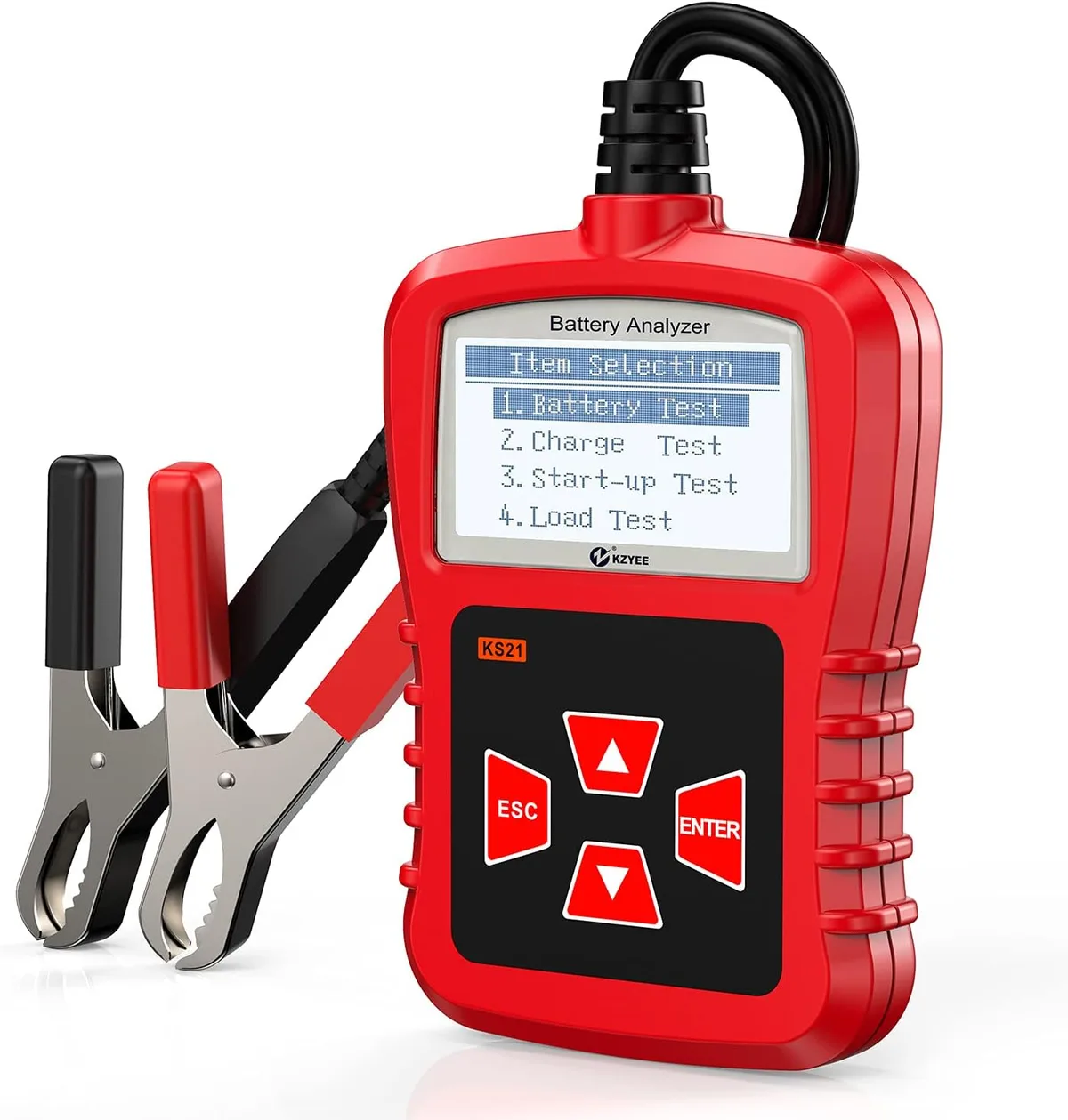
A load tester simulates the draw of a cold start and shows whether voltage holds above roughly 9.6 volts.
Image source: Web (Bing) / amazon.co.uk (Web image (fair-use with source credit))
If you'd rather test at home, a digital conductance tester costs $20 to $50 and gives the same verdict in seconds. If you own a Bluetooth OBD2 adapter, you can go further: once paired, you can watch live sensor data — including charging voltage — straight from your phone.
One more thing: test the charging system too. With the engine running, you should see roughly 13.5 to 14.7 volts at the terminals. A failing alternator will kill even a brand-new battery in weeks, so don't replace a battery until you've confirmed the alternator and belt are healthy.
Climate and Driving Habits: Your Personal Timeline
This is where the 3-to-5-year rule gets personal.
Hot climates. If you live in the Southwest, Gulf Coast, or anywhere that regularly tops 90°F, treat year 2 as the start of your testing window. Heat isn't a defect — it's physics.
Cold climates. Cold doesn't shorten life, but it front-loads the failure. If you're in the Upper Midwest, New England, or Canada, replace any battery 4 years or older before winter. Getting stranded in a frozen parking lot at 6 a.m. is the expensive version of procrastination.
Short trips. Every start drains the battery, and the alternator needs meaningful drive time to put that charge back. Trips under 20 minutes never fully recharge it, and months of this leads to sulfation — hardened lead sulfate crystals that permanently reduce capacity. A weekly 30-minute drive helps; a smart charger or maintainer helps more.
Cars that sit. A parked battery self-discharges — a few percent a month at room temperature, faster in heat. Left long enough, it sulfates and dies young. For classics, RVs, boats, and seasonal vehicles, a battery tender is cheap insurance and can push lifespan well past year 5.
AGM vs. Flooded vs. EFB: Does Battery Type Change the Timeline?
Yes — the technology inside the case changes the math:
| Battery type | Typical lifespan | Typical cost | Best for |
|---|---|---|---|
| Flooded lead-acid | 3 to 5 years | $120–$200 | Standard economy cars |
| AGM (Absorbent Glass Mat) | 5 to 7 years | $200–$400 | Start-stop systems, heavy electrical loads |
| EFB (Enhanced Flooded Battery) | 4 to 6 years | $180–$260 | Budget start-stop vehicles |
Flooded lead-acid is the traditional design — liquid electrolyte, serviceable caps, lowest price. It's perfectly adequate for a basic commuter car, though it loses water faster in heat and tolerates deep discharges poorly.
AGM batteries hold their electrolyte in fiberglass mats between the plates. That makes them spill-proof, vibration-resistant, and far better at surviving repeated charge cycles. Modern vehicles with start-stop systems, regenerative braking, and piles of electronic modules almost always need one. Even EVs and hybrids still carry a 12-volt AGM-style battery for accessories, so this isn't going away.
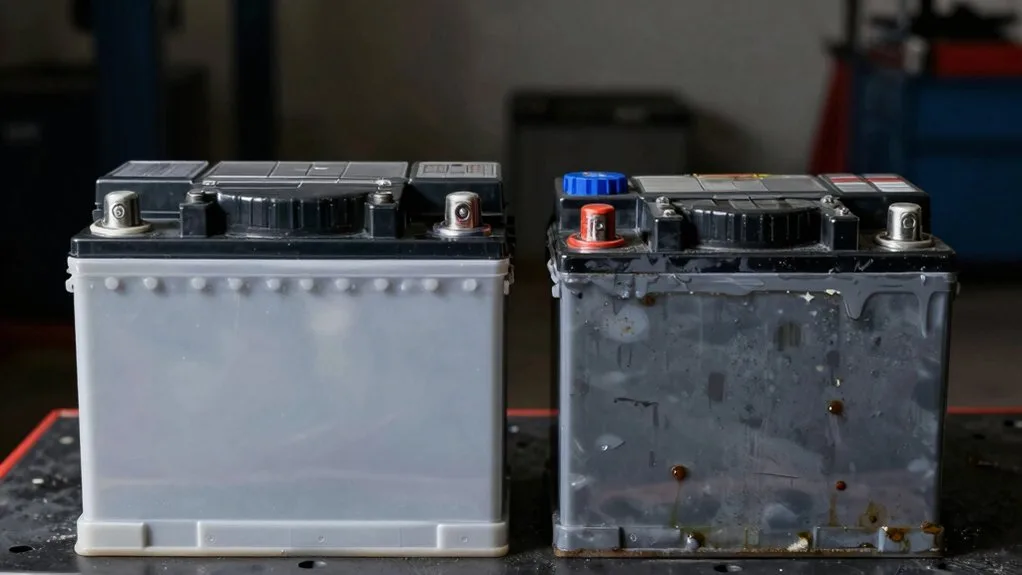
AGM and flooded batteries look similar from the outside — the electrolyte arrangement inside is what changes lifespan and charging behavior.
Image source: Bing (Web (fair-use with source credit))
EFB is an upgraded flooded battery with tougher plates — a mid-priced option some European makers spec on entry-level start-stop models.
The non-negotiable rule: replace like with like. A common mistake is downgrading from AGM to flooded to save $50. The charging system is calibrated for AGM's charge-acceptance, and a flooded substitute will be overcharged, boiled dry, and dead within two years.
What a Battery Replacement Actually Costs
| Item | Typical cost |
|---|---|
| Flooded battery (part only) | $120–$200 |
| AGM battery (part only) | $200–$400 |
| Shop installation labor | $30–$60 |
| Mobile installer premium | +$50–$80 |
| Tow after a no-start | $100–$200 |
Warranty structure matters as much as sticker price. Most batteries carry a free replacement window — usually the first 2 to 3 years — during which a failed battery swaps out at zero cost with your receipt. After that, coverage shifts to pro-rated, meaning a discount on a new battery scaled to how much of the warranty you've used. Be honest with yourself about pro-rated coverage: the discount is calculated off the manufacturer's list price, not what you'd actually pay, so in practice it rarely saves much.
That's why the genuinely money-saving move is proactive replacement. A borderline battery that fails at the grocery store costs you a tow or a service call — often more than half the price of a new battery before you've spent a dollar on the battery itself. Buy a unit with a long free-replacement period, then treat everything after that window as borrowed time and test it annually.
How To Choose the Right Replacement
Matching specs prevents the "new battery died in 18 months" story. Get these four right:
- Group size. Batteries follow standardized BCI group numbers (24F, 35, 48, 65, and so on) that define case dimensions, terminal positions, and hold-down fit. Your owner's manual or any parts store lookup will confirm yours. The wrong group size won't secure properly, and vibration kills batteries early.
- Cold cranking amps (CCA). This is the current a battery can deliver for 30 seconds at 0°F while holding at least 7.2 volts. Match the manufacturer's rating — you can go somewhat higher, but never lower, especially in cold climates.
- Reserve capacity. This measures how long the battery can run accessories if the alternator fails. Higher is better if you idle with loads on.
- Terminal type and orientation. Top-post vs. side-post, and which side the positive terminal sits on, varies by group. A battery with backward-facing terminals won't reach the cables.
And if the car calls for AGM, buy AGM — no exceptions.
DIY vs. Shop vs. Mobile Installation
You have three routes when the swap is due, each with a real trade-off:
DIY. The cheapest path and genuinely a 20-minute job with basic tools. The honest risks are weight and shorting the terminals. Batteries run 30 to 50 pounds — check just how heavy they are before you lift one, and use your legs, not your back. If it's your first swap, skim the full fitting walkthrough so the sequence is fresh before you start.
Local shop. Convenient and safe, with labor around $30 to $60 on top of a modestly marked-up battery. You're paying to skip the mess and the heavy lifting.
Mobile installer. A growing option that brings the battery to your driveway or workplace and handles disposal for a premium of $50 to $80. Worth it if your schedule is tight or the car won't start at home.
One exception that isn't DIY-able: many BMW, Mercedes-Benz, Audi, and Volkswagen models from the past decade require battery registration, where the car's computer must be told a new battery's type and capacity. Skipping it can cause overcharging, warning lights, and start-stop faults. If your car needs registration, use a shop or mobile installer with the right scan tool.
How To Replace a Car Battery Safely, Step by Step
Safety first: a battery contains sulfuric acid and vents explosive hydrogen gas. A single spark from a loose wrench can ignite it.
What you'll need: safety glasses, nitrile gloves, a 10mm or 13mm socket, baking soda and water, a wire brush, dielectric grease, and a helper or carrier strap for the lift.
- Disconnect negative first. This is the critical rule — negative ties to the chassis, so disconnecting it first prevents a wrench-on-positive short circuit. Tuck the cable clear of metal.
- Disconnect positive. Twist the clamp gently if corrosion has seized it.
- Remove the hold-down bracket. Usually a clamp or J-hook bolt at the base.
- Lift out the old battery. Keep it upright; if the case is cracked and leaking, gloves are non-negotiable.
- Clean the tray and clamps. Baking soda solution neutralizes acid residue; wire-brush the cable clamps until bright. Let everything dry.
- Install the new battery. Seat it, secure the bracket, then connect positive first, negative last — the reverse of removal. Snug the nuts firmly; overtightening cracks the lead posts.
- Protect the terminals. A thin coat of dielectric grease, or anti-corrosion washers, buys you a year of clean connections. Skip this and you'll be scrubbing green fuzz within twelve months.
If the car had a battery registration requirement, handle it now with a scan tool before driving off. Forgetting this step is the most common cause of post-swap warning lights.
When a New Battery Dies Overnight: Parasitic Draw
You replaced the battery, did everything right — and the car's dead the next morning. That's usually not a battery problem. It's a parasitic drain: an electrical load that keeps pulling current after shutdown.
Modern cars legitimately draw a small amount for clocks, security systems, and module memory — typically under 50 milliamps. Anything much higher, and something is stuck on. To check it:
- Park the car, remove the keys, and let everything close.
- Disconnect the negative cable.
- Set a digital multimeter to the 10A or 20A DC setting and connect it in series between the cable and the negative post.
- Wait several minutes for the modules to go to sleep — the reading spikes, then settles.
- A settled reading above 50 milliamps confirms a drain.
Common culprits: trunk and glovebox lights that never switch off, a faulty door switch, a dashcam or dongle left in the OBD2 port, and an aftermarket stereo wired carelessly — if you suspect a bad connection, chasing down wiring faults with a meter takes minutes, not hours. Pulling fuses one at a time isolates the offending circuit.
The good news: fixing the drain fixes the problem. The battery itself is usually fine. If DIY electrical work isn't your thing, a shop can pinpoint this in a 30-to-60-minute diagnostic.
5 Mistakes That Shorten a New Battery's Life
- Letting it sit discharged. Below roughly 80% charge, sulfation begins and permanently eats capacity. Use a tender for any vehicle that sits.
- Wrong battery type. A flooded battery in an AGM-spec car gets overcharged and dies early. Match the spec, always.
- Overtightened terminals. Gorilla-tightening cracks the lead posts, creating heat and resistance. Snug, not stomped.
- Ignoring corrosion. That buildup adds resistance and slows charging. Clean the terminals every six months.
- Skipping the annual test. Age is a guideline, not a guarantee. The whole point of testing yearly after year three is replacing the battery on your schedule, not the parking lot's.
How To Make Your Next Battery Last Longer
Small habits compound. A battery that dies at year 2 could plausibly have reached year 4 with better care:
- Keep it held down tight. Vibration sheds plate material faster than almost anything else. A missing or loose hold-down bracket quietly destroys batteries.
- Clean terminals every six months. Wire brush, baking soda, then grease. Five minutes, twice a year.
- Keep it charged above 80%. Take one longer drive weekly if your routine is all short hops.
- Use a maintainer for stored vehicles. This single habit is the difference between a 3-year and a 6-year battery for weekend cars.
- Test annually from year 2 in hot climates, year 3 elsewhere. Cheap, fast, and it converts a surprise into a planned errand.
Recycling the Old Battery
Never put a car battery in household trash — it's illegal in many places and terrible practice everywhere. Lead-acid batteries are among the most successfully recycled products in existence, with the EPA regulating their handling and recovery. Every parts store and most service shops will accept your old battery, and most refund the core charge — typically $10 to $30 — when you trade it in. The lead, plastic, and acid all get reprocessed. In practice, you should end up with money back, not a disposal problem.
The Bottom Line: What To Do Right Now
Here's the decision framework, stripped down:
Replace it now if:
- It failed a load test
- It cranks slowly every morning
- The case is swollen, cracked, or smells of sulfur
- It's 5+ years old in a hot climate
- Winter is coming and the battery is 4+ years old
Test it yearly if:
- It's 3 to 4 years old and recently passed a load test
- You live in a moderate climate with regular longer drives
Relax for now if:
- It's under 3 years old, starts instantly, and the terminals are clean
If your battery is past year three and you can't remember its last test, book a free load test this week — five minutes now beats a $150 tow later. Want more guides like this? Our hands-on maintenance guides cover the jobs most owners keep putting off.
The pattern across every case is the same: batteries give you warning, testing confirms it cheaply, and acting early always costs less than being rescued. Replace on your terms.
Frequently Asked Questions
Can I jump-start a dead battery and keep driving?
Only as a temporary fix. A jump gets the engine running, but the alternator needs sustained drive time to recharge — and if the battery itself is failing, it won't hold the charge and you'll be stranded again. Get it tested the same day.
Does idling charge the battery faster than driving?
No. At idle the alternator spins slowly and produces far less current. If the battery is low, take a 20-to-30-minute drive rather than idling in the driveway — you'll reach full charge several times faster.
How long does a battery last in a garage-kept car?
Five to seven years is common. The garage shields the battery from temperature swings, which are the biggest lifespan killers, so garage-kept cars typically land on the long end of the range.
Is it safe to replace a car battery myself?
Yes, with precautions: wear gloves and safety glasses, disconnect negative first and reconnect it last, and never let a metal tool bridge both terminals. Follow the correct sequence and it's a safe 20-minute job.
What does the battery warning light actually mean?
It usually indicates a charging-system fault — alternator, voltage regulator, or serpentine belt — not the battery itself. If the light comes on while driving, you're running on battery power alone, so get the charging system tested before buying a new battery.
Can a battery die with no warning at all?
Almost never. What feels sudden is usually a fast decline masked by warm weather — the first cold morning simply exposes a battery that's been weak for months. That's exactly what the yearly load test is designed to catch.
Do I need to reprogram anything after installing a new battery?
On many European models from the past decade, yes — battery registration tells the computer the new battery's type and capacity so it charges correctly. Check your owner's manual first; skipping this step causes overcharging and electrical glitches.

Leave a Reply