
That glowing orange check-engine light is the ultimate test of patience. Is it a loose gas cap, or is your catalytic converter about to fail? For millions of drivers, the budget-friendly Bluetooth OBD2 scanner has become the go-to solution. But in an age of advanced vehicle security gateways, CAN FD protocols, and counterfeit chips, how accurate are Bluetooth OBD2 scanners, truly? Let's cut through the marketing hype and examine the technical reality of these devices.
What Exactly Is a Bluetooth OBD2 Scanner?
A Bluetooth OBD2 scanner is a bridge between your car's ECU (Engine Control Unit) and your smartphone. The small device plugs into the standardized OBD2 port—typically located under the dashboard—and transmits diagnostic data wirelessly to apps like Torque, Car Scanner, or BlueDriver. For more on this, see our guide on what is vpwr on obd2 scanner.
In 2026, the market has matured significantly. We are no longer dealing solely with the archaic ELM327 v1.5 chips. Modern adapters now utilize BLE (Bluetooth Low Energy) and advanced microcontrollers like the STN1170 and STN2120. These newer chips offer faster data refresh rates and more robust protocol handling. However, the fundamental question remains: can you trust the numbers displayed on your phone?
How Accurate Are They Really? The Short Answer
In practice, a high-quality Bluetooth OBD2 scanner is highly accurate for standard OBD2 (OBD-II) data. If you are checking engine RPM, coolant temperature, oxygen sensor voltage, or generic powertrain codes (P0xxx), your Bluetooth scanner will usually match a professional-level scan tool within a 1-2% deviation. For more on this, see our guide on can an obd2 scanner detect transmission problems 2.
The accuracy drops significantly, however, when you venture into manufacturer-specific codes (like U-codes for network or B-codes for body control modules), advanced bidirectional controls, or when you are working on vehicles with "Security Gateway" modules that lock down access to critical systems.
Bluetooth vs. Wired vs. Professional Scanners: A Comparative Analysis
To understand the performance ceiling, we must compare the hardware architecture. The table below pits consumer Bluetooth adapters against wired consumer models and professional diagnostic interfaces.
| Feature | Bluetooth OBD2 (Consumer) | Wired Consumer | Professional Tools (OEM/High-End) |
|---|---|---|---|
| Connection | Wireless (BLE) | USB / Direct Cable | Wireless & Wired (Heavy Duty) |
| Data Speed | Slower (~5-10 frames/sec) | Faster (~20-30 frames/sec) | Extremely Fast (Real-time oscilloscope) |
| Protocol Access | Basic CAN, KWP2000, J1850 | Basic CAN, some Enhanced | Full OEM Protocols (CAN FD, DoIP) |
| Security Gateway Bypass | Poor / Not Available | Limited | Yes (OEM-specific software) |
| Bidirectional Controls | Rare / Very Basic | Sometimes | Yes (Actuators, Coding, Adaptations) |
| Price Range | $15 – $120 | $50 – $400 | $500 – $5,000+ |
| Target User | DIY Enthusiasts | Advanced DIY / Shade-tree | Professional Mechanics |
Why Wired Scanners Generally Win
Wired scanners win because of bandwidth—not necessarily because the sensors read differently. The CAN bus (Controller Area Network) in your car outputs data at a specific rate. A wired connection can capture nearly 100% of that data stream with minimal latency. Bluetooth, on the other hand, samples the stream and has a transfer protocol that introduces a slight delay. This latency is negligible for reading a check-engine code but crucial when graphing erratic live data from a failing transmission solenoid.
6 Hidden Factors That Destroy Bluetooth OBD2 Accuracy
If you are experiencing frustrating data inconsistencies, it is usually caused by one of these six factors:
1. The Curse of Counterfeit ELM327 Chips
The most significant threat to accuracy is the flood of fake ELM327 chips on the market (often sold in $10 adapters). Genuine ELM327 chips were discontinued, and the clones often use cheap microcontrollers that miscommunicate with the vehicle, producing incorrect data or failing to read certain modules altogether. If an adapter cannot read MS-CAN (used in older Ford, Lincoln, and Mercury vehicles), you will get zero data.
2. The "Security Gateway" in Modern Cars
Since roughly 2020 (and heavily adopted by 2026), manufacturers like BMW, Mercedes-Benz, and the VW Group have installed cybersecurity gateways. These act as firewalls separating the infotainment system from the critical ECU networks. Standard Bluetooth scanners will only see a fraction of the data unless the scanner is specifically programmed or bypasses this gateway. If your scanner shows "no communication" with the airbag or ABS modules on a 2022+ vehicle, it is not a broken scanner—it's a security lockout.
3. The App Algorithms
Your adapter simply transmits raw voltage signals. The app on your phone translates those signals into "Coolant Temp: 195°F". If the app you are using has outdated calibration tables or lacks the specific PID (Parameter ID) definitions for your car, the translation will be wrong. A good scanner with terrible software will yield terrible accuracy.
4. Bluetooth Interference and Signal Integrity
Bluetooth operates on the 2.4GHz band, the same frequency as Wi-Fi routers, phone hotspots, and even some LED drivers. Radio interference can cause dropped packets, which result in skewed data graphs. To ensure stability, keep your phone within 3-5 feet of the adapter.
5. Inaccurate PID Definitions
Cars report data in raw hexadecimal values. It is up to the app to convert that hex data into arithmetic units. For example, a Toyota coolant temp stores data in one formula, while a GM model uses another. If the app interprets the wrong formula, you might see "Coolant Temp -40°F" on a hot summer day.
6. Assuming "OBD2" Means "Every Module"
A common mistake beginners make is assuming that plugging a scanner in allows access to all vehicle modules. The OBD2 standard (OBD-II) legally requires manufacturers to provide access only to emissions-related data (P codes, Misfire counts, Fuel trims, O2 sensors). Transmission slip data, SRS (airbag) deployment data, and ABS pump pressures are proprietary. A $30 scanner is often physically incapable of pulling these codes, regardless of the app.
Real-World Performance: What the Data Tells Us
From a mechanic's perspective, the data shift is observable. In a controlled environment with a professional tool (like a Snap-On or Autel) wired into a 2024 F-150, a genuine BlueDriver will match engine RPM within 1% and MBT (Manifold Absolute Pressure) within 2%. This is perfectly fine for detecting a vacuum leak or a misfire.
However, when looking at CAN FD (CAN Flexible Data), which is the new standard for fast, reliable communication in vehicles post-2020, most consumer Bluetooth adapters hit a wall. The Bluetooth adapter may fail to recognize specific codes or report a "genericity" error. This doesn't mean the scanner is "inaccurate"—it simply means the vehicle is speaking a language the adapter hasn't learned yet.
 Live sensor data streaming to a smartphone via a Bluetooth OBD2 connection.
Credit: www.ebay.com
Live sensor data streaming to a smartphone via a Bluetooth OBD2 connection.
Credit: www.ebay.com
Can You Trust the "Live" Data?
If you are using the scanner to watch your ECU stream real-time data, you need to understand the "frame rate" limitation.
- Bluetooth Adapters: Typically update at 5 to 10 frames per second.
- Professional Tools: Capture at 25 to 50 frames per second.
For a DIY user checking if a fan kicks on at a certain temperature, the low frame rate is perfectly adequate. But for troubleshooting a rapid sensor flicker, like a faulty throttle position sensor cutting out for milliseconds, a Bluetooth scanner will miss the artifact, displaying a smooth (and inaccurate) curve.
How to Maximize Bluetooth OBD2 Accuracy (2026 Tips)
You can tighten up the accuracy of your cheap adapter with these professional-grade habits:
1. Invest in a Genuine Chipset
Avoid generic cheap clones. Look for adapters explicitly mentioning "STN1110" or "STN1170" chipsets. Newer chips offer optional low-power modes and better noise filtering.
2. Verify Vehicle Compatibility Before You Plug In
Visit the app's support page to see if users have reported security gateway issues for your specific model year. Some newer Jeep and Chrysler models require standardized "Gateway Authorization codes" to access modules. If you have a newer vehicle, check our guide on selecting the appropriate child seat for family safety, and be wary that modern security protocols might block your engine scanner—you may need a specialized interface.
3. Use an App Bundle
Don't rely on a single free app. If you are a power user, cross-reference the data from two different apps simultaneously. If both apps read "Coolant Temp: 212°F" and "216°F", you know the truth is in the middle. Try the paid "Pro" versions of "Torque Pro" or "Car Scanner" to allow for custom PID definition uploads.
4. Update the Firmware
Look for adapters that allow firmware updates. Just like your phone, the Bluetooth adapter's bus-interface in your car sometimes needs updates to handle new vehicle software patches.
The Ultimate Verdict: Should You Buy One in 2026?
Let's cut through the technical jargon and deliver the conclusion you came for.
Yes, a Bluetooth OBD2 scanner is worth every penny for the average car owner. If your goal is to diagnose a check-engine light, read engine data, and decide whether you can drive to work or need to call a tow truck, a quality Bluetooth scanner is astonishingly effective. It is also an excellent tool for monitoring basic fuel trim levels to spot an upcoming vacuum leak before it causes a breakdown.
No, it cannot replace a professional diagnostic tool. If you are a mechanic looking to reset crash data, program a new ECU, or perform an ABS solenoid test on a 2023 European luxury vehicle, you will waste hours trying. The hardware physically lacks the pinout authority and encryption keys required.
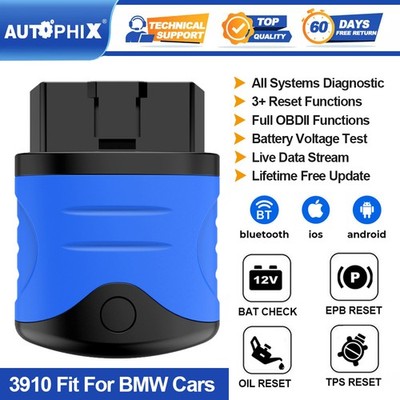 Professional-grade diagnostic interfaces offer deeper access than standard BLE adapters.
Credit: www.ebay.com
Professional-grade diagnostic interfaces offer deeper access than standard BLE adapters.
Credit: www.ebay.com
Frequently Asked Questions
Are Bluetooth OBD2 Scanners Safe for My Car Computers?
Yes, they are safe. A quality Bluetooth scanner only reads bulletins and passively monitors the CAN bus. It does not have the ability to inject signals that would cause a terminal fault in the vehicle logic. The risk of 'bricking' a module is effectively zero unless the device is a low-quality clone that shorts a pin (which is a physical hardware risk, not a software one). Use trusted brands to avoid physical damage.
Can a Bluetooth OBD2 Scanner Clear Airbag (SRS) or ABS Codes?
On most vehicles built before 2018, yes, they can clear these codes if the scanner can read them. However, on post-2020 vehicles with security gateways, attempting to communicate with the SRS or ABS modules will result in an "Access Denied" message. You will need a modular-level tool (like a multi-system diagnostic unit) to reset these lights on newer cars.
Why Does My Bluetooth Scanner Show Incorrect Speed on a Digital Cluster?
If your digital cluster is driven by the ABS sensors (wheel speed sensors), the Bluetooth scanner reading from the ECU will vary slightly. This is because the ECU calculates speed based on driveshaft rotations, while the ABS uses wheel spin. Slight tire pressure differences alter the rolling circumference, causing a 1-2 mph discrepancy compared to the cluster.
Do I Need the Engine Running to Read Codes?
You only need the key in the "ON" position (position II) to read stored codes. However, to monitor live data (like O2 sensor voltage) or to verify a repair, you will need to start the engine. Some Ford and Hyundai models require specific procedures that necessitate the engine being off or running, so always check the app's specific instructions for your vehicle.
Will a Bluetooth Scanner Drain My Car Battery?
Yes, if you leave it plugged into the OBD2 port when the car is off. The OBD2 port is not switched off via the ignition on many vehicles. This is a common problem, and can easily lead to needing a full battery recharge. Remember to unplug the adapter when not in use, especially if you are leaving the car parked for several days.
Conclusion
Bluetooth OBD2 scanners have democratized the auto repair industry. They have transformed the smartphone into a powerful diagnostic engine that connects directly to a vehicle's oxygen sensors, fuel injectors, and temperature modulators. While they are not precise enough to blueprint an engine or bypass manufacturer cybersecurity locks, they are more than accurate enough to prevent you from getting ripped off at a repair shop and to give you confidence in your DIY maintenance.
When you hit the buy button, ignore the $9.99 generic adapters. Choose a dedicated adapter that costs a bit more—it's a one-time investment for a tool that puts you in control of your car's health.
Ready to take control of your vehicle ownership experience? For more expert-level tips on fixing, cleaning, and maintaining your car, check out our extensive collection of automotive guides. And while you are maintaining your car, don't neglect the cabin health—learn the proper techniques for deep cleaning your vehicle's cabin to keep it smelling fresh and hygienic.

Leave a Reply