
If you've ever popped the hood and stared at that black rectangular box with its red and black terminals, the question is a fair one: is a car battery AC or DC power? The answer is DC — direct current — every time. But there's a twist hiding in the engine bay: your alternator actually generates AC first, and a component called a rectifier converts it to DC before it ever reaches the battery.
As of 2026, virtually every passenger vehicle on the road still runs on a 12-volt DC electrical system. Whether the battery under your hood is an old flooded lead-acid unit or a modern AGM type in a start-stop car, it stores and delivers direct current. Understanding where AC exists — and where it doesn't — is the difference between charging a battery correctly and accidentally cooking it.
This guide covers the battery chemistry, the alternator's AC-to-DC conversion, the voltages to expect, how to test everything with a multimeter, and why mixing up AC and DC gets expensive fast.
Quick Answer: It's Always DC
A car battery is DC power. Direct current flows in one direction, and a lead-acid cell is chemically incapable of producing anything else. The alternator produces AC, but its rectifier converts it to DC before the current reaches the battery or any other component.
Everything on the 12-volt rail — the ECU, fuel pump, headlights, infotainment, sensors — runs on DC. Household outlets deliver AC, which is exactly why you can't plug anything automotive directly into the wall.
Here's the whole system at a glance:
| Component | Current type | Typical voltage |
|---|---|---|
| Battery (engine off, resting) | DC | ~12.6 V |
| Alternator (before the rectifier) | AC | varies with rpm |
| Charging system output (engine running) | DC | 13.5–14.8 V |
| Household outlet | AC | 120 V |
| EV traction pack | DC | hundreds of volts |
What DC Power Means: Inside the 12-Volt Battery
DC stands for direct current — electricity flowing steadily in a single direction, like water running through a straight pipe. Your battery stores energy chemically and releases it as DC every time you crank the engine or switch on the headlights.
Inside that plastic case are six cells connected in series. Each cell produces roughly 2.1 volts, which is why a fully charged battery reads about 12.6 volts across the terminals. Every cell contains a lead dioxide positive plate, a sponge lead negative plate, and a sulfuric acid electrolyte. That electrochemical reaction is what stores and releases the energy.
Here's the key point: the reaction only moves in one direction. Lead-acid chemistry produces one-way current by design, so a battery can't store AC — if someone tells you your battery runs on alternating current, they're describing the wrong component entirely.
The volt and ampere — the units behind every reading in this guide — are formally defined by the National Institute of Standards and Technology, which maintains the U.S. measurement standards your multimeter's numbers trace back to.

A standard flooded lead-acid starting battery — a purely DC device by chemistry.
Image source: Web (Bing) / nl.grandado.com (Web image (fair-use with source credit))
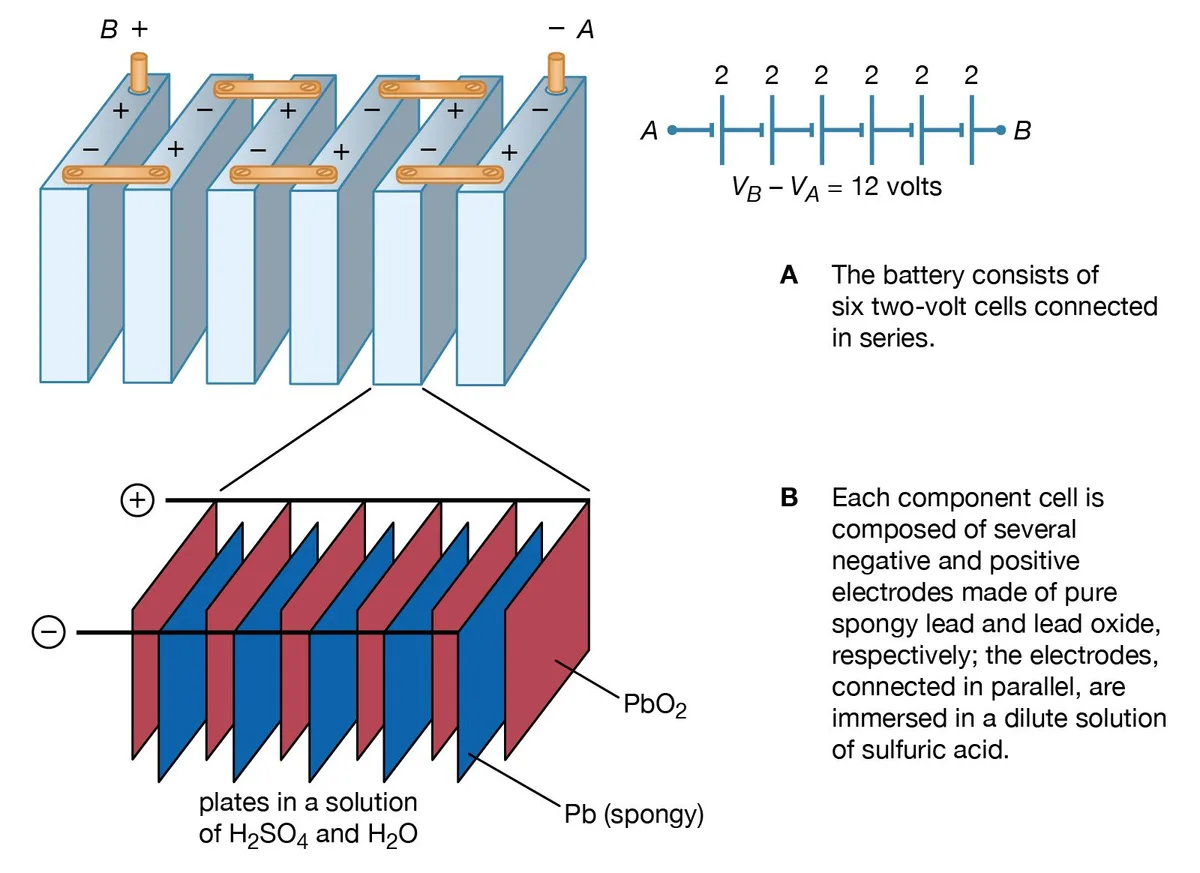
Six 2.1-volt cells in series add up to the familiar 12.6-volt resting reading.
Image source: Web (Bing) / hitchesguide.com (Web image (fair-use with source credit))
Why 12 Volts Became the Automotive Standard
The 12-volt standard dates to the mid-1950s, when manufacturers moved from 6-volt systems because engines were getting bigger and cars were gaining electrical accessories. Doubling the voltage halves the current needed for the same power, which means thinner, cheaper wiring and less energy lost as heat.
Going higher than 12 volts wasn't worth the trade-off: more cells, more cost, and greater arc and shock risk. Twelve volts cranks a modern engine reliably while staying manageable to work around, so it became the universal standard.
A 2026 note: start-stop vehicles commonly use AGM batteries — the same DC lead-acid chemistry with sturdier plates — and mild hybrids add a separate 48-volt DC rail for the belt starter-generator. Every one of these is still DC. The 12-volt system remains the backbone of the car.
Polarity: Why One Direction Changes Everything
In conventional notation, current flows from positive to negative. Electron flow actually runs the opposite way, negative to positive — but either way, it's one consistent direction. Get the polarity backwards and sensitive electronics can be damaged instantly.
In practice, the most common place owners meet polarity face-to-face is aftermarket electronics. When wiring a new head unit, one reversed power wire is enough to blow a fuse or worse.
Reverse polarity is also a classic reason a head unit goes dark with no warning after someone reconnects a battery incorrectly — the protection circuits are doing their job.
Where the AC Comes From: Inside the Alternator
Here's where people get confused. The alternator doesn't produce DC — it generates three-phase AC and converts it on the way out.
The alternator spins a rotor (an electromagnet) inside a stationary stator. That spinning magnetic field induces an alternating current that reverses direction many times per second. Why build it this way? Alternators are lighter, simpler, and far more reliable than the old DC generators they replaced, because their small brushes only carry the field current rather than the full output. They also produce useful charge at idle, which old generators didn't.
The trade-off is that AC oscillates, and your battery needs steady one-way DC. So the alternator relies on a rectifier — a bank of six diodes that act as one-way valves. The rectifier effectively flips the negative half of the AC wave into pulsating DC, which the battery and regulator then smooth into a steady charging voltage.
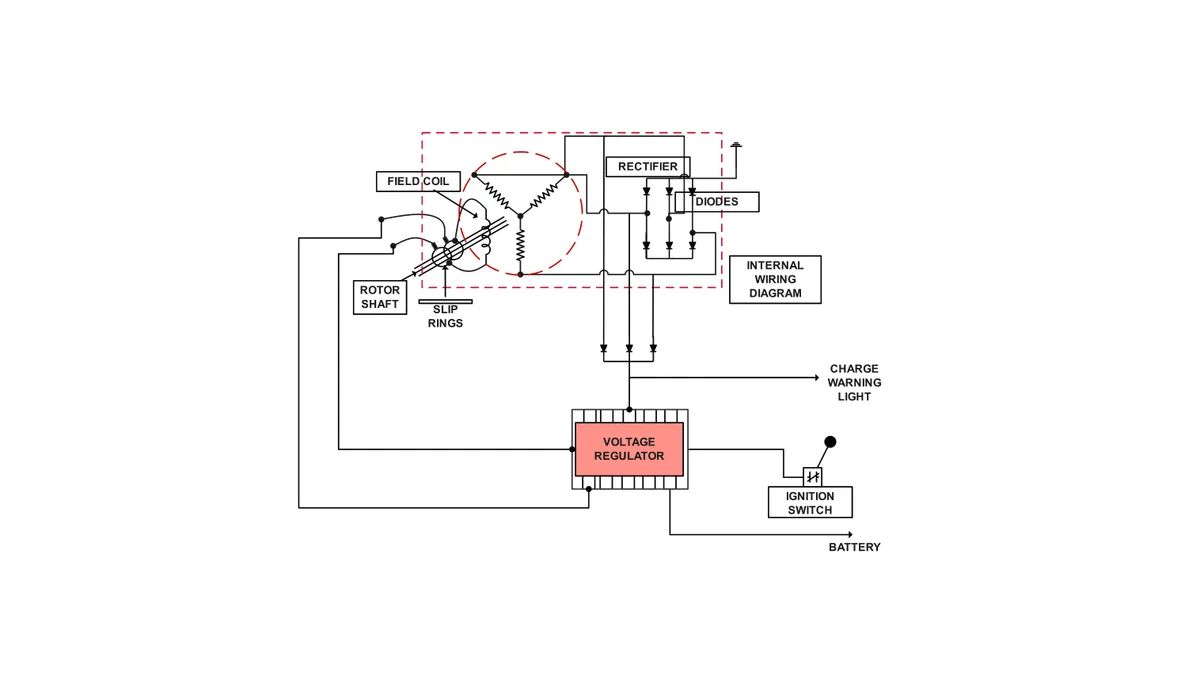
Diodes act as one-way valves, flipping the negative half of the AC wave.
Image source: Web (Bing) / edrawmax.wondershare.com (Web image (fair-use with source credit))
The Voltage Regulator Sets the Charge Rate
Once the rectifier converts AC to DC, the voltage regulator takes over. It controls the alternator's field current to hold output between 13.5 and 14.8 volts — deliberately higher than the battery's 12.6-volt resting voltage, so current is pushed back into the cells.
With the engine running, you're not running off the battery; you're running off the alternator's DC output. That's why a car can keep running with a weak battery — though modern cars rely on the battery to smooth voltage spikes, and some will run rough or throw faults without one. Load matters here too: adding an amplifier draws far more current than most owners expect, and a tired alternator reveals itself as lights that dim at idle and brighten with revs.
AC vs DC in Your Vehicle: Side-by-Side
| Feature | AC | DC |
|---|---|---|
| Flow direction | Reverses constantly | One direction only |
| Where it exists in your car | Only inside the alternator, before the rectifier | Battery, starter, ECU, lights — the entire 12-volt system |
| Typical voltage | Varies with rpm | 12.6 V resting; 13.5–14.8 V charging |
| Storage | Not practical to store | Stored chemically in the cells |
| Household equivalent | 120 V wall outlet | Battery charger output |
The only AC a typical owner ever touches is through a power inverter — more on that below.
Why the Distinction Matters in the Real World
Plug a DC device into AC and you'll likely fry it. Push AC into your battery and you'll damage the battery, the charger, or both. Household outlets deliver 120 volts AC; your battery delivers 12 volts DC. They are fundamentally incompatible, which is why a dedicated charger — not a lamp cord — is required to recharge a car battery.
Charging From a Wall Outlet
A proper smart charger converts household AC to DC and manages the current through three stages: bulk (maximum current until the battery is roughly 80 percent full), absorption (holding around 14.4 volts while current tapers off), and float (a maintenance voltage that prevents self-discharge). Look for a charger with an AGM mode if your car has an AGM battery.
A common mistake is leaving an old manual trickle charger connected unmonitored. Continuous overcharging boils off electrolyte and warps the plates — a smart charger costs more, but in practice it pays for itself the first time it saves a battery.
Jump Starting: DC to DC
Jump starting works because both batteries are DC at the same nominal voltage with the same chemistry. The donor battery pushes charge into the flat one, and everything stays compatible.
Reverse the cables and you invite disaster: blown main fuses at best, damaged control modules, fried alternator diodes, or a ruptured battery at worst. Hydrogen gas vents from the cells and ignites easily, so connect the final negative clamp to the engine block or chassis — away from the battery — so any spark happens far from the vent ports.
What AC Would Actually Do to a Battery
If alternating current were applied directly, the plates would be forced through a reversal every half-cycle — producing heat, gassing, and permanent plate damage. Nothing in a healthy vehicle allows this, because the rectifier always sits between the alternator and the battery.
How to Test It Yourself With a Multimeter
Testing is straightforward, but the meter setting matters. Set your digital multimeter to DC volts — marked V with a solid line above a dashed line. The AC setting has a wavy tilde. Using the wrong scale gives you a useless number.
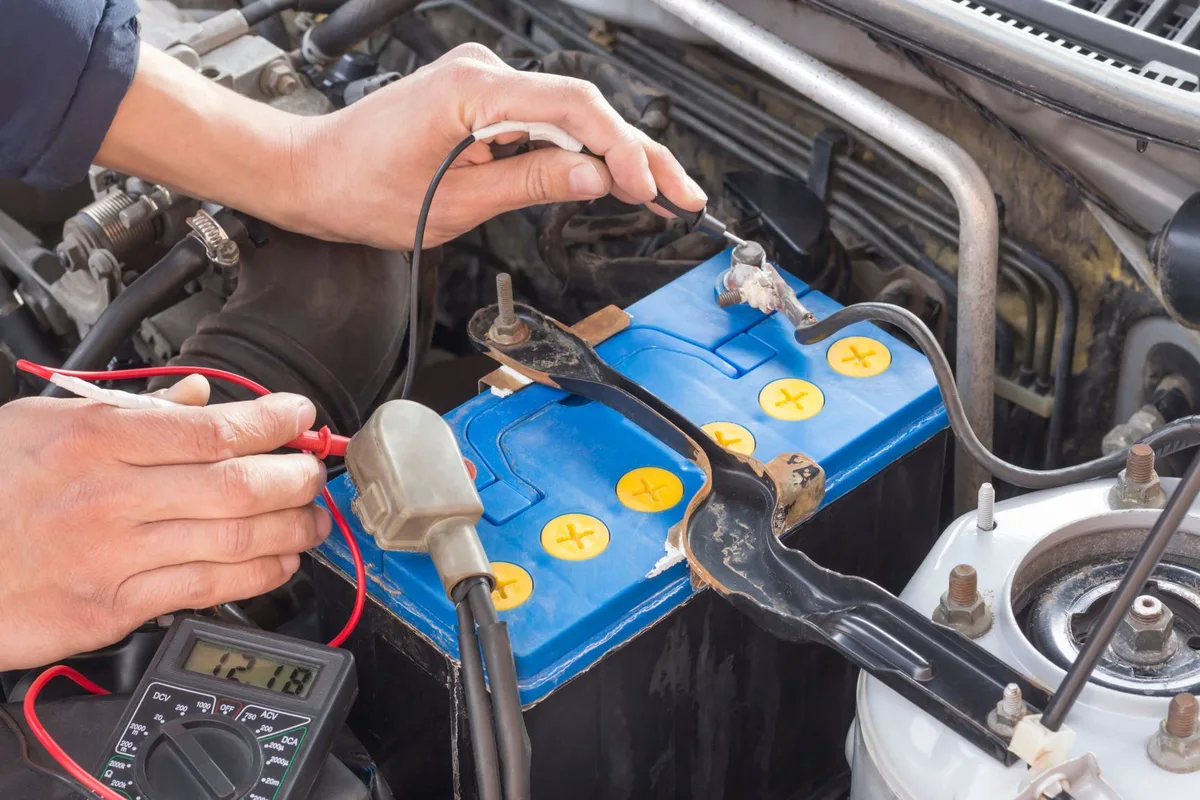
Resting voltage on the DC scale tells you the battery's true state of charge.
Image source: Web (Bing) / tontio.com (Web image (fair-use with source credit))
Checking Resting Battery Voltage
- Turn the ignition off and confirm all lights and accessories are off.
- Set the meter to the 20V DC range.
- Red probe on the positive terminal, black probe on the negative.
- Read the voltage.
| Reading | State of charge |
|---|---|
| 12.6 V or higher | Fully charged |
| 12.4 V | About 75% |
| 12.2 V | About 50% |
| 12.0 V | About 25% |
| Below 12.0 V | Discharged; sulfation likely |
If you test straight after a drive, surface charge can inflate the reading above 12.6 V. Switch the headlights on for about 30 seconds, turn them off, wait two minutes, then measure — you'll get the true number. If you've ever traced speaker wiring with a meter, you'll recognize the same probing technique here. Polarity discipline matters most when swapping a head unit, where one reversed lead can end the install badly.
Checking Alternator Output
- Start the engine and let it idle.
- Keep the meter on 20V DC.
- Place the probes on the battery terminals again.
- Read the voltage with the engine running.
A healthy charging system shows 13.5 to 14.8 volts. Below 13 volts, the alternator or its rectifier isn't keeping up. Above 15 volts, the voltage regulator may be failing — and that excess voltage will slowly cook both the battery and the electronics. For a load check, turn on the headlights and blower fan; the reading should stay above roughly 13 volts at idle.
Write your numbers down and re-test monthly. A reading that keeps sliding between checks tells you far more than any single snapshot.
Running AC Devices From a DC Battery: Inverters
An inverter converts your battery's 12-volt DC into 120-volt AC, letting you run household devices from the car. Two honest trade-offs to know before buying:
- Modified sine wave inverters are cheaper and fine for simple tools and resistive loads, but they can buzz or misbehave with chargers and sensitive electronics.
- Pure sine wave inverters cost more but deliver clean output that anything can use.
Size the inverter to the device's continuous wattage, check the surge rating for anything with a motor or compressor, and run the engine for anything beyond small loads — an idling alternator can only support so much.
What About Hybrids and EVs?
Every production EV and hybrid still uses a DC battery pack. Lithium-ion cells, like lead-acid cells, only charge and discharge in one direction. The onboard charger converts household AC into DC for the pack, and DC fast chargers feed it directly, skipping that conversion entirely. If you want to go deeper on the difference, the U.S. Department of Energy publishes clear explainers on how AC and DC charging work.
Here's the fun nuance: most EV drive motors actually run on AC. The inverter converts the pack's DC into three-phase AC for the motor — so an EV is a DC system that manufactures its own AC on demand. And the small 12-volt auxiliary battery that runs the computers and lights? Still DC, still 12 volts.
Frequently Asked Questions
Can a car battery power household appliances on its own?
No. A battery supplies roughly 12 volts DC, while most appliances expect 120 volts AC. You need a power inverter between the battery and the device. Size the inverter for the appliance's continuous wattage, keep cables short and thick, and run the engine so the alternator can replace the energy you're drawing.
Why does the alternator produce AC at all?
Generating alternating current is simply more efficient in a small package. A spinning electromagnet inside a stationary stator induces a three-phase AC waveform, with no brushes carrying the main output. That design is lighter, cheaper, and stronger at idle than an old-style DC generator. Six diodes in the rectifier convert it to DC before it reaches your battery.
What should a 12-volt battery read at rest and while running?
After sitting for a few hours, a healthy fully charged battery measures about 12.6 volts. With the engine running, the charging system should show between 13.5 and 14.8 volts. Readings below 12.4 at rest or below 13 while running point to a discharged battery or a weak alternator that needs attention.
Do electric and hybrid vehicles use AC or DC batteries?
Every production EV and hybrid uses a DC battery pack. Lithium-ion cells can only charge and discharge in one direction, just like lead-acid. The onboard charger converts household AC into DC for the pack, and DC fast chargers feed it directly. The drive motor usually runs on AC created by the inverter from that DC.
What happens if you hook up jumper cables backwards?
Reverse polarity sends current through the vehicle's electronics in the wrong direction. Expect blown main fuses at best, and at worst damaged control modules, fried alternator diodes, or a battery rupture. Hydrogen gas venting near the terminals can ignite from a spark. Always match red to positive, and connect the final negative clamp to the engine block.
Can I test my battery on the AC setting of a multimeter?
You can, but the number will be meaningless. On a DC source the AC scale typically reads a small residual value that looks nothing like the true voltage, inviting a wrong diagnosis. Always select the DC volts position — marked V with a solid line over a dashed line — and confirmthe terminals are clean before trusting the number.
Conclusion
So, is a car battery AC or DC power? DC, without exception. The lead-acid chemistry inside can only push current one direction, and everything on the 12-volt bus — starter, ECU, lights, infotainment — is built around that one-way flow. The only AC in the entire system is born inside the alternator and dies at the rectifier, converted to DC before it ever reaches the battery.
That single fact explains almost every practical rule in this guide: why the DC scale is the only multimeter setting worth trusting, why a wall outlet needs a dedicated charger rather than a direct connection, why reversed jumper cables are so destructive, and why an inverter — not an adapter — is the only legitimate bridge to household power.
Your one clear next step: take two multimeter readings this week. Measure resting voltage after the car has sat overnight, then again at idle. Resting near 12.6 volts and charging between 13.5 and 14.8 means the system is healthy. Anything lower deserves a closer look — and if the battery keeps sagging no matter how often it's recharged, our guide to typical battery service life explains when replacement makes more sense than another charge.
Put This Knowledge to Work
The AC-vs-DC distinction becomes second nature once you start working on the 12-volt system yourself. A few natural places to build on what you've learned:
- Chasing a dark dashboard after a battery swap? A head unit that refuses to power on usually traces back to a blown fuse or reversed polarity — both fixable in an afternoon with the polarity discipline from this guide.
- Planning an audio upgrade? Running power for an amplifier is the biggest DC load most owners ever add, and it's the fastest way to expose an alternator that's already running out of headroom.
- Before you button up any install, checking each wire with a meter confirms voltage and continuity land exactly where you expect them — the same probing technique you just practiced on the battery.
- New to 12-volt wiring altogether? Splicing into a head unit's harness is far less intimidating once you know which color carries what.
Ready for the next project? Browse our full library of hands-on car guides — from electrical testing to interior care — and keep building the skills that save you shop bills.

Leave a Reply