
Your car battery never truly sleeps. Even with the engine off and the keys in your pocket, it quietly powers the clock, keeps the alarm system armed, and preserves the memory in your car's computer. That continuous background draw is why knowing the normal battery voltage when car is off is one of the most useful diagnostic skills a driver can develop.
A simple voltage reading can tell you whether you have months of reliable service ahead, or whether a breakdown is lurking around the corner. This guide covers everything you need to know—what the numbers mean, how to measure them correctly, what causes voltage to drop, and the exact steps to take when readings look unhealthy. For more on this, see our guide on normal battery voltage when car is running.
Why Resting Voltage Matters More Than You Think
The voltage of a battery at rest—meaning the car has been off long enough for the surface charge to dissipate—is the single best indicator of its true state of charge. You can think of it as a fuel gauge for electrical energy.
Most passenger vehicles use a 12-volt lead-acid battery. That "12-volt" label is a nominal figure, not a precise measurement. A fully charged battery actually sits closer to 12.6 to 12.8 volts. Understanding the correlation between voltage and charge percentage enables you to predict starting problems before they actually strand you. For more on this, see our guide on what voltage is a car battery.
The most common mistake beginners make is testing the battery immediately after turning off the engine. The alternator leaves behind a surface charge that skews the reading higher. Unless you wait for that charge to settle, you will get a falsely reassuring number. Resting voltage is the reliable figure, and it is the one every driver should learn to interpret.
The Exact Numbers: What Should a Car Battery Read When Off?
Here is the reference point every driver needs. After your car has been sitting for at least 30 minutes, ideally overnight, the multimeter should show the following:
| Resting Voltage | State of Charge | What It Means |
|---|---|---|
| 12.6–12.8V | 100% | Fully charged, healthy battery |
| 12.4–12.6V | 75% | Adequate, but worth monitoring |
| 12.2–12.4V | 50% | Low; charge soon and investigate why |
| 12.0–12.2V | 25% | Very weak; may struggle to start |
| Below 12.0V | 0–10% | Discharged or possibly faulty |
A reading of 12.6 volts or higher indicates the battery is holding a full charge and is ready for normal use. If you see 12.4 volts, the battery has lost some capacity but should still start the car in moderate weather. Anything below 12.4 volts demands attention—start by recharging the battery fully, then retest. For more on this, see our guide on when to remove newborn insert from car seat.
Dropping below 12.0 volts is a red flag. A battery at this level is severely depleted, and repeated discharges to this point will permanently shorten its lifespan. If a battery shows below 12.0 volts even after a full charge cycle, replacement is almost certainly the right call.
How to Measure Battery Voltage Correctly
Testing voltage is straightforward, but doing it right matters. Here is a step-by-step process.
What You Need Before Starting
- A digital multimeter set to DC voltage (20V range)
- Safety glasses and gloves, since battery acid is corrosive
- A clean, dry terminal surface so the probes make good contact
Step-by-Step Voltage Test Procedure
- Let the car sit undisturbed for at least 30 minutes after the last drive. Overnight is even better for a true resting voltage reading.
- Turn off all electrical loads—lights, radio, interior lights, and ensure doors are fully closed.
- Connect the red probe to the positive terminal (marked with a red cover or a plus sign).
- Connect the black probe to the negative terminal (marked black or with a minus sign).
- Read the display and compare it to the state-of-charge chart above.
If the battery reads between 12.6 and 12.8 volts, your battery is in excellent shape. A reading of 12.4 to 12.6 volts is acceptable but should prompt you to test again soon. Under 12.4 volts means the battery needs a charge and possibly further diagnosis. For more on this, see our guide on when do kids stop using car seats.
Why Waiting Matters: The Surface Charge Problem
Many drivers test immediately after a drive and get a reading of 12.8 volts or higher. The alternator has just been pushing 14 volts into the battery, leaving a temporary surface charge. This is an unreliable measurement. Without allowing the battery to rest—providing at least 30 minutes, and ideally a full night—you cannot assess the true state of charge.
- A battery reading 12.6V after sitting overnight is genuinely healthy.
- A battery reading 12.6V right after a drive might actually be at 12.2V once the surface charge dissipates.
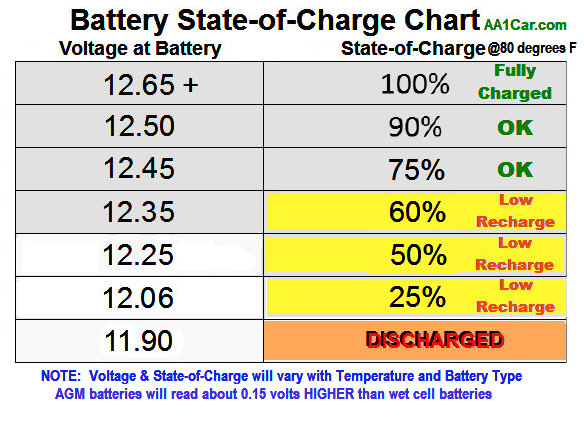
Image source: www.aa1car.com — A battery voltage chart showing the relationship between voltage and state of charge.
Why Battery Voltage Drops When the Car Is Off
It is completely normal for voltage to decrease slightly over time after shutdown. Modern vehicles contain dozens of electronic modules that remain active even when the ignition is off.
Normal Parasitic Draw
Your car's clock, security system, keyless entry receiver, and the engine control unit (ECU) memory all consume a small amount of electricity. This is called parasitic draw, and every car has it. Typical modern vehicles draw somewhere in the range of 20 to 50 milliamps when completely off. At that rate, a healthy battery can easily sit for several weeks and still retain enough charge to start the engine.
Abnormal Parasitic Drain
The problem arrives when the draw is excessive. A failing trunk light switch, a glove box light stuck on, or a poorly installed aftermarket stereo can increase the drain to hundreds of milliamps. At that rate, a battery can go from fully charged to dead in just a few days.
Common culprits of abnormal parasitic drain include:
- Faulty interior or trunk light switches
- Aftermarket audio systems wired directly to the battery
- Damaged or corroded wiring harnesses
- A malfunctioning alternator diode that drains the battery in reverse
How to Test for Parasitic Draw Safely
This test requires care. Do not disconnect the battery while the engine is running.
- Ensure all lights and accessories are off, and close all doors.
- Disconnect the negative battery cable.
- Set your multimeter to measure DC amps (not volts).
- Connect the meter in series between the negative terminal and the negative cable.
- Wait 10-15 minutes for the vehicle's modules to enter sleep mode.
- Read the current draw.
A reading above 50 milliamps (0.05A) generally indicates a problem worth investigating. For a deeper check of this issue, learning about hidden electrical stranglers can help you spot problems early.
Battery Voltage When the Car Is Running
Once the engine starts, the voltage should rise significantly. The alternator takes over as the primary power source and simultaneously recharges the battery.
| Engine Status | Normal Voltage Range | What It Tells You |
|---|---|---|
| Engine off (resting) | 12.6–12.8V | Battery fully charged |
| Engine running (idle) | 13.7–14.7V | Alternator charging correctly |
| Engine running (accessories on) | 13.4–14.7V | Charging system handling the load |
If the voltage stays below 13 volts while the engine is running, the alternator is likely not charging properly. This could be due to a failing alternator, a loose belt, or a faulty voltage regulator. Conversely, readings above 14.7 volts can indicate overcharging, which causes battery damage through excessive gassing and water loss.
The Impact of Battery Age on Voltage Readings
A brand-new battery behaves differently from a battery approaching the end of its service life. Knowing what to expect at each stage helps set realistic expectations.
| Battery Age | Expected Resting Voltage | Voltage After 24 Hours at Rest |
|---|---|---|
| New (0–1 years) | 12.7–12.8V | 12.6–12.8V |
| Mid-life (2–3 years) | 12.6–12.7V | 12.4–12.6V |
| Old (4+ years) | 12.4–12.6V | 12.2–12.4V |
A voltage drop of more than 0.2 volts over 24 hours indicates an aging battery or an abnormal electrical drain. In either case, the situation will only worsen without intervention.
Most conventional lead-acid batteries last between three and five years. However, climate plays a massive role in lifespan. In very hot regions, battery life often drops to just two or three years, as heat accelerates internal corrosion and water loss. In cooler climates, batteries routinely survive twice as long.
How Temperature Affects Voltage Readings
Temperature changes have a direct effect on battery chemistry, which means your voltage reading will vary with the season.
Cold Weather Effects
In freezing temperatures, the chemical reactions inside the battery slow down. The battery produces less current, and the engine oil thickens, requiring more electrical power to turn the engine. A battery that read 12.6 volts in October might read slightly lower in January, and its actual cranking ability will be significantly reduced. This is why so many batteries fail on the coldest mornings of the year.
Hot Weather Effects
Heat is actually harder on batteries than cold. High temperatures speed up the chemical reactions that cause internal corrosion and evaporate the electrolyte in non-sealed batteries. A battery subjected to repeated extreme heat can lose capacity long before the normal three-to-five-year lifespan.
Seasonal Voltage Testing
- Before winter: Test voltage to ensure the battery has full reserve capacity for cold starts.
- Before summer: Test voltage and inspect for corrosion, swelling, or electrolyte levels on serviceable batteries.
- Monthly checks: For drivers who take mostly short trips, monthly voltage testing provides early warning of developing problems.
Common Battery Problems and Their Warning Signs
Several issues cause low voltage readings. Recognizing the symptoms helps you diagnose the root cause rather than just treating the symptom.
Aging and Sulfation
Every battery eventually degrades. The active material inside gradually sheds and loses capacity. Sulfation occurs when a battery is left discharged for extended periods—lead sulfate crystals form on the plates and permanently reduce capacity. This explains why a battery left dead for months may show a normal voltage after recharging but fail to deliver sufficient cranking power.
Corroded or Loose Terminals
A poor electrical connection at the terminal creates resistance, which drops the effective voltage reaching the starter. You may see a healthy voltage at the battery itself, but the car struggles to start because the power cannot flow efficiently. Cleaning the terminals and ensuring a tight connection is an easy fix that resolves many starting complaints.
Short Trip Syndrome
Driving only short distances prevents the alternator from fully recharging the battery after each start. Starting the engine consumes a significant amount of charge, and any electronic accessories draw even more. If your commute is under 15 minutes, the battery may never reach a full state of charge, leading to a slow decline in voltage and performance.
Charging System Failures
It is easy to blame the battery when the real culprit is the alternator. A failing alternator that only produces 12.5 volts while running will never fully recharge the battery. The battery runs down over time and appears to be the problem when it was, in fact, working correctly. Always test voltage with the engine running to verify the charging system is healthy.
How to Maintain a Healthy Resting Voltage
Simple habits extend battery life and prevent avoidable breakdowns. Consider these maintenance steps as part of your regular vehicle routine.
Drive Regularly
A battery needs to be recharged, not just used. Driving once a week for at least 20 minutes at highway speeds gives the alternator enough time to replace the energy spent starting the engine and running accessories.
Clean the Terminals
Corrosion appears as a whitish or bluish powder around the terminals. This buildup acts as an insulator. Clean the terminals with a wire brush and a mixture of baking soda and water, then rinse and reconnect the cables tightly.
Use a Battery Maintainer for Storage
If you park a car for more than two weeks, connect a battery maintainer. These devices deliver a small, precisely controlled charge that keeps the battery topped up without overcharging. For vehicles in storage, a maintainer is far superior to simply disconnecting the battery, as it preserves the battery's charge profile.
Minimize Off-Engine Electronics
Running the radio, headlights, or interior lights with the engine off drains the battery without giving the alternator a chance to replenish it. Limit this usage, especially if you take short trips.
Consider a Smart Charger for Recovery
If battery voltage has dropped below 12.4 volts, a smart charger is the correct tool. Unlike a traditional charger, a smart charger monitors the battery's condition and adjusts the charging rate to avoid overcharging. This is particularly important for maintenance-free batteries, which cannot have water added. Charging a depleted battery properly at a low rate can reverse mild sulfation and restore some lost capacity.
When to Replace Your Car Battery
Replacement is necessary when the battery can no longer hold a charge, even after a full charge cycle.
Clear Signs It Is Time
- The car requires jump starts more than once
- Voltage drops below 12.2 volts overnight, even after charging
- The battery case shows visible swelling, cracks, or leaks
- The battery is older than four years and test results are marginal
Replacing Your Battery
Choose a replacement with the same group size, terminal configuration, and cold-cranking amps (CCA) rating specified in your owner's manual. Installing a battery is a manageable DIY task: disconnect the negative cable first, remove the positive cable, unbolt the hold-down bracket, and lift out the old battery. Install the new unit in reverse order and tighten all connections securely.
Frequently Asked Questions
What voltage should a car battery read after sitting overnight?
A healthy battery should read between 12.6 and 12.8 volts after sitting overnight. Below 12.4 volts indicates the battery is not fully charged and needs investigation.
Can cold weather cause the voltage to drop?
Yes. Cold temperatures slow the chemical reactions inside the battery, reducing voltage and cranking power. This is a normal effect, but if voltage drops below 12.4 volts, the battery may struggle to start the car in freezing conditions.
Is it harmful to leave my car parked for weeks?
Leaving a car parked for weeks allows the unavoidable parasitic draw to deplete the battery. Over several weeks, voltage drops below the level needed to start the engine. If you plan to leave a car unused for a long period, connect a battery maintainer.
How can I prevent low resting voltage?
Drive the vehicle at least once a week, keep the terminals clean, avoid leaving electrical accessories on with the engine off, and test the voltage regularly. Following this routine will catch most problems before they become breakdowns.
Does a healthy battery guarantee my car will start?
No. Even with a healthy battery reading 12.6 volts, a failing starter, a faulty ignition switch, or corroded cables can prevent the engine from cranking. Voltage testing is a valuable diagnostic tool, but the battery is only one component of the starting system.
Conclusion
Understanding normal battery voltage when car is off is a simple, powerful skill. A resting voltage of 12.6 volts or higher means your battery is fully charged and ready to meet the demands of a cold morning or heavy accessory use. Readings below 12.4 volts are a warning that should never be ignored.
The habit that will save you the most trouble is consistency. Test voltage at least once a month, before extreme seasonal changes, and anytime the car seems slow to start. Compare your readings against the state-of-charge chart, keep terminals clean, and drive regularly to allow the alternator to maintain a full charge.
Your next step is immediate: grab or borrow a digital multimeter and test your battery this week. It takes under a minute, costs nothing, and gives you precise knowledge about whether your car will be reliable—or whether you should start planning for a replacement. A healthy battery is the foundation of your car's entire electrical system, and a simple voltage check keeps that foundation solid.

Leave a Reply