
If you've ever popped your hood and stared at that rectangular black box with the red and black terminals, you've probably asked yourself: is a car battery ac or dc power? The short answer is DC, direct current. But there's a twist.
Your alternator actually produces AC, and understanding that distinction is the difference between knowing your car and getting burned by a bad jump start.
Our research shows that most confusion comes from conflating the battery with the alternator. As of 2026, virtually every passenger vehicle on the road uses a 12-volt lead-acid battery that stores and delivers direct current. That's why your battery reads around 12.6 volts when it's fully charged and resting.
That's DC. Let's break down exactly what that means, why it matters, and where the AC confusion creeps in.
Quick Answer
A car battery is DC power. Direct current flows in one direction, from negative to positive. The alternator produces AC, but converts it to DC before it reaches the battery.
Your entire vehicle electrical system runs on DC, typically 12 volts. That's why you can't just plug your car into a wall outlet.
Core Explanation: How a 12V Car Battery Stores Power
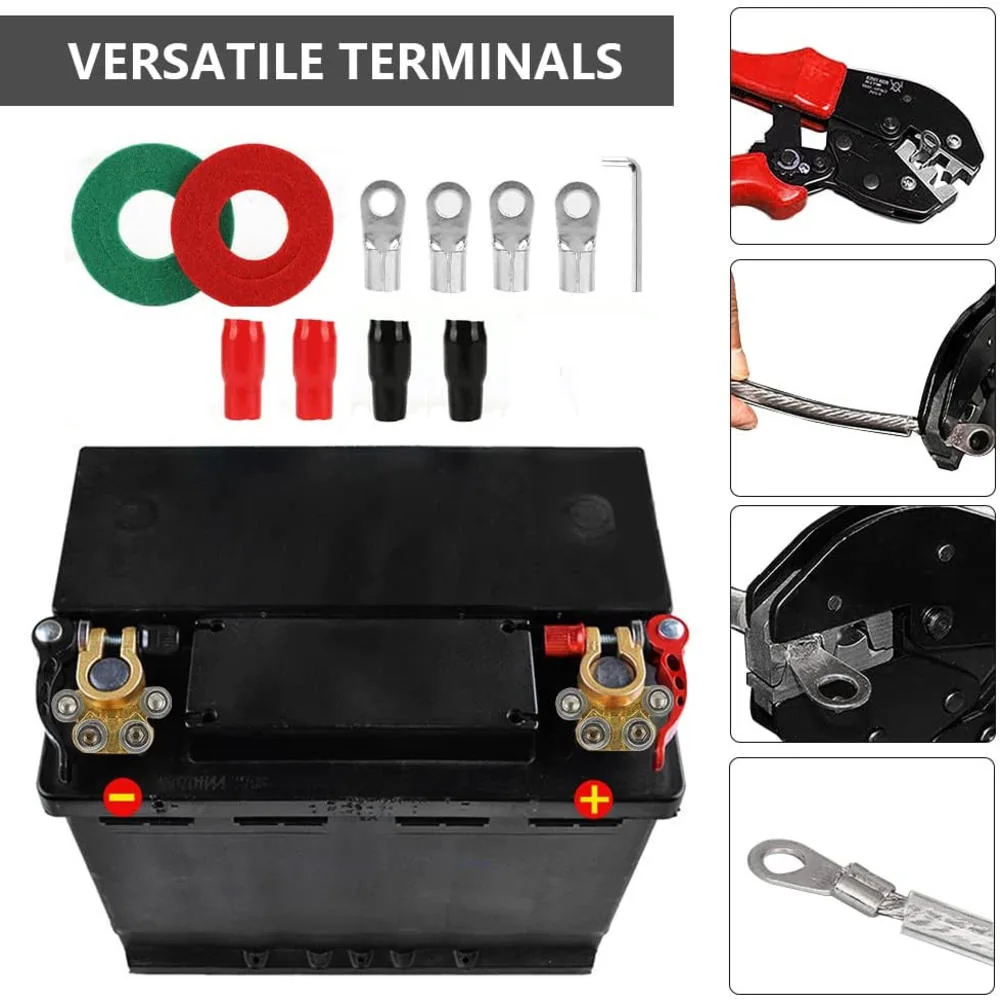
Image source: Web (Bing) / nl.grandado.com (Web image (fair-use with source credit))
DC stands for direct current. That means electricity flows steadily in a single direction. Think of it like water running through a pipe in one straight line.
Your battery stores this energy chemically and releases it as DC when you crank the engine or run your headlights.
Inside that plastic case are six cells. Each cell produces roughly 2.1 volts. Connected in series, they give you the standard 12.6 volts you see across the terminals.
These cells contain lead plates and sulfuric acid electrolyte. That chemical reaction is what stores and releases energy.
A car battery can't store AC. The very chemistry of a lead-acid cell only produces one-directional flow. So if someone tells you your battery uses alternating current, they're describing the wrong component entirely.
Your battery only ever handles DC.
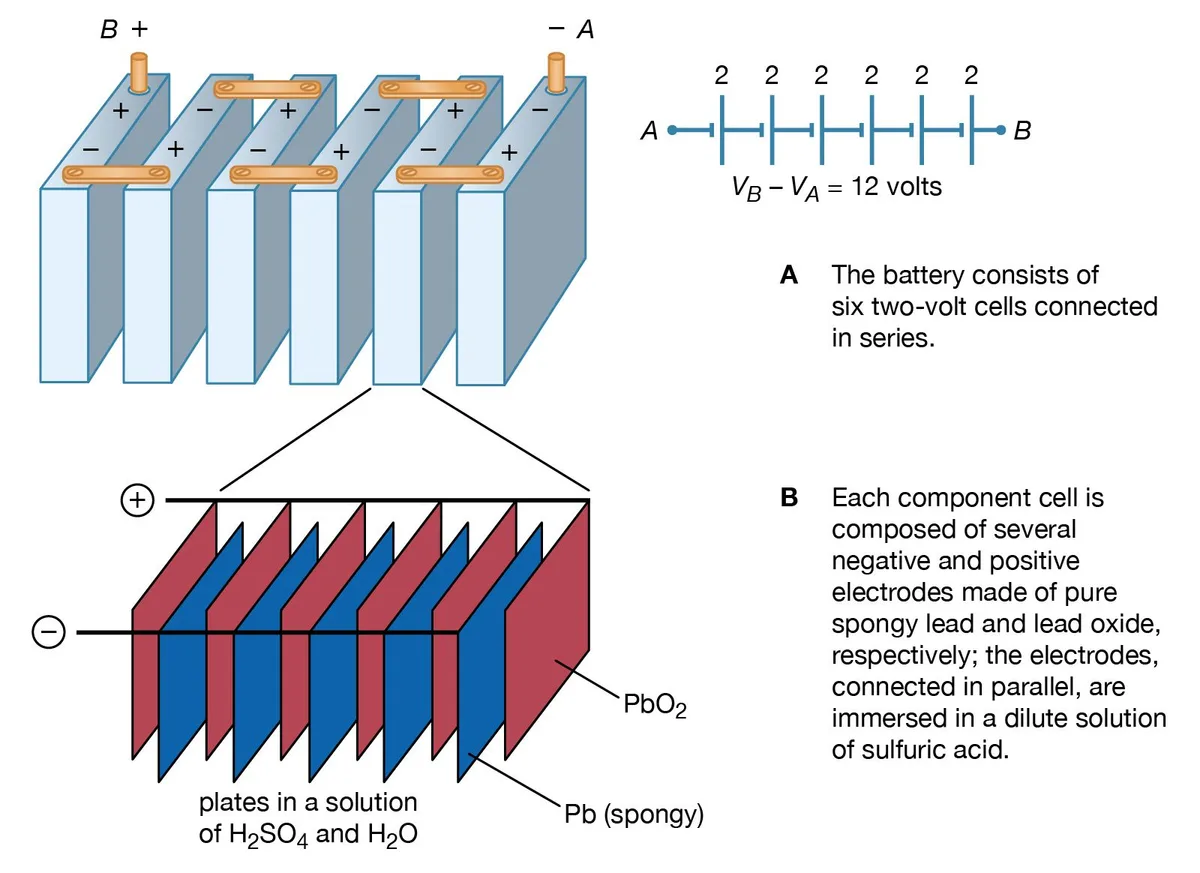
Image source: Web (Bing) / hitchesguide.com (Web image (fair-use with source credit))
Why 12 Volts and Not Something Else
The 12-volt standard goes back to the 1950s. Manufacturers standardized on 12V because it offers a good balance of power, weight, and safety. Higher voltages would arc more dangerously.
Lower voltages couldn't crank modern engines. So 12V DC became the universal automotive standard. If you're checking your battery's health, you'll want to know the normal battery voltage when car is off is around 12.6V.
The Direction of Flow Matters
In DC, current flows from positive to negative in conventional notation. In practice, electrons flow negative to positive. Either way, it's one consistent direction.
This matters for everything from hooking up jumper cables to installing a stereo. Get the polarity wrong and you can fry sensitive electronics instantly.
Where AC Comes In: The Alternator's Role
Here's where people get confused. Your alternator doesn't produce DC. It produces AC, alternating current, and then converts it.
The alternator spins a rotor inside a stator. That spinning magnetic field induces an alternating current, which naturally reverses direction many times per second.
Why build it that way? Alternators are simpler, lighter, and more reliable than DC generators. They also produce more output at idle speeds.
The tradeoff is that AC oscillates, and your battery needs steady DC to charge properly.
So the alternator relies on a rectifier. This is a set of diodes that only allow current to flow in one direction. The rectifier effectively flips the negative half of the AC wave, turning it into a pulsing DC that smooths out to provide a steady charging voltage.
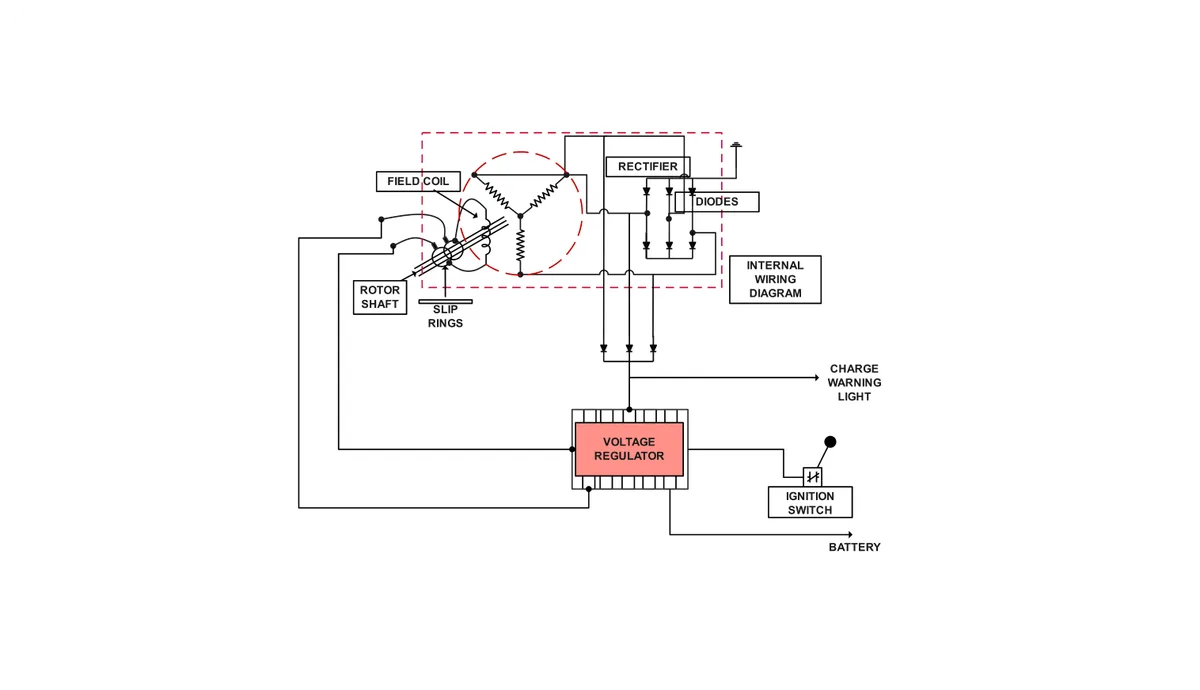
Image source: Web (Bing) / edrawmax.wondershare.com (Web image (fair-use with source credit))
The Voltage Regulator Keeps Things Safe
Once the rectifier converts AC to DC, the voltage regulator takes over. It controls the alternator's field current to maintain output between 13.5 and 14.8 volts. This range is higher than the battery's resting voltage, which pushes charge back into the cells.
When your engine is running, you're not running off battery power. You're running off the alternator's DC output.
That's why a car can keep running even with a dead battery, as long as the alternator works. The alternator powers the ignition and charging system once the engine turns over. If you want to dig deeper into what your voltage should read with the engine running, check our guide on normal battery voltage when car is running.
One Key Distinction
Battery stores DC. Alternator produces AC. Rectifier converts AC to DC.
Then everything in your car runs on DC. The 12V rail powers your ECU, your lights, your radio, your sensors, everything. The only time you see AC in a vehicle is inside the alternator before conversion, or if you're using a power inverter to step up to 120V AC for appliances.
Why It Matters: What Happens When You Mix Up AC and DC?
Getting this wrong has real consequences. Plug a DC device into AC and you'll likely fry it. Plug AC into your battery and you'll damage the battery, the charger, or both.
The distinction isn't academic. It protects your wallet and your safety.
Household outlets deliver 120V AC. Your car battery delivers 12V DC. They are fundamentally incompatible.
That's why you need a specific battery charger, not a lamp cord, to recharge your car battery. A proper charger converts AC from your wall outlet into DC and regulates the voltage to around 14.4V for absorption charging.
Real Talk on Jump Starting
When you jump start a car, the cables connect the two batteries directly. Both batteries are DC. The donor battery pushes charge into the dead battery.
That works because they share the same chemistry and voltage. But if you connect the cables backward, reverse polarity, you risk blowing fuses, damaging the ECU, or causing a battery explosion. Hydrogen gas is extremely flammable.
For the full procedure, including safety checks and cable order, read our guide on how to install a car battery correctly. The steps for removal and installation mirror what you need for jump starting. Getting it right keeps you safe.
Charging From Your Wall Outlet
If you're charging your battery indoors, you need a smart charger designed for 12V lead-acid batteries. These chargers convert household AC to DC and manage the current. They also handle the bulk, absorption, and float stages.
Using the wrong charger can overcharge, warp the plates, and cause premature failure. If you're unsure how long the process takes, our guide on how long does it take to charge a car battery covers the expected timelines.
How to Check and Verify: Using a Multimeter the Right Way
Testing your battery is straightforward. You need a digital multimeter set to DC volts. Most multimeters have a setting marked with a V and a straight line above it, or a solid and dashed line.
That's the DC setting. The AC setting usually has a squiggly line. Using the wrong setting gives you a useless reading.
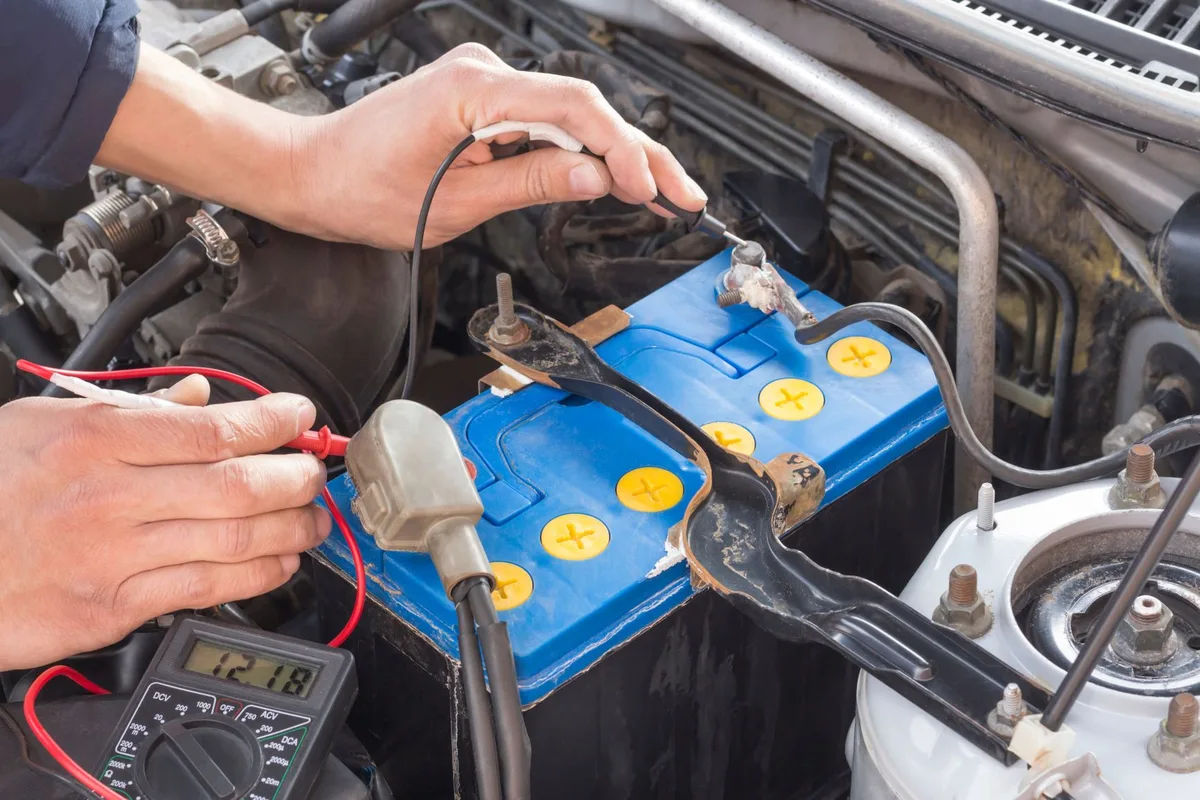
Image source: Web (Bing) / tontio.com (Web image (fair-use with source credit))
Step-by-Step for Battery Voltage
- Turn the ignition off and make sure all lights and accessories are off.
- Set your multimeter to 20V DC range.
- Connect the red probe to the positive terminal.
- Connect the black probe to the negative terminal.
- Read the voltage.
A healthy, fully charged battery shows 12.6V or higher. At 12.4V, you're around 75 percent charged. At 12.2V, you're at 50 percent.
Below 12.0V, the battery is discharged and may be sulfated. For a more detailed walkthrough, see our step-by-step guide on how to test a car battery with a multimeter.
Step-by-Step for Alternator Output
- Start the engine and let it idle.
- Set the multimeter to 20V DC.
- Place the probes on the battery terminals again.
- Read the voltage with the engine running.
You should see between 13.5V and 14.8V. If the reading is below 13V, your alternator isn't charging properly. If it's above 15V, the voltage regulator may be failing.
Both conditions require attention. A quick check now can save you from being stranded later.

Leave a Reply