
Your OBD2 scanner is only as useful as the workflow around it. Pulling the code, clearing it, and hoping the check engine light stays off is not diagnosis. Hidden engine problems usually live in the data before a code is ever set: fuel trim creeping upward, a sluggish oxygen sensor, or a misfire counter that only ticks under load.
In this guide, you will learn how to find hidden engine problems with an OBD2 scanner fast, without replacing parts on a guess. The goal is simple: catch the failure while it is still cheap to fix, not after it strands you on the side of the road.
Why a Code-Only Scan Misses the Real Problem
A diagnostic trouble code (DTC) does not appear the moment something starts failing. The engine computer waits until a sensor reading crosses a threshold for a set amount of time. That means a weak coil can misfire for weeks without ever setting a code. A small vacuum leak can push fuel trim far out of range without turning on the check engine light.
In practice, this is one of the most common diagnostic mistakes: no code equals no problem. That assumption is wrong. Codes are a starting point, not a complete report.
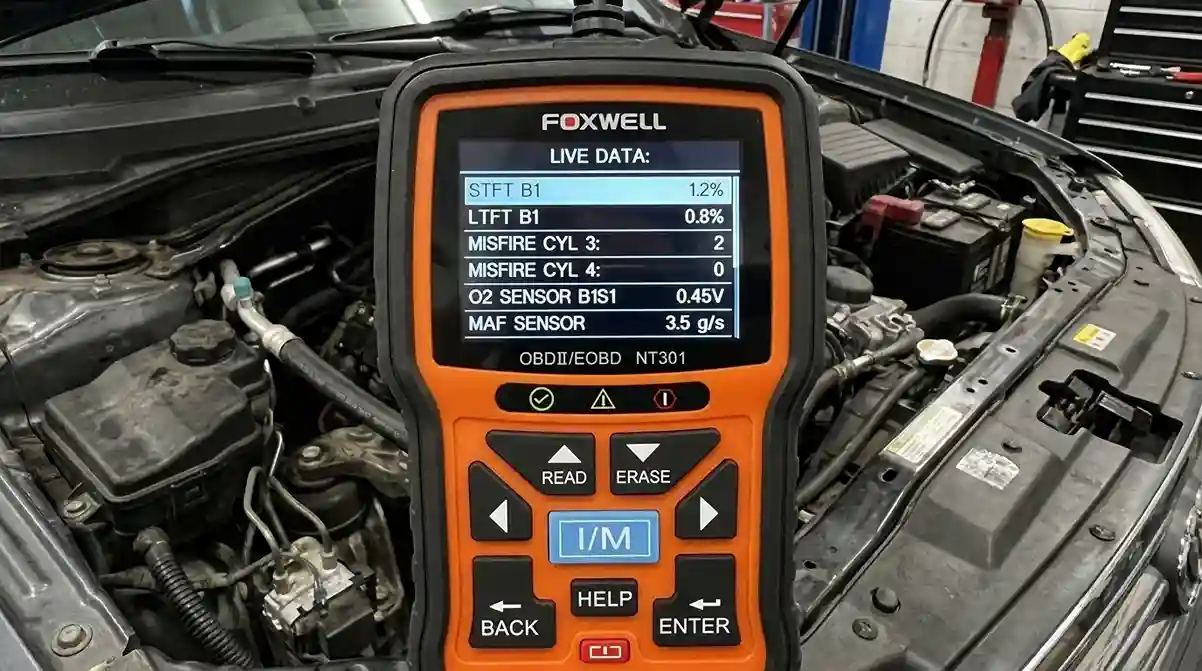
The OBD2 port is the gateway to live sensor data, not just a place to read codes.
The real diagnosis comes from four things most drivers skip:
- pending codes
- freeze-frame data
- live sensor values
- Mode 6 test results
Once you start looking at those, you will see problems that have not yet triggered a warning light.
Know What Your Scanner Can Actually Do
OBD2 became mandatory on 1996-and-newer gasoline vehicles sold in the United States under federal emissions regulations. Almost every scan tool on the market can talk to that system, but not every tool shows the same amount of data.
| Scanner Type | Typical Features | Best Use |
|---|---|---|
| Basic code reader | Read and clear generic powertrain codes | Emergency checks and beginners |
| Mid-range scan tool | Live data, freeze frame, Mode 6, graphing | Finding hidden engine problems |
| Professional scanner | Enhanced manufacturer codes, bidirectional controls, ABS/SRS access | In-depth diagnostics and serious DIYers |
A basic code reader is fine for reading a P0302 misfire code. It is not enough to find out why that misfire is happening. For hidden problems, you need a scanner that can display live data and run Mode 6 tests. Many affordable scan tools in 2026 include these features, so there is no excuse for relying on a bare code reader.
Credit: www.foxwelldiag.com
Live parameter display is the feature that separates a real scan tool from a code eraser.
Step-by-Step: How to Find Hidden Engine Problems Fast
Use the same workflow every time. It takes less than ten minutes once you know where to look.
Step 1: Read Stored and Pending Codes
Start with the full diagnostic scan. Do not just look at the code on the screen; look at every code in every available module.
Two categories matter here:
- Stored codes are confirmed by the computer and will usually turn on the check engine light.
- Pending codes were detected once but not yet confirmed across consecutive drive cycles. They may not trigger the light at all.
A pending code is often the first clue to an intermittent problem. If a vehicle has a pending lean code but no stored code, there is still something worth investigating.
Step 2: Save Freeze-Frame Data Before You Clear Anything
Freeze frame is a snapshot of engine conditions taken at the exact moment a code was stored. It tells you:
- engine RPM
- vehicle speed
- coolant temperature
- throttle position
- fuel system status
One example: a misfire code with a freeze frame showing cold start at 20 mph points to a different cause than the same code at wide-open throttle on the highway. Write down those numbers before erasing anything. Once you clear codes, that snapshot is gone forever.
Step 3: Watch Live Sensor Data With the Engine Running
Live data is where hidden problems become visible. Start the engine, let it reach normal operating temperature, and monitor these key sensors.
| Parameter | Typical Warm-Idle Reading | What Should Worry You |
|---|---|---|
| Engine RPM | Around 650–850 rpm in Park or Neutral | Hunting, dropping, or stuck high |
| O₂ sensor (upstream) | Cycling between roughly 0.1 V and 0.9 V | Frozen high/low, slow switching |
| MAF sensor | Roughly 2–7 g/s at idle on a small engine | Spikes, zero readings, high values at idle |
| Coolant temperature | 195–220°F (91–104°C) once warm | Stuck low, stuck high, jumping wildly |
| Long-term fuel trim | Usually within ±5% on a healthy engine | Creeping beyond +10% or −10% |
Test conditions matter. A sensor reading taken in your driveway at cold idle is nearly useless. If you want to find a hidden problem, you have to look at the data when the engine is warm, under load, and at different speeds.
Step 4: Use Fuel Trim to Catch Air and Fuel Problems
Fuel trim is one of the most powerful tools for finding hidden engine problems, and most drivers ignore it.
- Short-term fuel trim (STFT) is the immediate correction the computer is making right now.
- Long-term fuel trim (LTFT) is the learned correction stored over time.
If the trim is positive, the computer is adding fuel because the engine is running lean. Common causes include vacuum leaks, contaminated MAF sensors, weak fuel pumps, or exhaust leaks before the oxygen sensor.
If the trim is negative, the computer is pulling fuel because the engine is running rich. Common causes include failing fuel injectors, a stuck-open injector, faulty oxygen sensors, or an engine temperature sensor that is driving the computer into cold-start enrichment.
A high fuel trim can sit there for hundreds of miles without setting a code. By the time it sets a lean code, the damage may already be done. Check fuel trim on every scan, especially when there is no check engine light.
Step 5: Run Mode 6 Tests
Mode 6 is part of the OBD2 standard that monitors the performance of emissions-related components. It can show internal test counts and results that are not turned into trouble codes.
For example, Mode 6 can show:
- cylinder misfire counts
- oxygen sensor monitor results
- catalyst efficiency numbers
- EGR system performance
A scanner that supports Mode 6 will show a list of monitors with values and limits. You may need to look up what each identifier means for your make and model, but the effort is worth it. A misfire count that is climbing on one cylinder is an early warning, even if no P0300 code has appeared yet.
Step 6: Log Data During a Test Drive
Some engine problems only show up when the car is moving. Idle data is not enough.
Take the vehicle on a safe route and watch the data while you:
- cruise at a steady speed
- accelerate moderately uphill
- let off the throttle and coast
- run with the air conditioning on and off
Focus on fuel trim changes, misfire counts, and coolant temperature stability. If a cylinder misfire counter jumps only under load, that is a clue pointing toward spark plugs, ignition coils, or fuel delivery.
Step 7: Compare Data Over Time
A single scan can tell you what is happening today. A history of scans tells you what is changing.
Keep a simple log in your phone or notebook. Record the date, odometer reading, any codes, fuel trims, and misfire counts. A long-term fuel trim that moves from 3% to 9% over three months is more meaningful than a one-time reading. This habit also helps if a mechanic later needs to see the trend.
Common Mistakes That Hide the Real Problem
Even with a good scanner, it is easy to steer yourself in the wrong direction.
- Clearing codes before recording data. Once you press erase, freeze-frame data and some monitor information disappears.
- Trusting the first code you see. A P0302 misfire code does not mean the coil is bad. It means cylinder 2 is misfiring. The cause could be fuel, spark, compression, or a vacuum leak.
- Scanning only at cold idle. Many sensors do not reach closed-loop mode until the engine is warm.
- Ignoring live data. Codes tell you which system is failing; live data tells you why.
- Replacing parts instead of testing. The scanner is not a parts-ordering machine. Use it to narrow the list, then test the suspect component.
Hidden Engine Problems You Can Spot Before the Check Engine Light
Here are realistic examples of problems that can hide behind normal-looking codes or no code at all.
| Problem | Scanner Evidence | First Thing to Check |
|---|---|---|
| Vacuum leak | LTFT above +10%, rough idle, no lean code | Intake hoses, PCV valve, intake gaskets |
| Weak ignition coil | High cylinder-specific misfire count in Mode 6 | Swap coil with another cylinder and retest |
| Dirty MAF sensor | Odd MAF readings, high fuel trim, hesitation | Inspect air filter; clean MAF with the correct cleaner |
| Failing oxygen sensor | Sluggish voltage changes, poor fuel trim | Compare upstream and downstream sensors |
| Stuck thermostat | Coolant temp stays low, heater weak, trim shifts | Check warmup pattern; replace thermostat if needed |
None of these issues wait politely for the check engine light. They build up slowly, quietly hurting fuel economy and drivability until the computer finally gives up and sets a code.

Credit: www.amazon.de
Graphing live data makes slow sensor changes much easier to spot.
Real-Life Example: Tracking Down a Hidden Misfire
A common scenario in independent workshops is a vehicle that has a slight stumble under load but no check engine light. The owner only notices a rough vibration around 60 mph.
Plugging in a scan tool with Mode 6 shows that cylinder 3 has counted dozens of misfires while the other cylinders are near zero. There is no P0303 code yet because the misfire rate has not crossed the failure threshold stored in the computer.
The diagnostic move is to swap the ignition coil from cylinder 3 to cylinder 1, clear the misfire counters, and road-test again. If cylinder 1 now shows the high count, the coil is confirmed as the cause. A single coil replacement fixes the issue before the car develops a serious driveability problem.

Credit: www.amazon.sa
Basic code readers are fine for simple checks, but Mode 6 support is what reveals hidden faults.
Choosing the Right OBD2 Scanner for Hidden Diagnostics
Do not buy a scanner based only on price or star count. Look for the features that actually help you diagnose.
Must-have features for finding hidden engine problems:
- Live data streaming with the ability to graph or record values
- Freeze-frame data display
- Mode 6 support for component monitors and misfire counts
- CAN protocol support for newer vehicles
- Firmware updates so the tool does not become obsolete
A scanner that only reads and clears codes is not enough. A mid-range scan tool with live data and Mode 6 is the starting point for serious DIY diagnostics. If your budget allows, look for one with a color screen and a fast refresh rate, because flickering numbers are almost impossible to read while driving.
Practical Tips for Faster, More Reliable Diagnosis
Speed does not mean guessing. These habits will make every scan more useful.
- Keep the scanner firmware updated. Manufacturers add new data paths as vehicles change.
- Always check the freeze frame before clearing a code.
- Compare your readings to the manufacturer's specification, not to someone else's car.
- Check wiring, connectors, and grounds before replacing expensive sensors.
- Use the scanner's recording feature during a test drive instead of trying to watch numbers while driving.
- Take the same measurements every month so you can spot trends early.
After a diagnosis session, do not ignore the cabin. A clean car makes it easier to notice wet carpets, fluid smells, and debris that can hide from a quick visual inspection. Dirt tends to gather in the hard-to-reach floor areas, and a damp floor can make the interior feel musty. You do not need a heavy shop unit for this; a compact vacuum is enough for routine cleanups. Just make sure it has usable suction so it removes grit instead of pushing it around.
If you drive with children, take the same careful approach to their safety equipment. A smooth-running engine means little if the child restraint is not installed properly. Occasionally review the restraint fit before a long trip.
When to Seek Professional Help
There is no shame in admitting when a problem is beyond your tool or experience. Some hidden engine issues require dealer-level equipment, especially on European or hybrid vehicles. Manufacturer-specific enhanced codes often reveal data that a generic OBD2 scanner cannot see.
If you notice any of the following, stop guessing and call a professional:
- serious drivability issues that make the car unsafe to drive
- misfires that do not improve after testing coils, plugs, and injectors
- codes pointing to internal engine damage, such as low compression
- multiple linked codes that require diagnostic flowcharts
A professional can also perform live data analysis while driving on a dynamometer, which is impossible with most consumer scan tools.
Frequently Asked Questions
What OBD2 features do I need to find hidden engine problems?
You need live data, freeze-frame data, and Mode 6 support. Basic code readers cannot see the early warning signs that appear in sensor data.
Can a hidden engine problem exist with no check engine light?
Yes. Many failures must exceed a threshold for a certain time before a code is stored. A weak coil, small vacuum leak, or lazy oxygen sensor can cause noticeable symptoms long before the light turns on.
What is Mode 6 on an OBD2 scanner?
Mode 6 is a diagnostic service that returns monitor results and component performance data. It can show cylinder misfire counts and sensor performance readings that are not normally displayed as trouble codes.
Should I clear codes before fixing a problem?
No. Always record the code, freeze-frame data, and sensor readings first. Clearing codes too early destroys useful diagnostic information and may make an intermittent problem much harder to find.
Are live data values the same for every car?
No. Manufacturer specifications vary. Coolant temperature ranges, fuel trim limits, and MAF readings all depend on engine design. Use manufacturer data, not general internet guesses, when deciding whether a value is abnormal.
Conclusion
If you only read codes, you are seeing the end of the story, not the beginning. Hidden engine problems are almost always visible in the data before the check engine light comes on. Fuel trim, freeze-frame snapshots, live sensor values, and Mode 6 tests give you an early warning system that a basic code read cannot match.
Your next step is simple: before you clear another code, spend a few minutes looking at the freeze frame and fuel trims. If the numbers are abnormal, investigate now. Early detection saves money, keeps the car reliable, and gives you real confidence in your own diagnostic skills. For a broader view of vehicle care, keep browsing our other car-care guides.

Leave a Reply