
Silence from the dashboard can turn the simplest commute into a guessing game. You press the power button, turn up the volume, and still hear nothing. The good news? Most dead-stereo problems are electrical, and many are fixed in ten minutes with tools you already own. This guide covers the top causes and quick fixes for a failing car stereo, from a blown fuse to a locked security code, so you can decide whether to fix it yourself or call a professional.
Use the table below to match your symptom to the likely cause before you start pulling panels. If you are doing broader car care at the same time, our other maintenance guides will be useful once the audio system is working again. You can also read our guide on car stereo screen not working.
| Symptom | Most likely cause |
|---|---|
| No power, no display, no clock | Blown fuse, bad wiring, dead battery, or security lockout |
| Powers on but no sound | Wrong source, speaker wiring, external amp, or factory amp failure |
| Intermittent cutting out | Loose harness, poor ground, or failing ignition switch |
| Resets every time you start | Weak battery, charging fault, or broken constant 12V wire |
Why Is My Car Stereo Completely Dead?
A completely unresponsive head unit — no clock, no display, no sound — almost always means the stereo is not receiving electrical power. Work through these causes in order. The first one is by far the most common.
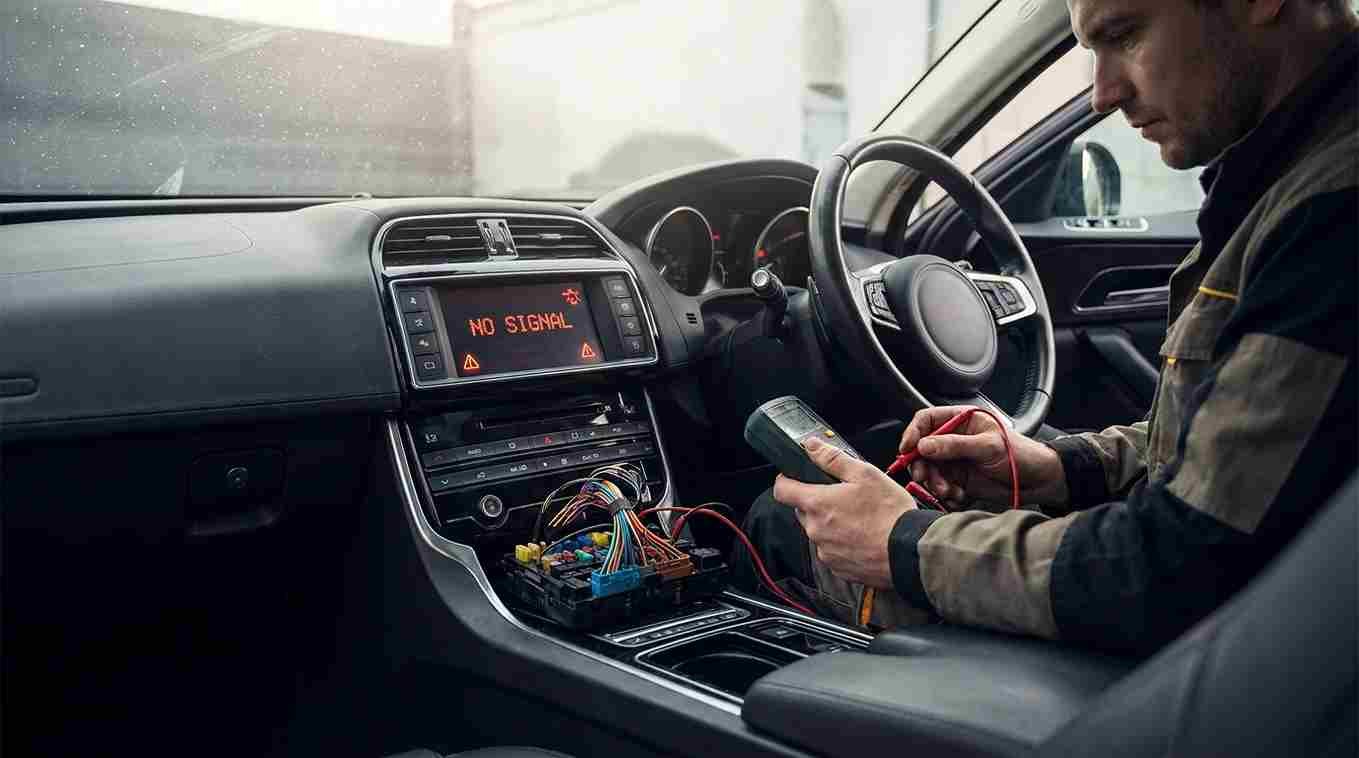 A head unit with no clock and no display is usually a power-delivery problem rather than a speaker problem.
Blown Stereo Fuse
The stereo fuse is a thin metal link that protects the audio circuit from current surges. When too much current flows — from a shorted wire, a failed accessory, or an aftermarket installation mistake — the fuse melts and breaks the circuit. The stereo then goes completely dead. You can also read our guide on why does my car stereo keep resetting.
How to check it: Locate the interior fuse box, usually under the driver’s dash or behind the glovebox. Look for a fuse labeled RADIO, AUDIO, or ACC. Pull the fuse with a fuse puller or needle-nose pliers and hold it up to the light. If the metal strip inside is broken or blackened, replace it with a fuse of the same amperage.
Never install a higher-amp fuse as a “quick fix.” If the circuit is shorted, a larger fuse can overheat the wiring and start a fire. And if a new fuse blows immediately, stop and trace the underlying short instead of swapping in another one. You can also read our guide on how to change language on car stereo.
Loose or Corroded Wiring
Vibration and moisture are the enemies of car audio connections. The harness behind the stereo can loosen over time, especially in older vehicles. When the constant 12V (yellow), switched 12V (red), or ground (black) wire loses contact, the unit will die or cut out.
- If the stereo dies on bumpy roads, suspect a loose harness or bad ground.
- If jiggling the wiring makes the stereo come back, you have a poor connection at the harness, not a failed head unit.
Check the ground wire first. A ground needs clean, bare metal contact with the chassis. If the ground is bolted to a painted panel or a rusty screw, the radio can behave erratically. Move the ground to bare metal or clean the contact area with sandpaper.
Weak Battery or Failing Charging System
A car stereo needs steady voltage. If the battery is weak or the alternator is not charging properly, the stereo may refuse to turn on, reset when you crank the engine, or forget its presets.
Quick test: with the car off, the battery should sit around 12.6 volts. With the engine running, it should rise to 13.5–14.5 volts. If your readings are lower, have the battery and charging system tested before you blame the radio. In practice, a worn-out battery is responsible for far more “dead” stereos than people expect.
Failed Head Unit
After years of heat, vibration, and electrical stress, the internal components of the head unit itself can fail. Capacitors and power-supply transistors are common weak points, which is why many factory stereos die somewhere between the eight- and twelve-year marks.
Common signs: the stereo powers on but the display distorts, buttons stop responding, or every speaker produces the same static. If the fuses, wiring, and voltage check out, the head unit is usually the culprit.
Anti-Theft Security Code Lockout
Many factory stereos include an anti-theft feature that locks the radio when power is interrupted. The system requires a four- to six-digit code before it will play again. You will see “CODE,” “SAFE,” or “LOCK” on the display.
Solution: Look for a code card in the glovebox or owner’s manual. Many automakers also print the code on the side of the head unit itself, so pull the unit partway out and check. If you still don’t have it, your dealership can retrieve the code using your VIN and the stereo’s serial number. Never guess repeatedly — some units lock permanently after a set number of wrong entries.
Why Is My Car Stereo Display Not Working?
Sometimes the audio works fine but the screen stays dark or shows a distorted image. This points to a display or wiring problem, not a complete power failure.
- Burnt-out backlight: Shine a flashlight directly at the screen. If you can see a faint image underneath, the internal backlight has failed. The display panel usually needs to be replaced.
- Faulty dimmer wire: The orange/white dimmer wire tells the stereo when your headlights are on. If it is grounded or shorted, the unit can force the screen into night mode, leaving it almost impossible to read in daylight.
- Dead touchscreen layers: Modern LCD and touchscreens are made of stacked layers. A cracked digitizer or a failing display ribbon cable can leave the screen dark while the radio continues to play audio behind it. If the unit responds to steering wheel controls but the touchscreen is blank, the display assembly is failing.
If you replace the stereo rather than repair the screen, you can also set the on-screen language and menu preferences to match your needs, which many factory units restrict.
Car Stereo Turns On But No Sound: Speaker and Amp Troubles
A head unit that powers up but produces silence is almost always a signal-chain problem. Work through this checklist in order.
- Check the source. Make sure you’re not on a blank AUX input or connected to a phone that isn’t playing anything. Switch between FM, AM, and Bluetooth to rule out a dead source.
- Adjust fade and balance. Crank the fade fully to the front, then to the rear, and sweep the balance left and right. If only one speaker works, that speaker’s wiring or driver is likely at fault.
- Inspect door speaker wires. Chafed wires rubbing against metal, especially in the rubber boot between the door and the chassis, are a classic cause of intermittent sound loss.
- Check the external amplifier. Aftermarket amps have their own fuse and a remote turn-on wire. If the amp’s power light is off, check the fuse and the 12V trigger wire coming from the head unit.
 A harness with poor pin contact or degraded insulation is a classic source of audio dropouts.
If your car has a factory amplifier under a seat or in the trunk, it can also fail internally. A powered head unit with no output on any speaker is often a factory amp that has gone into protection or simply quit.
How to Diagnose a Dead Car Stereo (Step-by-Step)
Work through these steps in order. They take about twenty minutes and cost nothing if you already own a multimeter.
Step 1: Rule Out the Obvious
- Is the volume turned up past the minimum?
- Is mute engaged?
- Try a different source, such as a CD or USB stick, to eliminate a dead input.
Step 2: Locate and Test the Fuses
Check both the cabin fuse labeled RADIO or AUDIO and any fuse on the rear of the head unit. Use the fuse puller and inspect the metal strip. Swap out any fuse that looks scorched or split with one of the same amperage.
Step 3: Test Power and Ground Connections
Set your multimeter to DC volts, remove the head unit, and disconnect the harness.
- Yellow wire: should show 12V at all times, powering memory and presets.
- Red wire: should show 12V only when the ignition is in ACC or ON.
- Black wire: should show near-zero ohms to the chassis.
If the red wire has no voltage with the key on, trace the ignition-switch circuit. If every wire is correct, test for voltage at the head unit’s own power connector to isolate a broken internal connection.
Step 4: Perform a Factory Reset
Many head units have a small reset hole; press it with a pen. If that doesn’t help, disconnect the negative battery terminal for fifteen minutes. This clears volatile memory and can resolve software glitches that cause the unit to freeze or run silent.
Step 5: Swap in a Known-Good Unit
Temporarily connect a stereo you know works. If it works, your original head unit is faulty. If the spare also fails, the problem is in the vehicle’s wiring, speaker system, or factory amp.
Why Car Stereos Stop Working After a Battery Swap
A battery change is one of the most common triggers for a sudden stereo failure. Several things can go wrong during the job.
- Voltage spike damage: Disconnecting the battery while the key is in the ON position can send a surge through the electrical system, blowing the stereo fuse or damaging the head unit’s internal power supply.
- Security code lockout: As covered above, power loss triggers the anti-theft protocol on many late-model vehicles.
- Lost memory and reset errors: The constant 12V wire is interrupted, wiping presets and clock settings. If the head unit was already weak internally, this power cycle can finish it off.
Always disconnect the negative battery terminal first, and keep the key completely out of the ignition whenever you work on electrical components.
 An anti-theft lock screen will immobilize the stereo until the correct code is entered.
When to Call a Professional Installer
While many stereo problems are DIY-friendly, some situations need professional tools and experience.
- Repeated blown fuses: If a new fuse blows immediately, you have a short circuit. Continuing to replace it risks permanent damage to the wiring or even a vehicle fire.
- Factory integration work: Bypassing a factory amp or integrating steering wheel controls and a backup camera often requires CAN-bus adapters and programming. Getting this wrong can disable safety systems.
- Melted or corroded connectors: If the factory harness is melted, brittle, or corroded, proper repair means soldering and heat-shrink tubing — not wire nuts or crimp caps.
Professional installers follow OEM standards for wiring and harness integration. Before authorizing major electrical work, review the National Highway Traffic Safety Administration guidance on vehicle electronic systems to understand the safety implications of modifications. If you need to learn the basics before attempting a DIY fix, reputable training resources from retailers like Crutchfield’s learning center can walk you through harness color codes and adapter kits.
Cost Breakdown: Repair vs. Replacement
Knowing what each fix costs helps you decide between repairing your current unit and replacing it with a modern aftermarket model.
| Problem | DIY Cost | Shop Cost | Time Required |
|---|---|---|---|
| Fuse replacement | $5 – $15 | $20 – $50 | 10–30 minutes |
| Speaker replacement | $30 – $150 per speaker | $75 – $200 per speaker | 1–2 hours |
| New head unit | $50 – $700 | $150 – $900 | 1–3 hours |
| Wiring or circuit repair | $10 – $60 | $50 – $250 | 1–4 hours |
| Screen or display rebuild | $100 – $300 | $250 – $600 | 2–5 hours |
If the stereo is more than eight years old and the repair estimate passes half the price of a new unit, replacement is usually the smarter call. A modern unit adds Bluetooth, Apple CarPlay, Android Auto, and a warranty for only a little more than a major repair.
How to Prevent Future Car Stereo Failures
A few simple habits will keep your audio system reliable for years.
- Keep liquids sealed. A spill into the dash is the fastest way to corrode a head unit’s internals. Use a cupholder with a lid if you carry drinks.
- Protect the wiring. Use proper harness adapters and loom during installation to avoid chafing and shorts.
- Check battery health annually. Low voltage stresses every electronic module, including the radio.
- Vacuum your cabin regularly. Dust and dirt accelerate wear in buttons, knobs, and vents. Choosing a capable interior vacuum makes this quick, and reaching the crevices under the seats prevents debris from working its way into the trim.
- Update firmware. Check your manufacturer’s website for audio system updates, especially if you have CarPlay or Android Auto connectivity issues.
If you spend time on routine car care, cleaning beneath the seats and pulling out trapped pet hair can also protect the wiring and modules that sit under the front seats.
Frequently Asked Questions
Can a bad fuse cause the stereo to drain the battery?
No. A blown fuse stops current flow completely. However, a shorted wire that hasn’t yet blown the fuse can drain the battery. If your car battery dies overnight, test for a parasitic draw by measuring current through the fuse box with the engine off.
Why does my stereo turn off when I hit the gas?
This usually points to a poor ground connection. When the engine moves under acceleration, it shifts the chassis slightly and can break a marginal ground contact. Inspect the ground wire where it bolts to bare metal and re-crimp the terminal if needed.
Why does my stereo work only when the headlights are off?
This points to a bad dimmer wire connection. The stereo reads the dimmer signal incorrectly and drops into a dimmed or powered-down state when the headlights come on. Check the orange/white wire for proper voltage and routing.
Is it worth repairing an old car stereo?
If the internal amplifier has failed, repair costs often approach the price of a new aftermarket unit. A replacement gives you modern connectivity, stronger built-in amplification, and a warranty, making it the better value in most cases.
Conclusion
A dead car stereo is rarely random. A blown fuse, a loose ground, a failing battery, or a security lockout accounts for the vast majority of failures. By systematically testing power with a multimeter and starting with the cheapest fix, you can avoid an expensive shop visit. If the head unit itself is beyond saving, a modern aftermarket replacement is an affordable upgrade that adds features your old radio never had. Start with the fuses and battery voltage, and take it one step at a time — your music will be back before you know it.

Leave a Reply