
When the check engine light glows on your dashboard, the first tool you reach for is an OBD scanner. But plugging the wrong one into your vehicle wastes time, money, and patience. If you drive a classic car from the early 1990s or a modern daily commuter, knowing the difference between OBD1 and OBD2 scanners determines whether you can diagnose the issue yourself or need to book a shop appointment.
The short version: OBD1 systems are brand-specific, pre-1996 technologies that use unique connectors and cryptic codes, while OBD2 is a universal standard used in nearly every car sold since 1996. But the full picture involves connectors, protocols, live data, and practical buying decisions that this guide breaks down in plain language. For more on this, see our guide on what is vpwr on obd2 scanner.
By the end, you will know exactly which scanner matches your vehicle, what features actually matter, and how to avoid the common mistakes that send DIYers back to the mechanic.
What Is On-Board Diagnostics (OBD)?
On-board diagnostics is the built-in self-monitoring system that tracks your engine, transmission, emissions, and other critical components. When a sensor reading falls outside expected ranges, the system stores a diagnostic trouble code (DTC) and illuminates the check engine light. For more on this, see our guide on can an obd2 scanner detect transmission problems 2.
The OBD port is the gateway. A scanner plugs into this port, reads the stored codes, and displays the information for you. Before OBD existed, mechanics manually tested circuits and relied on physical symptoms — a slower, less accurate process.
The technology evolved in two major generations: OBD1 and OBD2. Understanding both is essential, especially if you own or work on vehicles from different eras. For more on this, see our guide on how to clear codes with obd2 scanner.
OBD1 Scanner: Features, Uses, and Real Limitations
OBD1 arrived in the 1980s as manufacturers began adding computer controls to meet tightening emissions regulations. Unlike today's standardized systems, each automaker built its own proprietary approach. This created a fragmented landscape of connectors, code formats, and diagnostic procedures.
How OBD1 Scanners Work
An OBD1 scanner connects to a manufacturer-specific diagnostic port. GM used a 12-pin ALDL connector under the dash, Ford used a 6-pin connector plus a self-test jumper wire, and Toyota used a small rectangular diagnostic box under the hood. These ports are not interchangeable.
Reading codes from an OBD1 system varies by brand. Some scanners display codes on a screen. Others use a blinking LED or the check engine light itself — you count the flashes to derive the code. A 1994 Honda Civic, for example, might flash two pulses, pause, then flash three more, signaling code 23.
Many OBD1 scanners also require a reference book or chart to translate numeric codes into meanings. Without the right documentation, a code like "43" tells you nothing.
Common OBD1 Diagnostic Uses
- Engine misfires and cylinder balance issues
- Emissions control component failures (EGR, oxygen sensors)
- Fuel system and ignition faults
- Basic idle speed and throttle position checks
Key Limitations of OBD1 Scanners
Brand-specific design: A GM scanner will not work on a Ford, and a Ford scanner will not work on a Toyota. Owning multiple older vehicles means owning multiple tools.
Limited system coverage: OBD1 primarily monitors powertrain and emissions. It does not typically track airbags, ABS, or body control modules.
No live data: Most OBD1 scanners show codes only. They do not display real-time RPM, coolant temperature, or oxygen sensor voltage — data that helps diagnose intermittent issues.
Fragmented code formats: Code 43 means "knock sensor circuit" on a Chevy, but something entirely different on a Mazda. Even within the same brand, code meanings changed across model years.
Basic communication protocols: OBD1 uses slower, simpler communication that transmits less data.
Practical trade-off: If you own a 1992 Silverado, an OBD1 scanner is your only option without a costly computer swap. Expect to consult brand-specific documentation regularly.
OBD2 Scanner: Features, Standards, and Modern Advantages
In 1996, the United States mandated OBD2 for all new passenger vehicles. The goal was to standardize diagnostics to reduce emissions and simplify repairs. The result is the universal 16-pin port and standardized code format that every modern vehicle uses.
How OBD2 Scanners Work
OBD2 scanners connect to a standardized 16-pin OBD-II port, typically located under the driver's side dashboard. The port shape and pin layout are identical across all makes and models sold in the US from 1996 onward.
The system uses a standardized set of diagnostic trouble codes. Powertrain codes start with "P" (P0300 for misfire), body codes with "B," chassis codes with "C," and network codes with "U." The first digit after the letter indicates whether the code is generic or manufacturer-specific.
Modern OBD2 scanners display these codes directly on a built-in screen or through a smartphone app. Many provide plain-language descriptions, eliminating the need for a separate reference book.
Advanced OBD2 Scanner Features
Live data streaming: Watch real-time sensor readings — engine RPM, coolant temperature, fuel trims, oxygen sensor output — as the engine runs. This feature is invaluable for diagnosing intermittent issues.
Freeze frame data: When a code is set, the system captures a snapshot of conditions at that exact moment. You see RPM, speed, load, and temperature right before the fault occurred.
Emissions readiness monitors: Check whether the vehicle is ready for an emissions inspection without driving through a full monitor cycle.
Bi-directional controls: Advanced scanners can command components to activate, such as cycling the cooling fan or opening an EVAP solenoid, to test functionality directly.
Special functions: Access ABS bleeding, airbag system resets, injection programming, and electronic parking brake maintenance on compatible vehicles.
Common OBD2 Diagnostic Uses
- Reading and clearing powertrain and transmission codes
- Checking ABS and airbag fault codes (on compatible scanners)
- Monitoring live sensor data
- Verifying emissions readiness
- Performing component activation tests
Important OBD2 Unlock Caveats
Not every OBD2 scanner accesses every system. Basic $25 models typically read only powertrain codes. Accessing ABS, airbag, or transmission modules requires a more expensive scan tool with manufacturer-specific protocols. Compatibility varies by brand, so check coverage before purchase.
Obd1 vs Obd2 Side-by-Side Comparison
| Feature | OBD1 Scanner | OBD2 Scanner |
|---|---|---|
| Vehicle Coverage | 1981–1995 (approx.) | 1996–present |
| Connector Type | Brand-specific | Standard 16-pin |
| Code Format | Brand-specific numeric | Universal (P0xxx, B0xxx, etc.) |
| Systems Covered | Engine, emissions | Engine, transmission, ABS, airbags, body |
| Live Data | Most do not offer | Standard on modern models |
| Code Interpretation | Requires reference manual | Built-in descriptions |
| Bi-directional Testing | Rarely available | Available on advanced models |
| Ease of Use | Moderate to difficult | Beginner-friendly |
| Availability | Niche, aftermarket only | Widely available, all price points |
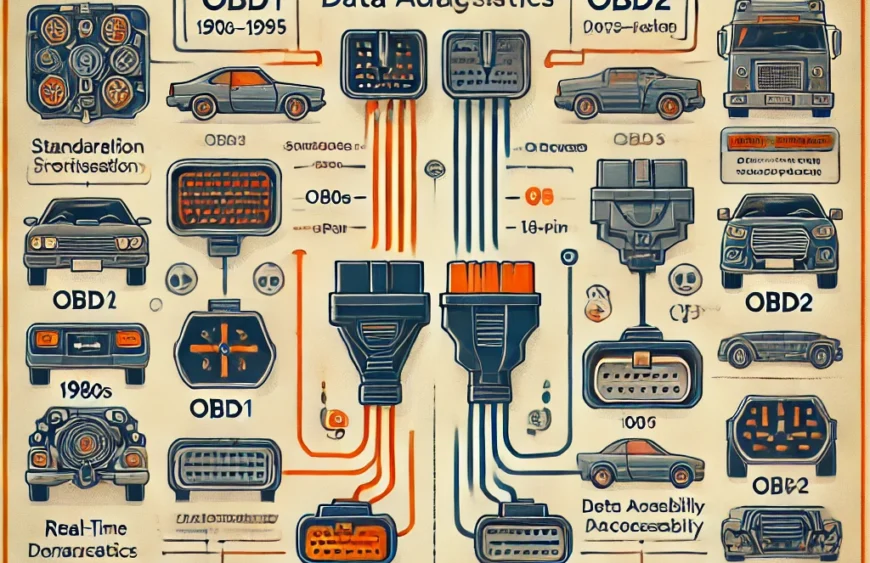
The 16-pin OBD2 connector is now the universal standard, replacing the brand-specific ports of the OBD1 era.
Credit: techroute66.com
Why Did the Industry Move From OBD1 to OBD2?
The shift was driven by the environmental protection regulations that required standardized emissions monitoring. In the late 1980s, the California Air Resources Board became frustrated with unreliable, brand-specific diagnostics that let high-emission vehicles pass inspection.
The resulting regulations mandated a universal system: standard connector, standard codes, and standard diagnostic protocol. The U.S. EPA adopted the standard for the 1996 model year. You can review the basic framework on EPA's on-board diagnostics page for current regulatory guidance.
OBD2 achieved two major goals:
Cleaner air: Vehicles must continuously monitor emission-control components. A fault triggers the check engine light before pollution levels rise significantly.
Simpler repairs: One scanner works on any car. Standardized codes and data streams mean any competent mechanic can diagnose any modern vehicle without brand-specific equipment.
This standardization effort is part of broader international standards such as those maintained by the International Organization for Standardization for road vehicle diagnostics.
How to Choose the Right Scanner for Your Vehicle
Your vehicle's model year narrows down your choices immediately.
For Pre-1996 Vehicles (OBD1)
You need a brand-specific OBD1 scanner. Key purchase considerations:
- Confirm the exact connector type for your vehicle's make and model
- Verify which model years and engine variants the scanner supports
- Look for scanners that include code reference documentation
- Consider OEM-specific tools for the most accurate results
For 1996–2003 Vehicles
These transition-era vehicles have the standard OBD2 connector, but not all OBD2 scanners read every module. Early systems can be finicky. Before buying, check the seller's compatibility notes for your specific model.
For 2004+ Vehicles
Nearly any OBD2 scanner will read engine and transmission codes. For ABS, airbag, or body modules, confirm the scanner's system coverage. Some manufacturers — particularly European brands — require specialized protocols.

Side-by-side view of an OBD1 connector (left) and the standardized 16-pin OBD2 connector (right).
Credit: obd2australia.com.au
Common Buyer Mistakes to Avoid
- Buying OBD2 only: If your car was built before 1996, an OBD2 scanner will not physically fit or communicate.
- Ignoring brand fit: An OBD1 scanner for GM will not work on a Honda.
- Assuming all OBD2 scanners are equal: Inexpensive models often read engine codes only. Verify module coverage.
- Forgetting software updates: Some advanced scanners require app downloads or firmware updates for newer vehicle models.
Obd1 and Obd2 Scanner Price Ranges
| Scanner Type | Typical Price Range | What You Get |
|---|---|---|
| OBD1 (brand-specific) | $50–$150 | Basic code reading, limited models |
| OBD2 (basic) | $20–$90 | Engine codes, live data, freeze frame |
| OBD2 (mid-range) | $90–$300 | ABS, airbag, some special functions |
| OBD2 (professional) | $300–$2,000+ | Full system coverage, bi-directional controls, programming |
| Combo OBD1 + OBD2 | $150–$700 | Multi-brand support, all vehicle eras |
A basic OBD2 scanner costs less than a single trip to a mechanic. That return on investment is why most vehicle owners find a budget-friendly model worthwhile. For the same money, an OBD1 scanner is harder to find and delivers far fewer features.
Real-World Examples: Scanners in Action
OBD1 Scenario: Diagnosing a 1992 Chevrolet Silverado
A rough idle and a check engine light send you to the parts store. A GM OBD1 scanner plugs into the ALDL connector under the dash. The scanner retrieves code 43 — knock sensor circuit. A visual inspection reveals chafed wiring to the knock sensor, a known issue on these trucks. A $15 wiring repair solves the problem.
What made this straightforward was using the correct brand-specific tool with a decoder manual. Without it, you might have replaced spark plugs, wires, and distributor components before identifying the actual fault.
OBD2 Scenario: Diagnosing a 2007 Honda Accord
The check engine light is on, and the car smells slightly of fuel. A $40 OBD2 scanner instantly shows P0455 — evaporative emission control system leak, large. The scanner's live data confirms the fuel tank pressure reading is holding near zero instead of building pressure.
The fix: a loose gas cap after a recent fill-up. Tightened, cleared the code, and verified with an emissions readiness check. Total time: five minutes. Total cost: $0.
Typical Trouble Codes
| OBD1 Code Example | Meaning | OBD2 Code Example | Meaning |
|---|---|---|---|
| 12 | Diagnostic mode active | P0300 | Random/multiple cylinder misfire |
| 43 | Knock sensor circuit | P0171 | System too lean (Bank 1) |
| 35 | Idle speed control issue | P0455 | EVAP emission leak (large) |
Advanced Features to Consider in Modern OBD2 Scanners
Modern scan tools go far beyond code reading. If you plan to maintain your vehicle long-term, consider these features:
Wireless connectivity: Bluetooth or Wi-Fi models pair with your smartphone, turning it into a powerful diagnostic display for much less than a standalone unit.
ABS and airbag diagnostics: Essential if you work on newer cars, where these modules are common failure points. Basic scanners often skip them.
Service reset functions: Oil life, brake pad, and battery registration resets that would otherwise require a dealer visit.
Live graphing: Visualize sensor data as real-time graphs to spot intermittent faults that numeric readouts hide.
Software updates: Higher-end scanners from reputable brands receive ongoing updates for new models. Budget units often cannot be updated.
Check whether the scanner covers both OBD2 generic functions and the manufacturer-specific systems on your vehicle.
Cost Impact: How the Right Scanner Saves Money
The right scanner is a financial tool as much as a diagnostic one. With OBD2 live data, you can verify whether a part is actually failing before replacing it. Swapping a $250 oxygen sensor without confirming the diagnostic is a mistake a scanner prevents.
Think of the cost perspective this way:
- A cheap OBD2 scanner costs less than one hour of diagnostic labor
- Monitoring live fuel trims can catch vacuum leaks before they damage the catalytic converter
- Emissions readiness checks prevent failed inspections and re-test fees
- Avoiding unnecessary parts replacement pays for the scanner many times over
OBD1 diagnostics are inherently slower and more error-prone. A misread code sends you chasing the wrong part. Mechanics charge more for these vehicles because the process genuinely takes longer. If you own an older car, invest in a quality brand-specific scanner and the reference materials to use it effectively.
Adapting to Newer Vehicles in an OBD2 World
The OBD2 standard remains in place, but vehicle technology continues advancing. Modern cars are increasingly connected and software-defined. Diagnostics in 2026 involve not just OBD2 codes but also over-the-air updates, telematics systems, and cloud-connected tools.
What does this mean for you?
- The physical OBD2 port is still the access point, but data richness varies by vehicle
- Some manufacturers restrict access to certain modules behind security measures
- A basic OBD2 scanner remains sufficient for engine diagnostics on nearly any 1996+ vehicle
If you service newer vehicles professionally, consider a scanner with manufacturer-level capabilities or a subscription-based tool that supports multiple brands. For private owners, a quality mid-range OBD2 scanner provides all the engine and emissions diagnostics you need.
Care and maintenance of modern tools makes sense as part of your broader vehicle maintenance routine, the same way you keep the interior of your car in good condition.
Frequently Asked Questions
What is the main difference between OBD1 and OBD2 scanners?
The essential difference is standardization. OBD1 scanners are brand-specific with proprietary connectors, codes, and protocols. OBD2 scanners use a universal 16-pin connector, standardized codes, and work on all vehicles manufactured from 1996 onward.
Can I use an OBD2 scanner on an OBD1 car?
No. The physical ports are different, and OBD2 scanners cannot communicate with OBD1 computer systems. You need a brand-specific OBD1 scanner for pre-1996 vehicles.
Are OBD2 scanners better than OBD1 scanners?
For most purposes, yes. OBD2 scanners provide more detailed data, cover more systems, are easier to use, and cost less. OBD1 scanners exist only because older vehicles require them — they offer fewer features and require more technical knowledge.
Why do some OBD2 scanners cost so much more than others?
The price difference reflects system coverage. Inexpensive scanners read only engine and emissions codes. Professional scanners access ABS, airbags, transmission, body control modules, and offer bi-directional testing and programming functions. The features determine the price.
How do I know which scanner is compatible with my car?
Check your vehicle's model year. For pre-1996 vehicles, note the make and engine, then search for a brand-specific OBD1 scanner. For 1996 and newer, any OBD2 scanner reads engine codes. For other systems, consult the scanner's compatibility list for your specific make and model. For related vehicle maintenance considerations, our guide on essential in-car accessories and interior upkeep can help you plan your full maintenance picture.
Do all OBD2 scanners read ABS and airbag codes?
No. Basic models read only powertrain codes. You need a scanner with manufacturer-specific coverage to access ABS, airbag, and body modules. Check the specification list before buying.
Can a scanner clear the check engine light?
Yes, most OBD2 scanners can clear codes and reset the check engine light. However, the light will return if the underlying fault remains. Use this feature after completing a repair, then verify the emissions readiness monitors.
Conclusion
The difference between OBD1 and OBD2 scanners comes down to standardization and capability. OBD1 systems are fragmented, brand-specific, and limited to basic engine and emissions data. OBD2 systems use one universal connector, standard codes, and offer live data, freeze frames, and extended system coverage — all at a fraction of the cost of older tools.
If your vehicle was built before 1996, invest in the correct brand-specific OBD1 scanner with reference documentation. If you drive anything from 1996 onward, a quality OBD2 scanner — even a budget model — pays for itself the first time it saves you an unnecessary trip to a mechanic.
Your next step: check your vehicle's model year, identify which systems you want to diagnose, and choose a scanner that matches your needs. Skip the cheapest generic options if you ever need ABS or airbag diagnostics, and verify compatibility with your specific car before you buy. The right scanner makes vehicle maintenance approachable and affordable.

Leave a Reply