
Seeing the ABS light glowing on your dashboard can be unsettling. You might picture expensive diagnostics or a lengthy shop visit. But here's the truth: in many cases, you can reset that light yourself with an OBD2 scanner in under an hour.
This guide walks you through everything you need to know — from understanding why the light came on, to picking the right scanner, to clearing the code the correct way. We'll also cover common pitfalls and explain when you genuinely need a professional. By the end, you'll have a clear, repeatable process for handling ABS warnings with confidence. For more on this, see our guide on obd2 scanner for hybrid vehicles guide.
What the ABS Light Actually Means
The Anti-lock Braking System (ABS) prevents your wheels from locking up during hard braking, helping you maintain steering control on slick surfaces. When this system detects a fault, it illuminates the amber ABS warning on your dashboard.
It's important to understand what the ABS light does not mean. It doesn't indicate that your brakes have failed entirely. Your base braking system will usually still work, but the anti-lock feature will be disabled or degraded. That matters in emergency stops, rain, snow, or gravel. For more on this, see our guide on what is vpwr on obd2 scanner.
Common ABS Light Triggers
The most frequent causes include:
- Faulty wheel speed sensors — exposed to road debris, moisture, and corrosion, these fail more often than other ABS components
- Low or dirty brake fluid — fluid level affects the ABS module's hydraulic operation
- A failing ABS module — the unit itself can wear out over time
- Blown fuses or damaged relays — a simple electrical issue that's quick to check
- Damaged tone rings — the toothed rings the sensors read can crack or collect debris
The National Highway Traffic Safety Administration (NHTSA) provides useful background on how anti-lock braking systems work and why they matter for vehicle safety. Understanding the system's role helps you make smarter repair decisions.
What Is an OBD2 Scanner?
An OBD2 (On-Board Diagnostics, Version 2) scanner is a diagnostic tool that plugs into your car's computer system. All vehicles sold in the US since 1996 are required to have a standard OBD2 port, making these tools widely compatible. For more on this, see our guide on can an obd2 scanner detect transmission problems 2.
However, not all OBD2 scanners are created equal. This is where many DIYers get stuck.
| Scanner Type | Functions | Price Range | ABS Reset Support |
|---|---|---|---|
| Basic OBD2 | Engine codes, emissions | $20–$50 | No |
| Advanced OBD2 | Engine, ABS, airbags, transmission | $80–$300+ | Yes |
A basic $25 scanner will read engine trouble codes and clear "check engine" lights. It won't touch your ABS system. To read and clear ABS codes, you need a scanner that specifically supports the chassis or ABS module — these are often marketed as "system-specific" or "all-system" scanners.
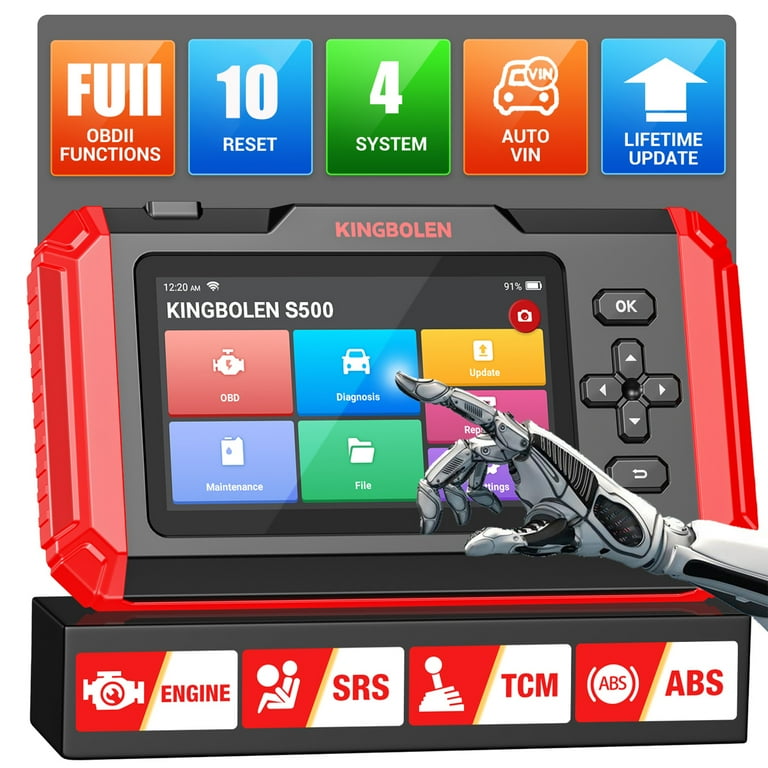
An advanced OBD2 scanner like this one can communicate with ABS, SRS, and transmission modules — not just the engine.
Credit: www.walmart.com
Choosing the Right Scanner for ABS Reset
If you're planning to reset your ABS light more than once, an advanced scanner pays for itself quickly. But before you buy, verify these four things:
- ABS compatibility — Does it support your car's make, model, and production year? Some affordable scanners skip European or older Asian vehicles.
- Live data capability — Can it show live wheel speed sensor readings? This is essential for diagnosing which sensor is failing.
- Reset functions — Does it explicitly offer "Clear ABS Codes" or "ABS Reset"? Merely reading codes isn't enough.
- Bi-directional control — Some advanced scanners can activate components like the ABS pump, which helps test hydraulic systems.
| Brand | ABS Support | Mobile App | Typical Price |
|---|---|---|---|
| Autel MaxiCOM series | Yes | No | $250–$500 |
| Launch CRP series | Yes | No | $150–$300 |
| Innova 6100P | Yes | No | $120–$200 |
| BlueDriver | Limited | Yes | $100–$120 |
A common mistake: assuming a Bluetooth adapter with a smartphone app can handle ABS reset. Many budget adapters only access engine codes. If you're shopping for a compact option, check the product specifications carefully before buying. For practical guidance on choosing a diagnostic tool that fits your needs, our tool selection guide covers the key features to compare.
Before You Reset: Preparation Steps
Resetting the light is only half the job. Proper preparation prevents wasted effort and repeated failures.
Step 1: Fix the Root Cause First
This is the single most important rule. If you clear the ABS code without repairing the underlying fault, the light will return — often within a few drive cycles. Treat the reset as the final step, not the shortcut.
Step 2: Check Battery Voltage
A weak battery can cause false ABS codes. The ABS module requires stable voltage to operate correctly. If your battery is below 12.4 volts or the engine cranks slowly, charge it before proceeding.
Step 3: Gather Your Tools
- An advanced OBD2 scanner with ABS support
- Your vehicle's owner's manual
- Basic hand tools in case you need to inspect a wheel sensor
- A clean, flat workspace
How to Reset ABS Light With OBD2 Scanner: The Full Process
Once you've addressed the underlying issue, follow these steps in order.
1. Locate the OBD2 Port
The port is almost always under the dashboard on the driver's side, near the steering column or fuse box. It has a distinctive trapezoid shape with 16 pins. If you can't find it, consult your owner's manual.
2. Plug In the Scanner
Insert the connector firmly until it clicks. It should sit snugly — a loose connection causes communication errors.
3. Turn On the Ignition
Most advanced scanners require the ignition in the ON position (engine off) to communicate with the ABS module. Some models prefer the engine running. Check your scanner's instructions or your vehicle's manual. Trying both modes is acceptable if you're unsure.
4. Navigate to the ABS / Chassis Menu
After the scanner boots up, it may ask you to select the vehicle's make and model. Then, look for a menu labeled ABS, Chassis, or Brake System. Ignore the "Engine" section for this task.
5. Scan for ABS Codes
Select the option to read codes. Note down every code the scanner displays — there may be multiple related faults. A code like "C0035" typically refers to a left front wheel speed sensor. Write down the descriptions too; they explain which side and which component is affected.
6. Repair the Fault
This step matters most. If the code indicates a speed sensor issue, inspect the wiring at that wheel. Look for:
- Damaged or frayed wires
- Corroded connectors
- Debris or rust on the sensor tip
- A loose or broken tone ring
A simple cleaning with electrical contact cleaner solves many cases. Replacement sensors are often affordable — you can usually buy one for under $50 for most vehicles.
7. Clear the Codes
With the repair complete, select Clear Codes or Erase Codes in the ABS menu. The scanner will communicate with the ABS module and reset its stored fault memory. This should extinguish the ABS warning light — sometimes immediately, sometimes after the next ignition cycle.
8. Test Drive
Take the vehicle for a 10–15 minute drive, including a few gentle braking stops. If the light stays off, the reset was successful. If it returns, rescan to see if a fault persists.
Common Mistakes That Cause Failed Resets
Even experienced DIYers make these errors. Avoid them:
- Skipping the repair step — clearing codes without fixing the real issue never lasts
- Using a basic scanner — it simply can't communicate with the ABS module
- Overlooking the ABS fuse — a blown fuse prevents ABS communication entirely
- Not checking brake fluid — low fluid activates the ABS warning and illuminates the light
Pro tip: After an accident, even a minor one, check for physical wire damage near the wheels. Impact damage is a frequent cause of ABS faults.
Troubleshooting: When the Light Won't Reset
Sometimes the light stays on despite your best efforts. Work through this table:
| Problem | Likely Cause | Solution |
|---|---|---|
| ABS light returns after reset | Unfixed or intermittent fault | Repair the component, then rescan |
| Scanner won't connect | Loose port connection or wrong ignition mode | Re-seat the connector, try engine running |
| No codes found | Scanner lacks ABS module access | Use a system-specific scanner |
| Light stays on after clearing | Sensor or wiring still faulty | Carefully inspect the affected wheel |
Scanner software updates matter. Manufacturers release updates to improve compatibility with newer vehicle models. If your scanner hasn't been updated in a while, an outdated firmware version may fail to read or clear ABS codes on recent cars. Many brands offer free lifetime updates — it's worth checking.
For detailed guidance on maintaining your vehicle between repairs, including keeping the interior in good condition, our car vacuum cleaner guide offers practical tips for routine upkeep.
Safety Precautions
Working near your car's braking system demands care:
- Park on level ground and engage the parking brake
- Never work with wet hands around electrical connectors
- Do not attempt to reset ABS codes while driving
- If a test drive reveals unusual brake behavior, stop immediately and have the car inspected
ABS Diagnosis on a Real Vehicle
To illustrate how this plays out in practice, consider a common scenario. A driver notices the ABS light after a week of off-road driving. The scanner reveals a code indicating a left front wheel speed sensor fault. A visual inspection shows the sensor covered in mud and debris.
After cleaning the sensor tip and the surrounding wiring connector, the driver clears the code. The light stays off for the next several weeks. The fix cost nothing but time — no new parts were needed.
This example highlights an important lesson: ABS faults aren't always catastrophic. Many are triggered by dirt, corrosion, or minor wiring issues that you can resolve at home.
When to Stop and Call a Mechanic
DIY diagnostics have limits. Seek professional help if you encounter:
- Multiple warning lights (ABS + traction control + brake warning all on)
- Codes you cannot clear after completing verified repairs
- Physical damage to the ABS module or brake lines
- A vehicle that pulls or behaves oddly during braking
Some modern vehicles, particularly luxury or hybrid models, require factory-level scan tools or software updates that consumer OBD2 scanners cannot perform. Attempting repairs beyond your equipment's capability can create bigger problems.
Cost Comparison: DIY vs. Professional
| Approach | Typical Cost | Time Required | Skill Level |
|---|---|---|---|
| Mechanic (diagnosis only) | $60–$120 | 2–3 hours | N/A |
| DIY with advanced scanner | $80–$300 (one-time purchase) | 30–60 minutes | Moderate |
A quality scanner pays for itself after just two or three uses. You'll also gain the ability to check engine codes, transmission codes, and airbag systems — turning a single-purpose purchase into a long-term diagnostic tool.
Frequently Asked Questions
Can any OBD2 scanner reset the ABS light?
No. Only system-specific or advanced scanners with ABS (chassis) module access can clear these codes. Basic engine-code scanners cannot do it.
Is it safe to drive with the ABS light on?
You can drive, but the anti-lock function is disabled or degraded. Emergency braking on slick surfaces will be less stable. Address the issue promptly, especially if the weather turns wet.
How long does an ABS reset take?
Budget 30–60 minutes for the entire process, including scanning and a test drive. Actual repairs — like replacing a sensor — add time depending on the job.
Why does my ABS light keep coming back?
The most likely reason: the underlying fault hasn't been fixed. A reset clears the memory, but the ABS module will re-detect the problem and re-illuminate the light.
Will a Bluetooth OBD2 adapter work for ABS reset?
Mostly no. Many phone-based adapters only read engine codes. Buy one only if the product specification explicitly confirms ABS or chassis system support.
Conclusion
Resetting your ABS light with an OBD2 scanner is a straightforward skill that can save you both time and money. The process breaks down into a simple sequence: diagnose the fault, repair it, clear the code, and test-drive to confirm.
The key takeaway is to remember that clearing the code is never the solution — it's only confirmation that the real fix worked. Tackle the issue at its source, use a scanner that can actually communicate with your ABS module, and you'll handle most ABS warnings confidently at home.
If you're ready to take control of your car's diagnostics, start by identifying the model that supports your vehicle's ABS system, then follow the steps outlined here. You'll be back on the road with a clear dashboard and a fuller wallet.

Leave a Reply