
An OBD2 scanner that shows a pending code can feel confusing. The check engine light is off, the car seems to drive normally, and yet the scanner is flagging something. Is your vehicle about to break down? Probably not. A pending code is your car’s computer saying “I saw something unusual, but I’m not sure it’s a real problem yet.”
Understanding this one distinction can save you from unnecessary repairs—and it can also help you catch small faults before they become expensive ones.
Quick Answer
A pending code is a diagnostic trouble code (DTC) that gets stored after a single failed OBD2 monitor test. It does not turn on the check engine light. If the same problem appears again during a later drive cycle, the code becomes confirmed and the light comes on. If the problem does not return, the pending code may clear itself automatically. For more on this, see our guide on what does obd2 scanner do.
Think of it as the computer’s “watch list” rather than a final verdict.
What Is a Pending Code on an OBD2 Scanner?
A pending code is an early warning. The engine control unit (ECU) runs dozens of self-tests while you drive, and when one of those tests fails, it records a DTC. A confirmed code means the fault has failed enough times to be considered real. A pending code means the fault has only failed once—or has not yet completed all required test cycles.
This is why pending codes are sometimes called “one-trip faults.” They are stored separately from confirmed codes, and many basic code readers can’t see them at all. For more on this, see our guide on does obd2 scanner work on bmw.
How Pending Codes Are Generated
The OBD2 system uses groups of tests called monitors. Each monitor checks a specific system:
- Fuel system monitors
- Oxygen sensor and catalyst monitors
- Misfire detection monitor
- Evaporative emissions (EVAP) system monitor
- EGR and other component monitors
Each monitor only runs when driving conditions are right. For example, some EVAP tests only run when the fuel tank is below a certain level, and some oxygen sensor tests only run at highway speeds. If a monitor runs and fails, the ECU stores a pending code. If the same monitor fails again on a later trip, the code is promoted to confirmed.
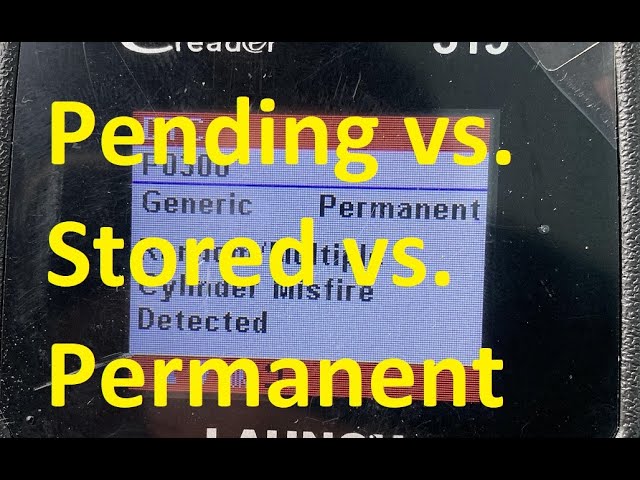
Image source: www.youtube.com
A scanner display can hold pending codes even when the dashboard light is off.
The Role of Drive Cycles
A single drive cycle usually includes a cold start, city driving, highway driving, and deceleration. The ECU needs live sensor data from real driving conditions to finish its tests. That is why a shop might ask you to drive the car for a week, to get a warm engine, a cold start, and varied speeds so the monitors can complete.
If you only drive short trips, monitors may never finish. That means a pending code can stay pending for a long time simply because the system has not had enough chances to re-test it.
Pending vs. Confirmed vs. Permanent Codes
Many drivers only learn about pending and confirmed codes, but modern cars also store permanent codes. Here is how all three compare.
| Code type | When it appears | Check engine light | How it clears |
|---|---|---|---|
| Pending | After one failed monitor test | Usually off | Clears automatically after the system sees the same test pass, or becomes confirmed if it fails again |
| Confirmed | After repeated failures on separate drive cycles | On | Cleared with a scanner after repair, or may auto-erase after many consecutive passes |
| Permanent | On many newer vehicles after a confirmed emissions fault | On until repaired | Cannot be cleared with a scanner; only clears when the ECU verifies the repair is complete |
That last point matters. If you clear a confirmed code and the check engine light goes out, the car may still have a permanent code stored in the background. This is one reason clearing codes before an emissions test is a bad idea.
Why Do Pending Codes Appear?
Pending codes can appear for reasons ranging from harmless to serious.
- Loose fuel cap — A small EVAP leak can set a pending code immediately.
- Weak battery — Low voltage can cause sensors to send odd readings.
- Dirty mass airflow sensor — This often logs lean mixture codes like P0171.
- Intermittent wiring issue — A loose connector can trigger a code that never comes back.
- Old spark plugs or ignition coils — These often start as pending misfire codes.
- Recent repairs or ECU reset — The computer is relearning fuel trims, and a marginal part may get exposed.
- Bad fuel or extreme weather — Poor fuel quality can temporarily push the fuel system out of its expected range.
In practice, a pending code is a breadcrumb, not a repair order. You should not ignore it, but you should not start replacing parts either.
Common Pending Codes and What They Mean
Some codes appear more often than others. Recognizing them helps you know whether to wait, inspect, or act quickly.
| Code | What it means | Common underlying causes |
|---|---|---|
| P0171 | System too lean (Bank 1) | Vacuum leak, dirty MAF sensor, low fuel pressure |
| P0300 | Random or multiple cylinder misfire | Worn plugs, failing coils, vacuum leak, compression problem |
| P0301–P0304 | Specific cylinder misfire | Faulty plug, bad coil, injector issue, mechanical problem in that cylinder |
| P0420 | Catalyst system efficiency below threshold | Weak catalytic converter, oxygen sensor lag, exhaust leak |
| P0442 | Small EVAP system leak | Loose gas cap, cracked fuel filler neck, leaking vent valve |
| P0455 | Large EVAP system leak | Loose or missing gas cap, broken EVAP hose |
These faults often begin as pending codes. If they keep happening, the ECU turns them into confirmed codes and lights the dashboard.
How to Read Pending Codes on Any OBD2 Scanner
Not every scanner can read pending codes. Generic code readers that only show confirmed DTCs use OBD2 Mode 03. Pending codes live in Mode 07. Many affordable scan tools and phone apps support Mode 07 even when basic code readers do not.
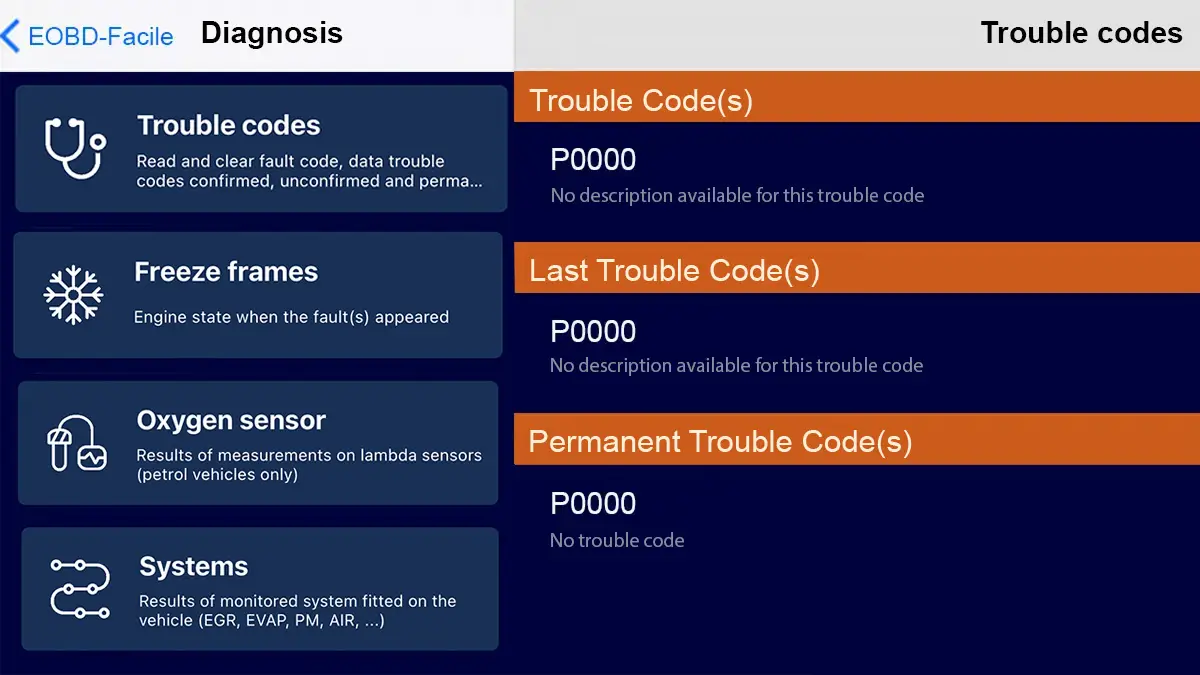
Image source: www.klavkarr.com
On many scanners, pending and confirmed codes are listed separately.
Scanner Types Compared
| Scanner type | Shows pending codes? | Useful extras | Typical price range |
|---|---|---|---|
| Basic code reader | No | Reads confirmed codes | $20–$60 |
| Bluetooth OBD2 adapter + app | Usually yes | Live data, pending codes, readiness monitors | $15–$70 |
| Professional scan tool | Yes | Permanent codes, bi-directional tests, manufacturer-specific data | $100–$1,000+ |
If you only want to know why the check engine light is on, a basic reader is enough. If you want early warnings, you need a scanner that can display pending codes.
Step-by-Step: How to Check for Pending Codes
- Locate the OBD2 connector under the dashboard, usually near the steering column.
- Turn the ignition to the ON position with the engine off.
- Connect the scanner or pair your Bluetooth adapter.
- Open the diagnostic menu and select Diagnostic Trouble Codes or Read Codes.
- Look for a separate tab or section labeled Pending Codes.
- Record the code exactly as shown.
- If your scanner offers freeze frame data, write it down—it shows engine RPM, coolant temperature, and load at the moment the code was recorded.
Do not clear the codes yet. A pending code is valuable diagnostic evidence.
What Should You Do When You See a Pending Code?
Here is a practical response that works for most drivers:
1. Don’t panic
Pending codes are common. Many never turn into confirmed codes.
2. Note the exact code and when it appeared
Write down the code, the date, and whether you were on a cold start, highway, or stop-and-go traffic.
3. Check the simple stuff first
Make sure the fuel cap is tight. Check the battery terminals for corrosion. Inspect air intake hoses for obvious cracks.
4. Drive normally through a full drive cycle
That means varied speeds, a cold start, and at least 10 to 15 minutes of driving. If the problem was a one-time glitch, the pending code may disappear.
5. Rescan
If the pending code is gone and the car drives fine, you are probably done. If the same code returns or becomes confirmed, it is time to dig deeper.
6. Investigate before replacing parts
A pending P0420 does not automatically mean the catalytic converter is dead. It can also be caused by an oxygen sensor or an exhaust leak. A mechanic will check live data, fuel trims, and sensor waveforms before recommending a part.
Practical Example
Imagine your scanner shows P0171 pending. Instead of buying a new MAF sensor, start by inspecting the intake boot and vacuum lines. A cracked rubber hose can cause a lean condition. If the code returns after your next drive cycle, move to cleaning the MAF sensor and checking fuel trim values with live data.
When Should You Worry About a Pending Code?
Most pending codes are harmless, but some deserve immediate attention.
- The same pending code keeps returning after being cleared or after several drive cycles.
- The car runs rough, idles badly, hesitates, or stalls.
- Fuel economy suddenly drops.
- The check engine light starts flashing, especially on a misfire code.
- You have an upcoming emissions inspection.
- The pending code relates to a misfire that could damage the catalytic converter.
A flashing check engine light is different from a pending code. If the light flashes, the engine is actively misfiring and sending unburned fuel into the exhaust system. Stop driving and have the car checked.
Clearing Pending Codes: Useful or a Mistake?
You can clear pending codes with most advanced scanners. But just because you can does not mean you should.
Clearing codes does not fix the underlying fault. If the problem is real, the code will come back. Worse, clearing codes also resets the OBD2 readiness monitors. If you take the car for an emissions test right after clearing, the computer may show “Not Ready,” which can cause an automatic failure.
| Action | What happens | Best use |
|---|---|---|
| Clear codes with scanner | Removes pending and confirmed codes from view | After the actual repair is complete |
| Drive a full drive cycle | Gives monitors a chance to re-test | Before deciding whether the code is real |
| Fix the fault, then clear | Keeps the code from returning | The only approach that actually solves the problem |
If you see a pending code, treat it as information. Diagnose the likely causes first, then decide whether clearing is appropriate.
Pending Codes and Emissions Tests
OBD2 became standard because the EPA required emissions-related monitoring on modern vehicles. If you live in a state with OBD-based testing, the inspection computer will check for confirmed codes and monitor readiness. In some states, even pending codes can be flagged, so it is worth checking your local rules before the test.
The EPA’s OBD program explains which vehicles and monitors are covered and why this system exists.
If your car shows a pending code but the check engine light is off, you may still want to address it before an inspection. A pending EVAP leak code, for example, can lead to a confirmed code and a failed test a few weeks later.
Using Pending Codes When Buying a Used Car
A pending code is one of the best hidden-information tricks for a used car inspection.
Sellers can clear confirmed codes with a cheap scanner, which also turns off the check engine light. But pending codes are often stored separately. A quick scan can reveal recent faults that the seller tried to hide.
Here is what to do:
- Bring a Bluetooth OBD2 adapter and phone app.
- Scan the car before you take it on a test drive.
- Look in the Pending Codes tab, not just the confirmed codes section.
- Check the freeze frame data if available.
If a car has a pending P0420, that could mean the catalytic converter is close to failure—a potentially costly repair. If it has a pending misfire code, you will want to check the plugs, coils, and compression more carefully.
For a family vehicle, a clean diagnostic scan is only part of the full picture. Make sure every child passenger has a correctly sized restraint. A proper installation guide is worth reviewing before you drive off the lot, especially if you are new to fitting seats.
Making Pending Codes Part of a Smarter Car-Care Routine
Most drivers only think about OBD2 when the check engine light comes on. But pending codes are most useful when you check them regularly.
- Scan once a month or at every oil change.
- Keep a simple log of pending codes and whether they return.
- Review the codes before a long road trip, especially in very hot or very cold weather.
- Check a rental car before driving it with family. A pending code in a rental can reveal a car that has not been maintained properly, and it is worth knowing what the rental company provides if you are travelling with children.
- Use the early warning to fix small things, such as a dirty air filter or loose hose, before they become bigger problems.
A car with a clean pending-code history is also easier to keep reliable.
Non-Obvious Facts About Pending Codes
There are a few things experienced technicians know that most drivers do not.
Pending codes help catch intermittent electrical faults
A loose connector, corroded wire, or failing sensor may only act up once every few hundred miles. These faults are almost impossible to find once they stop happening. A pending code gives you a starting point.
Some pending codes are never confirmed
If a sensor gives one strange reading on a humid morning and then works perfectly for weeks, the computer may simply erase the pending code. Not every pending code needs a repair.
Pending codes only cover certain systems
Generic OBD2 pending codes focus on engine, transmission, and emissions systems. ABS, airbag, and body control module faults are usually stored in separate manufacturer-specific systems. A pending code display will not tell you everything about the car.
A “Not Ready” status is not the same as a pending code
After a battery disconnect or code clear, the ECU may show that some monitors have not run yet. That is not a pending fault. It just means the computer needs more driving time before it can evaluate the systems.
Common Mistakes to Avoid

Image source: www.reddit.com
Scanner screens show extra letters and symbols that can confuse novice users.
Avoid these common pitfalls:
- Treating pending codes like confirmed codes. Do not replace major parts based on a single pending code.
- Ignoring a code that keeps coming back. Repetition is the computer telling you the problem is real.
- Clearing codes before diagnosing them. You lose valuable freeze frame data.
- Trusting a $20 scanner for advanced jobs. A basic reader cannot show pending codes, live data, or readiness status.
- Replacing the catalytic converter for every P0420. Check for exhaust leaks and oxygen sensor problems first.
- Forgetting to rescan after a repair. Always confirm the code is gone and the monitors are ready before returning to normal driving.
Frequently Asked Questions
What is the difference between pending and confirmed codes?
A pending code appears after one failed OBD2 monitor test. It does not turn on the check engine light. A confirmed code appears after the fault is detected on additional drive cycles, and it does turn on the light.
Can I still drive with a pending code?
In most cases, yes. Pending codes are typically temporary. If the car is driving normally and the code does not repeat, you can continue driving. If the code repeats or the car runs poorly, have it checked.
Will a pending code cause my car to fail an emissions test?
That depends on where you live. Some OBD-based inspection programs flag pending codes, while others only look for confirmed codes and readiness monitors. Check your local testing rules before going in.
How do I clear a pending code?
Most advanced scanners have a Clear Codes or Erase Codes function that will remove pending codes. However, clearing a code without fixing the cause will not solve the problem. On many newer vehicles, a permanent code will remain until the computer verifies the repair.
Are pending codes always serious?
No. A pending code can be triggered by a weak battery, bad fuel, a loose gas cap, or a one-time sensor glitch. Many clear themselves. But if the same pending code keeps coming back, it usually points to a real fault that needs attention.
Conclusion
A pending code is not a verdict. It is an early signal from your car’s computer that a fault was noticed but not yet confirmed. Treat it as useful information: check the simple causes, drive a full cycle, rescan, and only start replacing parts when the code shows a clear pattern.
The worst thing you can do is ignore a repeating pending code. The second worst is clearing it without understanding what caused it. The smartest move is to make a quick scan part of your regular maintenance routine.
Next time you plug in your scanner, check the pending code screen first. It gives you a window into small problems before they become big repair bills. For more plain-English car troubleshooting and maintenance guidance, explore our maintenance and buying guides so you can keep your vehicle running dependably for years.

Leave a Reply