
A dead car battery usually means jumper cables, another vehicle, or a long wait. When none of those are available, a fully charged 12V drill battery can sometimes get a small car started. It is not a true jump starter, but it works in a narrow set of circumstances.
This guide explains exactly when the trick works, when it won’t, and how to do it without damaging your car, your drill battery, or yourself.
What This Trick Can and Cannot Do
A drill battery can act as a temporary booster for a weak 12V car battery. It cannot single-handedly crank an engine.
The starter motor in a typical four-cylinder car can pull 150–250 amps. A 12V drill battery usually delivers only 20–40 amps before its internal protection circuit limits the output. That means the car’s original battery still has to provide most of the cranking current.
In practice, this method works best when:
- The car has a small four-cylinder engine.
- The car battery is partially drained but not completely dead.
- The drill battery is a true 12V (or 12V Max) battery rated at 2Ah or higher.
- The battery is fully charged and in good condition.
It will usually fail on trucks, SUVs, V6 engines, diesel engines, or any car with a completely dead battery. For a broader set of roadside fixes, browse the owner-maintenance library, but keep your expectations realistic for this specific trick.
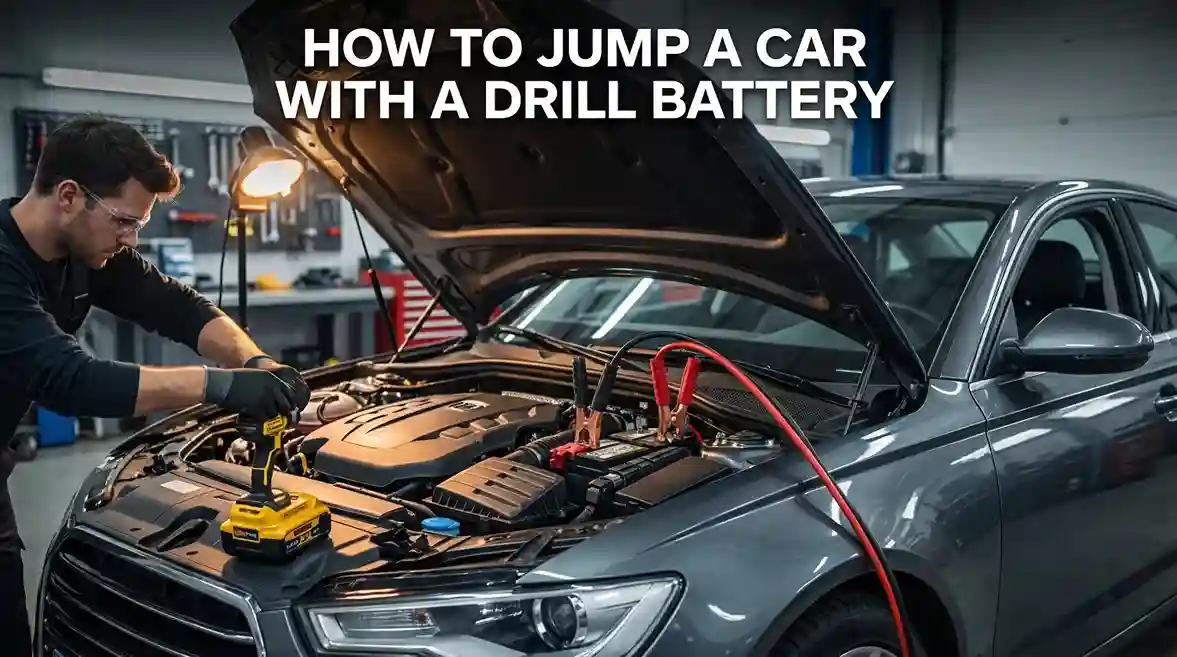
A drill battery can assist a weak car battery—it is not a full-power jump starter.
The Technical Reality: Drill Batteries vs. Car Batteries
The reason a drill battery sometimes works has to do with the difference between voltage, capacity, and cranking current.
| Feature | Car Battery | Drill Battery |
|---|---|---|
| Nominal voltage | 12.6V when fully charged | 10.8–12.6V depending on charge |
| Capacity | 40–70 Ah | 1.5–5 Ah |
| Cranking current | 300–800A | 20–40A typical |
| Built for | Short, high-current bursts | Steady, lower-current tool use |
| Recharge time | Several hours | 1–2 hours |
| Overload protection | Usually none | Built-in BMS circuit |
A car battery is designed to release a large amount of current in a few seconds. A drill battery is designed to run a motor steadily at lower current. Even a 5Ah drill battery holds far less energy than a car battery and cannot match the discharge rate.
The cranking amp numbers you see on a battery are measured under standards maintained by SAE International. Those standards exist because starting an engine is not about raw voltage—it is about delivering enough current quickly enough.
Tools You Need
Gather everything before you start. Rummaging for parts while cables are live is a good way to make a mistake.
- 12V or 12V Max drill battery, fully charged
- Battery connector adapter that fits the drill battery
- Heavy gauge wire leads, preferably 12 AWG or thicker
- Heavy-duty alligator clips
- Electrical tape or heat-shrink tubing
- Safety glasses
- Insulated gloves
- Multimeter (optional but strongly recommended)
- Owner’s manual for the car
Ready-Made Adapter vs. DIY Adapter
You can buy a pre-made drill battery-to-cable adapter online. These usually plug into the battery dock and have short leads with alligator clips. They are safer than a homemade setup because the connections are properly insulated.
Building your own adapter is possible, but only if you have experience soldering and know how to use heat-shrink tubing. A loose connection in a high-current circuit can melt, spark, or weld itself shut. If you are not confident in your wiring skills, do not attempt it.
Step-by-Step Guide: Jump a Car With a Drill Battery
Follow these steps in order. If anything feels hot, smells like burning, or sparks excessively, stop immediately.
1. Fully Charge the Drill Battery
Check the charge indicator on the battery. If it shows anything less than full, wait. A partially charged drill battery does not have enough voltage or current to help.
Also inspect the battery case. If it is cracked, swollen, leaking, or unusually hot, do not use it.
2. Check the Car Battery Condition
A drill battery can only help if the car battery still has some usable charge. If you have a multimeter, check the resting voltage at the car battery terminals:
- Around 12.4V or higher: the battery may be slightly discharged but still strong enough for the trick to help.
- Around 11.5–12.3V: the battery is weak; a drill battery can sometimes provide enough boost.
- Below 11.5V or 0V: the battery is deeply discharged. A drill battery will almost certainly fail.
If the car battery is completely dead, skip this method and use a real jump starter, jumper cables, or roadside assistance.
3. Connect the Adapter to the Drill Battery
Plug the adapter into the drill battery dock. Make sure it clicks or seats firmly. Wiggle it gently to confirm the connection is stable.
If you are using a homemade adapter, double-check that exposed wire is insulated and that the positive and negative leads cannot touch each other.
4. Connect the Positive Lead
Open the hood and locate the car battery. If your car has a remote positive terminal under a plastic cover, use that if the manual recommends it.
Attach the red alligator clip to the positive battery terminal. The positive terminal is usually marked with a red cover, a “+” symbol, or a red cable.
5. Connect the Negative Lead to the Chassis
Do not attach the black clip directly to the negative terminal of the car battery. Instead, attach it to an unpainted metal part of the engine block or chassis, at least 12 inches away from the battery.
This reduces the chance of sparks near the battery, which can ignite hydrogen gas produced by a charging lead-acid battery.
6. Do a Safety Check
Make sure:
- No wires are touching moving engine parts.
- No tools or metal objects are bridging the battery terminals.
- The alligator clips are clamped firmly onto clean metal.
- The drill battery is stable and not lying on the engine block.
7. Attempt to Start the Car
Start the car with the key or start button. Crank the engine for no more than five seconds at a time. Wait 30–60 seconds between attempts.
If the engine turns over, let it run for a few seconds, then disconnect the drill battery right away. The car’s alternator puts out about 13.8–14.4V, which is too high for a drill battery and can damage it.
If the engine only clicks or cranks very slowly, stop after a few attempts. The drill battery is not strong enough.
8. Disconnect Safely
Once the engine is running, disconnect in the reverse order:
- Remove the black clip from the chassis.
- Remove the red clip from the car battery terminal.
- Remove the adapter from the drill battery.
Keep the clips from touching each other during disconnection.
Safety First: What to Watch For
Using a drill battery in an automotive setting carries real risks. Lithium-ion batteries store a lot of energy in a small space. They can overheat, catch fire, or fail violently if mistreated.
- Use only a 12V drill battery. Do not use 18V, 20V Max, 36V, or 40V batteries. Higher voltage can damage car electronics instantly.
- Wear safety glasses and insulated gloves.
- Work in a dry area. Avoid standing on wet ground.
- Keep flammable materials away from the engine bay.
- Do not short the clips together. A short can produce sparks, burns, or a battery fire.
- Stop if you smell burning, see smoke, or feel unusual heat.
Good battery-handling habits matter here. The safety guidance from the National Fire Protection Association is a solid reference for understanding lithium-ion battery risks.
Common Mistakes and How to Avoid Them
Many failed attempts come down to small but avoidable errors.
| Mistake | Why It Fails | What to Do Instead |
|---|---|---|
| Using a dead or weak drill battery | Not enough voltage or current | Fully charge and check the indicator |
| Using an 18V or 20V battery | Voltage too high for the car | Use only a 12V battery |
| Thin, damaged wires | Overheat or melt under load | Use 12 AWG or thicker wire |
| Loose alligator clips | Poor current flow, sparking | Clamp onto clean, bare metal |
| Connecting black to the battery negative | Sparks near battery gas | Use a chassis ground instead |
| Cranking repeatedly without stopping | Overheats battery and wires | Limit to 5-second crank attempts |
| Leaving the drill battery connected after starting | Alternator can overcharge it | Disconnect within seconds |

Credit: www.youtube.com
Check every clamp before you crank; loose contacts are the most common cause of failure.
Troubleshooting: When It Won’t Work
If the car does not start, diagnose rather than cranking harder.
| Symptom | Likely Cause | Next Step |
|---|---|---|
| Single click, no crank | Weak current or low car battery | Recheck connections; try a real jump starter |
| Engine cranks slowly | Connections are loose or battery is too weak | Clean clamps, tighten, try once more |
| Drill battery stops after a few seconds | Overload protection kicked in | Wait 60 seconds for the BMS to reset |
| Wires feel warm or hot | Too much current or bad connection | Stop immediately and disconnect |
| Dashboard lights flicker or dim | Voltage is too low | Disconnect; use a proper jump starter |
The most common failure point is not the drill battery. It is the connection between the clips and the car. Make sure the clamps are biting into clean metal, not paint, grease, or corrosion.
Better Alternatives for a Real Emergency
A drill battery is a last-resort trick. The following options are safer, more reliable, or both.
| Method | Best For | Safety | Cost | Difficulty |
|---|---|---|---|---|
| Jumper cables | When another car is available | High | Low | Easy |
| Portable jump starter | Independent, any vehicle size | High | Medium | Easy |
| Drill battery | Small cars, mild battery drain only | Moderate | Low | Moderate |
| Push start | Manual transmission cars | Moderate | Free | Difficult |
| Roadside assistance | Any situation, no tools | High | Membership fee | Easy |
For most drivers, a compact lithium jump starter is a better investment than a custom drill battery adapter. It is purpose-built, safer, and will start a larger engine more reliably.

Credit: www.reddit.com
A home-made drill battery rig is a last-resort setup, not a permanent replacement for a jump starter.
Choosing the Right Drill Battery for This Job
If you still want to try this method, not every drill battery will do.
| Battery Type | Nominal Voltage | Full Charge Voltage | Suitable? |
|---|---|---|---|
| 12V Max (10.8V nominal) | 10.8V | 12.6V | Yes, the only safe option |
| 18V / 20V Max | 18V | 20V–21V | No, risk of electrical damage |
| 36V / 40V Max | 36V | 42V | No, serious damage risk |
Capacity also matters. Look for a 12V battery with at least 2Ah, preferably 3Ah or 5Ah. Higher amp-hour ratings store more energy and can deliver current longer before tripping the protection circuit.
Avoid old or heavily used batteries. A battery that no longer holds a full charge in a drill will not be helpful under the higher current demand of a car starter.
Non-Obvious Things Most Guides Miss
There are several details that separate a successful drill-battery start from a frustrating one.
The Protection Circuit Will Shut Down
Most lithium-ion drill batteries have a built-in battery management system that shuts off power when it detects too much current. This is normal. If the battery cuts out after one crank attempt, it is protecting itself. Wait 30–60 seconds before trying again.
A Dead Car Battery Drains the Drill Battery Fast
A deeply discharged lead-acid battery acts like a huge load. It will pull current from the drill battery the moment they are connected, before you even turn the key. That is why the car battery must have some charge left for this trick to work.
Newer Cars Are More Sensitive
Modern cars with electronic throttle control, sensors, and computer modules can behave oddly at low voltage. You may see dashboard warnings, chattering relays, or flickering lights. If that happens, disconnect immediately. This trick works best on simpler, older vehicles.
The Drill Battery Can Be Overcharged by the Alternator
Once the engine starts, the alternator raises system voltage to charge the car battery. That voltage is too high for a drill battery. Leaving the drill battery connected for even a minute can stress the cells, shorten its lifespan, or even trigger a thermal problem.
Disconnect before you rev the engine or drive away.
Before You Drive Off: A 60-Second Post-Jump Checklist
Getting the engine running is only half the job. Before you drive, do a fast safety sweep.
- Make sure the hood is fully closed and secure.
- Check that no cables or adapters were left in the engine bay.
- Look underneath the car for anything that may have fallen.
- Clear loose floor mats away from the pedals.
- Use a high-suction car vacuum to remove debris that may have slid under the seats.
- If the carpet has years of buildup, set aside time for deep-cleaning under seats.
If you are driving with children, take a moment to confirm they are secure. Double-check the child-seat harness fit before pulling out of the parking spot. Once they reach booster age, review the booster-age guidelines so the seat matches their height and weight.
Frequently Asked Questions
Can I use any drill battery to jump start a car?
No. Only a fully charged 12V or 12V Max battery with at least 2Ah capacity is worth attempting. Higher voltage batteries can damage the car’s electrical system.
Is it safe to jump a car with a drill battery?
It can be done safely in a narrow situation, but it is less predictable than a proper jump starter. Follow every connection step, wear safety gear, and stop if you see sparks, smoke, or heat.
Will jump starting my car with a drill battery hurt the drill battery?
Occasional use may not destroy it, but frequent attempts will stress the cells and the protection circuit. Treat this only as an emergency workaround, not a routine habit.
Why won’t a drill battery work on a truck or SUV?
Trucks and SUVs need far more cranking current. A drill battery simply cannot deliver the hundreds of amps a larger engine requires.
What should I do if the car still does not start?
Stop after three or four attempts. Use a portable jump starter, find another car with jumper cables, or call for roadside help. Do not keep cranking until components overheat.
Conclusion
Jump starting a car with a drill battery is a clever emergency trick, but it has strict limits. It only works on smaller vehicles with a partially charged battery, and it can never replace a real jump starter.
The safest way to handle a future dead battery is preparation. Keep a compact lithium jump starter in your vehicle and make sure your drill battery is charged before you head out. Take one concrete step today: pick the jump starter or jumper cables you will keep in the car, and put them in place before you need them.

Leave a Reply