
“FFA approved car seat” sounds reassuring, but it is not a real certification. In most cases, “FFA” is a typo for “FAA,” the Federal Aviation Administration. FAA approval relates to using a car seat on an airplane. For driving, the key standard is FMVSS 213, the federal safety standard enforced by NHTSA.
This guide explains the difference between FAA approval and FMVSS 213, how to read each label, and when each standard matters. You’ll also learn what to look for when choosing a car seat for everyday driving, road trips, and flights.
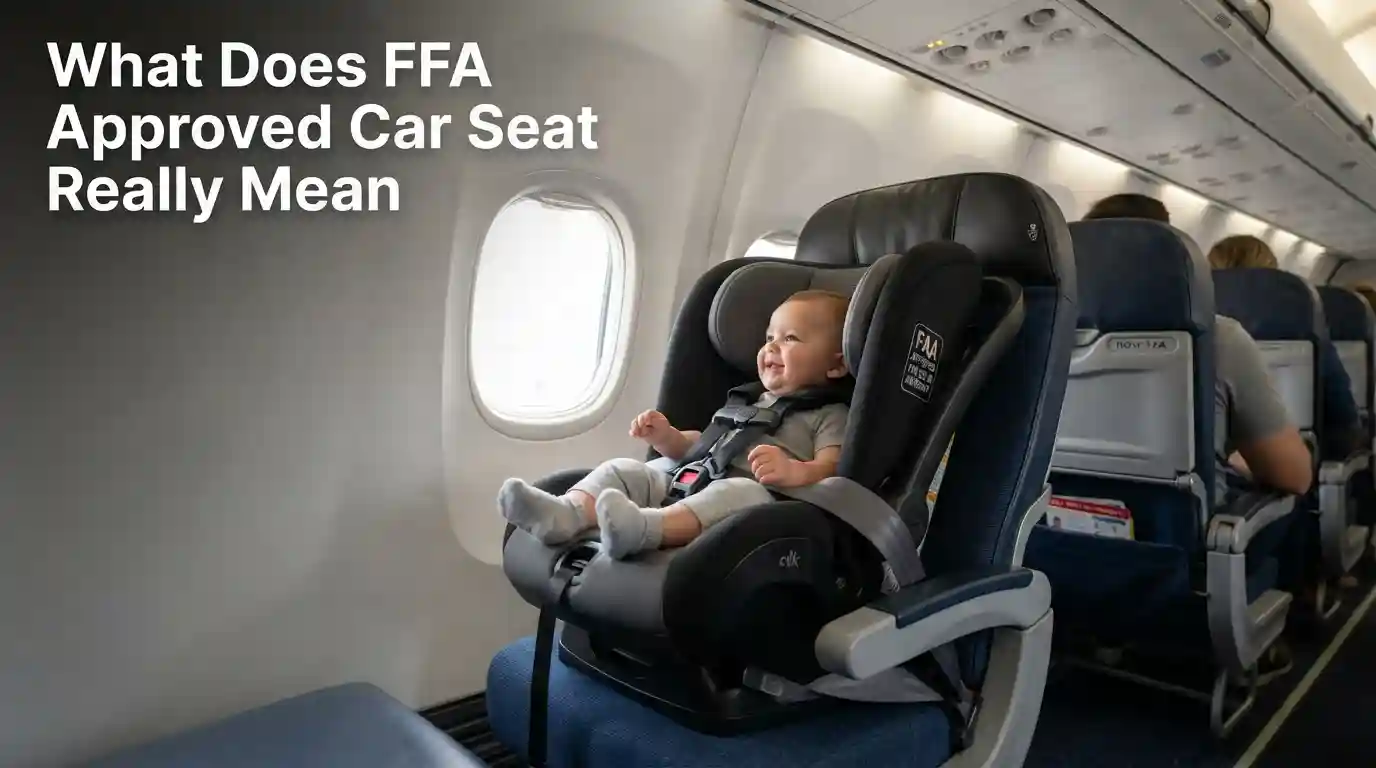
Quick Answer: FFA Is a Typo — FAA Covers Flying, FMVSS 213 Covers Driving
There is no official “FFA approval” in child passenger safety. What people usually mean is FAA approval. An FAA-approved car seat can be buckled into an aircraft seat using the airplane’s lap belt. A car seat for road use must meet FMVSS 213. Understanding the difference between these two standards is the difference between a seat that protects your child in a crash and one that gets turned away at the gate.
Core Explanation: FAA vs. FMVSS 213
The confusion around “FFA approved” comes from mixing up two different safety requirements. FMVSS 213 covers child restraint safety in motor vehicles, while FAA approval relates to using a car seat on an aircraft. A car seat may meet the requirements for driving, flying, or both. Understanding these labels helps you choose the right seat for your child and use it safely in each situation.
What FAA Approval Actually Means
The FAA sticker is usually red or orange and states the restraint is certified for aircraft use.
The Federal Aviation Administration sets safety guidelines for air travel. When a car seat is FAA approved, it means the manufacturer has voluntarily tested the seat to meet the FAA’s criteria for use on an aircraft seat. The seat must fit within the dimensions of an airplane seat, secure properly with the aircraft’s lap belt, and restrain a child during the unique forces of flight.
This approval is purely for aviation. Without it, most airlines will not let you use the seat on board. They will require you to check it as baggage instead.
What FMVSS 213 Compliance Means

Image source: Pexels / Yavuz Eren Güngör (Pexels License)
Federal Motor Vehicle Safety Standard 213 (FMVSS 213) is the federal standard that governs the design, performance, and labeling of child restraint systems used in motor vehicles. The National Highway Traffic Safety Administration (NHTSA) enforces this standard. Car seats sold legally in the United States must comply with applicable FMVSS 213 requirements.
The standard covers important areas such as crash protection, structural integrity, harness performance, and labeling. Look for the compliance statement on the car seat to confirm that it meets applicable Federal Motor Vehicle Safety Standards. For everyday driving, FMVSS 213 is the key standard to understand.
Why the Distinction Matters for Safety
Using a car seat in an environment it was not designed or approved for can put your child at risk. A seat intended for aircraft use may not meet the requirements for protecting a child in a motor vehicle crash. Likewise, a seat designed for cars may be too wide for an aircraft seat or may not secure properly with the airplane’s lap belt.
The forces involved in a car crash and those experienced during flight are different. That is why each standard addresses the specific environment where the restraint will be used. Choosing the right approval for the right situation helps ensure the car seat is suitable for both driving and flying.
For Your Car: FMVSS 213 Is the Only Standard That Matters
When you are driving your child to school, daycare, or the grocery store, FMVSS 213 compliance is the key federal standard for child restraints used in motor vehicles.This is the regulation that ensures your child’s seat has been crash-tested to protect them in a motor vehicle collision.
How to Check for FMVSS 213 Compliance
Look for the official compliance label on the car seat itself. It is usually found on the side, back, or bottom of the seat, and sometimes on the tether strap. The label should state that the child restraint system conforms to all applicable Federal Motor Vehicle Safety Standards.
This label helps confirm that the seat meets the applicable federal safety requirements for motor vehicle use. If you are buying a new seat, make sure the compliance label is present and legible. If you are buying a used seat, a missing or damaged label is a red flag because you may not be able to verify the seat’s compliance.
Once you confirm the label, the next step is proper installation. A correctly installed seat is just as important as choosing a compliant one. If you are unsure about the process, read our guide on how to install a car seat correctly for step-by-step guidance.
What About Convertible Seats?
Convertible car seats are a popular choice because they grow with your child, transitioning from rear-facing to forward-facing. These seats must meet FMVSS 213 just like any other seat sold in the U.S. The approval label will be present regardless of the seat’s configuration. If you are comparing options, understanding how convertible car seats work can help you make an informed choice.
For Airplanes: FAA Approval Is the Key
Image source: Openverse / NTSBgov (PDM 1.0)
If you are flying with your child, FAA approval is important if you want to use a car seat on the aircraft. An FAA-approved restraint can be secured to an aircraft seat using the airplane’s lap belt and is intended for use during air travel.
Not all car seats are FAA approved. Some seats that meet FMVSS 213 may be too wide for an aircraft seat or may not work properly with the airplane’s belt system. The FAA approval label helps you identify a restraint that is designed and approved for aircraft use.
How to Find the FAA Approval Label
The FAA approval sticker is typically red or orange and is easy to spot. It will state something like “THIS RESTRAINT IS CERTIFIED FOR USE IN MOTOR VEHICLES AND AIRCRAFT.” You will usually find it on the side or back of the car seat’s shell, or sometimes on the harness.
This label is distinct from the FMVSS 213 certification, which is specific to automotive safety. If you see both labels, the seat is dual-certified and can be used in both cars and airplanes.
Is an FAA-Approved Seat Safe for the Car?
Yes. If a car seat is FAA approved, it also meets FMVSS 213 standards for vehicle use. The FAA’s requirements are compatible with the more comprehensive safety testing conducted for automotive use. Manufacturers design these seats to perform dual roles.
An FAA-approved seat is safe for car use, provided you follow the seat’s specific installation instructions for your vehicle. This dual certification offers flexibility for families who travel frequently by both car and plane.
What If My Car Seat Isn’t FAA Approved?
If your car seat does not have the FAA approval sticker, it is designed and tested only for motor vehicle use. It is not permitted as a restraint on an aircraft seat. In this case, the airline will likely require you to check the car seat as baggage.
You have two options: check the seat and use the airline’s child restraint system, or purchase a separate seat for your child and use a different FAA-approved restraint. Relying on a non-approved seat on a plane is a safety risk because it has not been tested to meet aviation standards.
Airline Policies on Car Seats
Airlines have specific rules regarding car seats. Generally, if your seat is FAA approved, you can bring it onboard and secure it to an empty passenger seat. If the restraint is not approved for use on an aircraft, you generally cannot use it as a child restraint in an aircraft seat. Check the airline’s current policy before traveling.
Some airlines allow lap-held infants, but using a car seat is significantly safer, especially for infants and toddlers. Always check the specific airline’s policy before your flight, as rules can vary. If you are renting a car at your destination, you should also understand how rental car seats work so you are not caught off guard.
How Long Can My Child Use a Car Seat?
The approval labels matter, but so does the age and size of your child. Car seats are not one-size-fits-all, and using a seat past its limits is a safety risk.
Rear-Facing vs. Forward-Facing
Infants and toddlers should remain rear-facing as long as possible, up to the maximum height and weight limits of their seat. This is the safest position because it distributes crash forces across the entire back. Once your child outgrows the rear-facing limits, they can transition to forward-facing with a harness.
Booster Seats and Seat Belts
Eventually, your child will outgrow their forward-facing car seat and move to a booster seat, then to a regular seat belt. The transition points depend on your child’s height, weight, and the specific seat’s limits. Knowing when kids can stop using car seats helps you avoid transitioning too early.
What to Look For in a Car Seat
When shopping for a car seat in 2026, the approval labels are non-negotiable. Beyond that, here is what actually matters:
For Everyday Driving
- FMVSS 213 label present and legible — this is the baseline.
- Rear-facing capability — choose a seat that allows extended rear-facing.
- Easy installation — look for LATCH compatibility and clear instructions.
- Harness adjustability — a seat that grows with your child saves money long-term.
For Frequent Flyers
- FAA approval sticker — look for this approval if you plan to use the seat on a plane.
- Lightweight design — you will be carrying it through the airport.
- Narrow width — it must fit within the airplane seat dimensions.
- Dual certification — FAA and FMVSS 213 both present.
What to Avoid
- Used seats with unknown history — if you do not know the seat’s crash history, do not buy it.
- Missing labels — a seat without its approval labels is a safety risk.
- Expired seats — most seats have a 6-10 year lifespan from the date of manufacture.
- Aftermarket accessories — pads, covers, and toys not approved by the manufacturer can interfere with the harness. If you are considering seat covers, check whether car seat covers are safe for babies before adding one.
Frequently Asked Questions
Is “FFA approved” a real certification?
No. “FFA” is almost always a typo for “FAA” — the Federal Aviation Administration. There is no official FFA approval in child passenger safety. If you see “FFA approved” on a product listing, it is either a typo or a marketing error.
Can I use an FAA-approved car seat in my car?
Yes. An FAA-approved car seat also meets FMVSS 213 standards for motor vehicle use. The FAA’s requirements are compatible with automotive safety testing. You can use the same seat for both driving and flying.
What does the FAA approval sticker look like?
The FAA approval sticker is typically red or orange and states that the restraint is certified for use in motor vehicles and aircraft. It is usually found on the side or back of the car seat shell, or on the harness.
Do all car seats meet FMVSS 213?
Every car seat sold legally in the United States must meet FMVSS 213. This is a federal requirement enforced by NHTSA. If a seat does not meet this standard, it cannot be legally sold in the U.S.
What happens if my car seat isn’t FAA approved?
If your car seat is not FAA approved, you cannot use it on an airplane. The airline will require you to check it as baggage. You can either use the airline’s child restraint system or purchase a separate seat for your child with an FAA-approved restraint.
How long is a car seat safe to use?
Most car seats have a lifespan of 6-10 years from the date of manufacture. The exact expiration date is printed on the seat. After this date, the materials may degrade and the seat may not perform as tested. Always check the expiration date before using a seat.
Conclusion
“FFA approved” is not a real certification — it is a typo for FAA approval, which covers airplane use. For driving, the standard that matters is FMVSS 213, enforced by NHTSA. Understanding the difference between these two labels ensures your child is protected in both environments.
Your next step is simple: check the labels on your current car seat. Look for the FMVSS 213 compliance statement for driving and the FAA approval sticker for flying. If a required label is missing or unreadable, verify the seat’s compliance with the manufacturer before using it. If you are shopping for a new seat, prioritize dual certification so you are covered for both road trips and flights.

Leave a Reply