
Buying a cover for a new car seat feels like responsible parenting. It protects the upholstery, catches spills, keeps a newborn snug through winter, and makes a borrowed seat feel like your own. Then someone mentions airbags, and the question changes entirely: does adding a layer over — or under — the seat put your child at risk?
The honest answer is that almost all aftermarket covers are not safe with airbags. Not because covers are inherently dangerous objects, but because an airbag is a single-use, precisely engineered device that inflates in a fraction of a second along a path calibrated in crash testing. When you add an untested layer between that deployment and your child, you are modifying a certified system without any test data behind the change. You can also read our guide on what does obd2 scanner do.
This 2026 guide walks through the three products people usually mean by "car seat cover," how each one interacts with airbag deployment, how to spot a risky product before you pay for it, and what safe alternatives exist for heat, cold, and mess. By the end, you'll be able to make a defensible yes-or-no decision using two documents you already own: your car seat manual and your vehicle manual.
Quick Answer: Are Car Seat Covers Safe With Airbags?
Most aftermarket car seat covers are not safe with airbags unless the car seat manufacturer — or, for vehicle seat covers, the vehicle manufacturer — explicitly approves the exact product for your exact model. If the cover did not come with the seat and is not listed in the owner's manual, treat it as unsafe inside a moving vehicle. You can also read our guide on are car seat covers universal.
That sounds strict, but it maps cleanly onto the three products sold under the name "car seat cover":
| Product | Where it sits | Primary risk | Usable without approval? |
|---|---|---|---|
| Child restraint cover | Over the child's car seat | Harness slack, loose fabric near the child | No |
| Vehicle seat cover | Over the car's own seat | Blocks seat-mounted airbags, confuses occupant sensors | No |
| Seat protector | Under the car seat base | Base shifting or reduced stability in a crash | Only if the manual allows |
Two nuances matter. A thin liner made and sold by your car seat's manufacturer is part of the tested system and is generally fine. Everything else — universal covers, padded inserts, zip-on shells, thick mats — is unproven until the manual says otherwise.
First, Which "Car Seat Cover" Do You Actually Mean?
The phrase causes enormous confusion because retailers use it for three completely different products, each with its own airbag problem. Naming which one you're buying is the first step in judging it. You can also read our guide on car stereo screen not working.
1. Covers That Go Over the Child Restraint
These include canopies, fabric liners, padding, and full shell covers designed to fit over a child's car seat. The main danger here is not the airbag itself — it's what the cover does to the harness. Any padding that sits behind the child or under the straps introduces compressible slack, and slack is the enemy of crash performance. A secondary risk is loose fabric sitting in the deployment zone of a nearby side-curtain airbag.
2. Covers That Go Over the Vehicle Seat
These stretch over your car's actual seat. Many modern vehicles build side torso airbags directly into the seat back, so this type of cover carries its own and very different risk: it can sit directly in the path of an airbag that exits through the side of the seat. In the front row, some covers can also interfere with the weight sensors that decide whether the passenger airbag should fire at all. You can also read our guide on what gauge is car stereo wire.
3. Protectors That Go Under the Car Seat
A seat protector guards the vehicle's upholstery from dents, crumbs, and scratches beneath a child seat base. It rarely interacts with airbags directly, but it can affect how well the base stays installed. In a crash, a thick or slippery mat can compress or shift, letting the base move more than it should.
All three can interfere with protection in some way. The rest of this guide explains when and how.
How Airbags Actually Deploy — and Why Covers Get in the Way
Airbags are not balloons that inflate wherever there's room. An inflator generates gas almost instantly, the cushion bursts through engineered tear seams in the trim or seat cover, and the whole sequence completes in tens of milliseconds — along a direction and shape calculated to meet the occupant's body. The seams are designed to open at specific points and pressures. Anything sewn, glued, or zipped over them changes the system.
The National Highway Traffic Safety Administration has warned for years that padding, covers, and inserts not sold with a child restraint can compromise how the seat performs in a crash. That guidance still stands in 2026, and it applies with equal force to vehicle seat covers. Design standards from bodies like SAE International govern how inflators, seams, and trim behave — aftermarket accessories sit entirely outside that testing.
The Airbags That Matter for Child Passengers
- Frontal airbags fire from the steering wheel and dashboard. They're the reason a rear-facing child seat must never be placed in front of an active passenger airbag.
- Side-curtain airbags drop down from the roof rail along the windows, covering the head zone of outboard seats — including rear seats.
- Seat-mounted side airbags burst outward through the outer side of a seat back, protecting an occupant's torso in a side impact.
The rear-facing rule deserves emphasis. An inflating airbag meets the back of a rear-facing shell with tremendous force, directly where a child's head sits. In practice this is the single most dangerous placement mistake parents make. Rear-facing seats belong in the back, always — and even older children shouldn't ride up front until they meet front-seat age minimums, which arrive years later than most families expect. Vehicles without a back seat, such as many full-size pickups, are required to have an airbag on/off switch or automatic deactivation; follow the vehicle manual exactly before ever installing a rear-facing seat up front.
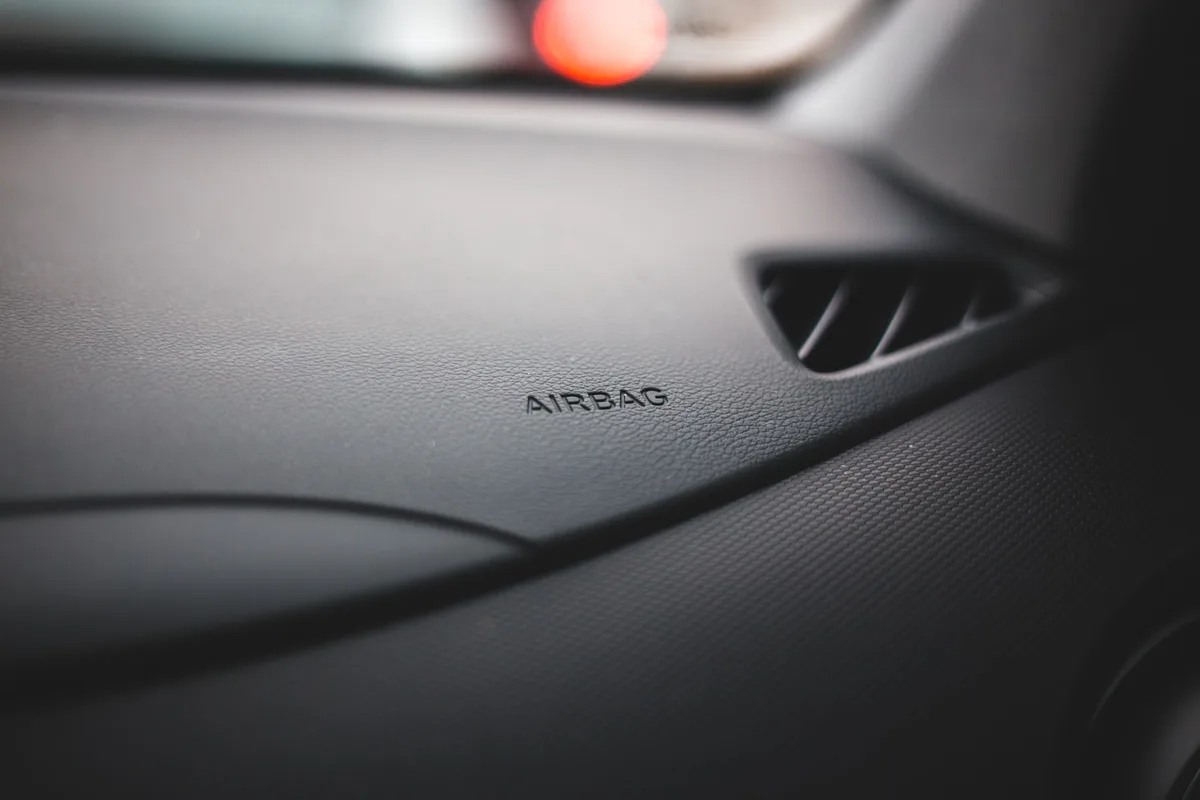
Image source: Pexels / Erik Mclean (Pexels License)
*Side-curtain airbags drop from the roof rail along the windows — the head-protection zone for outboard passengers, including anyone in the back seat. A canopy, blanket, or dangling toy that hangs into that path is sitting inside a live deployment zone.
The Four Main Ways a Cover Can Interfere
1. Blocked Deployment Path
A cover can physically stop an airbag from opening. This is most common with full vehicle seat covers that wrap around the side bolsters, because seat-mounted side airbags need a clear, engineered seam to tear through. Thick vinyl, neoprene, or quilted fabric can hold that seam shut — or delay it by milliseconds, and in a side impact, milliseconds are the whole game. Covers draped over a seatback in the curtain's path create the same problem: if the cushion can't drop cleanly, it can't protect the head.
In practice, the failure is rarely a dramatic rip. The realistic outcome is a seam that opens late or only partially — and a partially deployed airbag protects far less than a fully deployed one.
2. Redirected Airbag Force
Even when the cushion deploys, a cover can change its shape. Instead of expanding evenly toward the occupant, the airbag can shove the fabric sideways, fold it downward, or balloon into a pocket between the cover and the trim. Energy meant to cushion a torso gets spent moving material instead — and in the worst case, the bunched-up cover becomes the first surface the occupant hits.
3. Loosened Harness Fit
With covers and inserts that go over or inside the child restraint, the bigger danger is usually the harness, not the airbag. Padding behind a child's back or under the straps adds compressible bulk. In a crash, that bulk compresses — and a harness you adjusted snugly last week suddenly has slack. Slack lets the child travel forward before the restraint catches up, loading the head and neck instead of the shoulders and hips.
A related mistake: assuming the harness is fine because it "still clicks." The click measures the buckle, not flatness. A strap that twists, rides low, or sits off the shoulder bones because an insert pushed it out of position is a compromised strap, whatever the buckle does. Correct fit means the harness sits at or below the shoulders in rear-facing mode and at or above them once the seat flips forward — harness height at the shoulders is the exact detail to recheck after adding or removing anything inside the shell.
4. Loose Material Becoming a Projectile
A cover that isn't snug can shift in a crash. In the tens of milliseconds an airbag takes to inflate, loose fabric can be driven toward a child's face and chest. Even a lightweight canopy becomes hazardous at deployment speed — inflation is an explosive event, not a gentle puff, and any unsecured object in the cabin shares that physics.
The rule that ties all four together: if a product adds material between an airbag, a tear seam, or the harness and your child, it needs documented testing with your specific seat model before it goes anywhere near the vehicle.
How to Spot a Risky Cover Before You Buy
You don't need a crash lab to catch most problems. Two quick checks — one on the product, one on the car — flag nearly every risk.
Red Flags on the Box or Listing
- "Universal fit" or "fits most seats." If the listing doesn't name your exact car seat model, it wasn't tested for it.
- No airbag compatibility statement. Packaging for vehicle seat covers should explicitly describe how side airbags deploy through the fabric. Silence means untested.
- Thick padding or memory foam. Anything more than a few millimeters near the sides, the harness path, or the seat back is a concern.
- Straps, Velcro, or buckles routed near the belt path or LATCH anchors. Hardware can interfere with a tight installation or chafe webbing over time.
- Instructions that require disassembling the restraint. If fitting the cover means unthreading the harness, stop there.
Red Flags on the Car
- Seat-mounted side airbags. Check your owner's manual and look for a small "SRS AIRBAG" tag sewn into the seat's side seam. Many sedans and SUVs place torso airbags in both front seats, and some vehicles add them to the rear row as well.
- A hidden seam. If a cover sits over the stitched line where an airbag is designed to tear through, it is in the deployment zone — no matter what the seller claims.
- Occupant-sensing seats. Some vehicles weight-sense the passenger seat to decide whether the frontal airbag arms. A dense cover can alter that reading.
- Deeply contoured bolsters. Deeply bolstered sport seats often house larger side airbags, and their sculpted shape is precisely what stretchy one-size covers fail to clear cleanly.
Image source: Pexels / Andrea Piacquadio (Pexels License)
That small SRS tag means an airbag exits right there — keep the seam line uncovered.
What the Car Seat Manual Says — and Why It's the Final Word
Your child's car seat manual is the single most important document in this decision. It answers three questions:
- Does the manufacturer sell an approved cover, liner, or insert for your exact model?
- Does the manual explicitly warn against aftermarket accessories? Most do, in unambiguous language.
- Is there a model-specific part number for replacement covers? Those are the only covers the manufacturer has actually crash-tested.
Britax, Graco, Chicco, Nuna, Diono, and most other major brands state that unapproved accessories can compromise crash performance and void the warranty. That isn't legal boilerplate — it's the line between what was tested and what wasn't.
Two more manual details matter for long-term use. Every restraint has a service life: plastics age, webbing fatigues, and safety standards evolve, so each seat carries a cutoff date molded into its shell. You can usually locate the molded expiry stamp on the underside or back of the shell, and premium brands follow the same practice — a seat's total service life is spelled out in the manual alongside the date format. Any cover that hides those labels is hiding information you are required to be able to read.
What Child Passenger Safety Technicians Recommend
Certified child passenger safety technicians (CPSTs) are remarkably consistent on aftermarket accessories, and their advice has not softened:
- Use the seat as it comes out of the box. No added padding, no strap covers, no aftermarket inserts unless the manual lists them.
- Fix the underlying problem instead of padding it. A rolled towel or pool noodle to correct recline angle, a properly adjusted harness, or a different seat model if the current one genuinely doesn't fit the child or the vehicle.
- For cold weather, layer the child, not the harness. Dress the baby in thin layers, buckle first, then add warmth over the finished harness — a blanket or a shower-cap-style cover that attaches only to the shell's exterior or the carry handle, never between child and straps.
- Skip "comfort" products by default. Strap covers, body positioners, and plush liners are the category where well-meaning parents most often break the rules, because they're marketed as safety-adjacent and sold right next to the seats.
A common mistake inspectors see at check events: a parent added a soft strap cover "for comfort" months earlier, unaware the harness had silently lost flat contact with the child's collarbone. The fix takes two minutes; the risk it removed was not small.
The One Big Exception: Manufacturer-Approved Accessories
There is a short, real list of safe products — and every item on it comes from the car seat manufacturer or is explicitly named in your manual.
Approved Liners and Replacement Covers
Some brands sell thin mesh liners, seat pads, or replacement covers built for specific models. These are crash-tested with the seat and harness in place and add no bulk near the harness path or airbag seams. If the manual lists it, it passed testing with your seat. If it isn't listed, it didn't. Approved covers also come with official care instructions — and laundering it correctly matters even then, because harsh detergents and bleach can degrade flame-resistant treatments on fabric that was tested to begin with.
Factory Inserts for Newborns
Many infant and convertible seats ship with a newborn insert — a head-and-body pad that is part of the certified system for small babies. That insert is tested with the seat; a lookalike bought separately is not. Inserts also carry their own size cutoffs, so once a baby passes the stated limits, the pad comes out: its job is done, and keeping it in starts to affect harness fit as the child grows.
What This Means for Buying Used
If you're buying or accepting a secondhand restraint, insist on the original manual and all original parts, then remove any padded cover, strap wrap, or insert the previous owner added. There is no meaningful difference between a new unapproved cover and a used one — both are untested. And if you're on the giving end, strip aftermarket extras before passing it to another family, because the next parent inherits whatever you leave attached.
Image source: Pexels / Erik Mclean (Pexels License)
This factory insert shipped with the seat and was crash-tested with it — a lookalike bought separately was not.
Keeping Your Child Cool Without an Aftermarket Pad
Heat is a legitimate summer safety issue — an overheated, sweating toddler is miserable and dehydrates faster than an adult. The fix is to control the cabin, not to wedge a cooling mat between your child and the harness.
Before the Child Gets In
- Pre-cool the cabin. Run the air conditioning for a few minutes with the doors open to flush out the trapped heat before the buckle clicks.
- Park in shade. Obvious but effective; a shaded cabin stays dramatically cooler than one in direct sun.
- Use the drape-and-remove trick. Lay a towel or thin blanket over the seat and vehicle upholstery while parked, then take it off before the child goes in. It's safe precisely because it never rides in the car — it doesn't sit under the child or the harness while you're moving.
While Driving
- Shade the glass, not the seat. Window shades attach to the vehicle window and cut heat load without adding any layer near the child.
- Dress light. A single layer of cotton manages heat better than any gel insert.
- Touch-test the hardware. Buckles and harness clips in a parked car can get painfully hot; check them with the back of your hand before buckling.

Image source: Pexels / Engin Akyurt (Pexels License)
A shade on the glass cuts heat load without adding any layer near the child.
Before buying any product marketed as cooling, ask one question: does it need to sit between the child and the harness? If yes, it's an unapproved insert — full stop.
When to Skip Any Cover Entirely
Some situations are non-negotiable. No cover, pad, or protector belongs in the car in these cases:
- The child is rear-facing. Keep them rear-facing until they hit the seat's limits — check the size minimums for facing forward before any transition — and never place a rear-facing seat in front of an active passenger airbag. No accessory changes that rule.
- The vehicle has seat-mounted side airbags and the cover wraps the seat back. This is the most direct interference scenario possible: the cover is physically in the deployment path.
- The cover requires unthreading or modifying the harness. The harness is a primary restraint system. Anything that asks you to take it apart is telling you it wasn't designed for your seat.
- The cover hides labels or the manual storage slot. The model number, expiration, and instruction labels must stay readable at all times.
When in doubt, take the cover off. A clean, warm, slightly worn-looking seat is safe. A blocked airbag is not.
Been in a Crash? The Cover Question Becomes Moot
After a moderate-to-severe collision, manufacturers and safety guidance call for replacing the child restraint — the shell and harness may have absorbed stresses you can't see, and a cover on top of that is irrelevant. Before paying out of pocket, check how insurers handle a replacement seat; many policies cover it, and the claim process is simpler when you still have the model number and purchase details handy. Fit the new seat bare, and keep it that way.
If You're Still Unsure, Call the Manufacturer
The final authority here is not a blog or a forum thread — it's the car seat maker's customer service line. Call with your seat's model number, manufacture date, and the exact product name of the cover in question. They will give you a yes or a no, and if the answer is no, the conversation is over. Reputable brands answer quickly on this because accessory liability is well understood: they would rather lose one accessory sale than defend an untested product in a crash their seat was never certified with. Keep the manual in front of you during the call, and note that many manufacturers also publish approved-accessory lists on their support pages.
Frequently Asked Questions
Are any car seat covers safe with airbags?
Yes — but only covers made by your car seat's manufacturer and explicitly listed in the owner's manual for your exact model. Those have been crash-tested with the seat and harness in place. Universal covers, "fits most" products, and anything from a third-party brand have not been tested with your seat and should stay out of the vehicle.
Can I use a seat protector under the car seat base?
Most vehicle seat protectors are not crash-tested with car seat bases. A thick or slippery mat can compress or shift in a collision and reduce how firmly the base stays installed. The safest approach is to install the base directly on the vehicle seat, or use a thin mat only if your car seat manual explicitly permits one.
Do seat-mounted airbags make vehicle seat covers dangerous?
Yes. If your vehicle has side airbags built into the seat backs, a full cover that wraps around the bolsters can block or delay deployment. Even a cover advertising a "special airbag seam" is a risk, because neither your vehicle maker nor your child seat maker tested it. If the cover hides the SRS seam tag, it's in the zone.
Is a mesh liner safe for a child who gets sweaty?
Only if the liner is made by the same brand as the car seat and listed in the manual. A generic mesh liner hasn't been tested with your seat's harness and flame-resistance requirements. Sweat is uncomfortable; a compromised harness is not.
Are aftermarket covers safe for strollers or shopping carts?
Yes, when they're used only in a stroller or cart. The danger comes when the cover stays attached during drives. If a product isn't designed for use inside a moving vehicle, take it off before the car seat goes into the car.
How do I know if my car seats have built-in airbags?
Check two places: the owner's manual (search the index for "side airbag") and the seat itself — most vehicles with seat-mounted side airbags carry a small "SRS AIRBAG" tag on the side seam or the out edge of the headrest. Assume they're present in any modern vehicle until you confirm otherwise.
Does a non-approved cover void the car seat warranty?
In most cases, yes. Manufacturers state plainly that unapproved accessories can void coverage and shift liability. The warranty question is secondary, though — the real cost of an untested cover is that nobody, anywhere, has crash data proving it works with your seat.
Conclusion
Airbag safety is engineered, not improvised. A child car seat leaves the factory as a certified system, and a vehicle seat leaves the factory with seams and sensors placed exactly where the crash tests say they belong. A generic cover modifies both systems with zero test data behind the change — which is why the guidance from NHTSA and certified child passenger safety technicians is unanimous: manufacturer-approved accessories only, and everything else comes off before the drive.
Your next step takes five minutes. Pull out your car seat's manual (the paper copy or the PDF from the manufacturer's site), find the accessories section, and write down the only covers and liners listed for your model. If a product you own isn't on that list, remove it today; if you're shopping, buy nothing that isn't on it. And before your next trip to the baby aisle, screenshot that accessory page — it's the only compatibility chart that actually counts.

Leave a Reply