
You just bought a hybrid, and one question keeps nagging at you. How do you charge a hybrid car battery, and where exactly is the plug? The honest answer depends on which model is sitting in your driveway.
Some never touch an outlet at all.
Here’s the number that changes everything. Every standard hybrid sold in the US, from the Toyota Prius to the Honda Accord Hybrid, recharges its own high-voltage pack every time you slow down. Plug-in hybrids add a charge port, an onboard charger, and refill times that run from about 2.5 to 12 hours.
Let’s figure out which one you own, then plug it in the right way.
How Do You Charge a Hybrid Car Battery
How you charge a hybrid car battery depends on which type you own. Standard hybrids, like a Toyota Prius, refill their pack through regenerative braking alone. They have no charge port and never need an outlet.
Plug-in hybrids, like the Toyota RAV4 Prime, charge from a 120V or 240V outlet. A full charge takes roughly 2.5 to 12 hours.
If your car has a fuel door but no charging port, you own a standard hybrid, and charging is not your job. The car does it for you every time you brake. If you found a round port on the fender or a charging cable in the trunk, you own a plug-in hybrid, and the rest of this guide is written for you.
How a Hybrid Battery Charges Itself While Driving
If you drive a standard hybrid, the car handles all charging without any help from you. Two systems do the work: regenerative braking and an engine-driven generator. Neither one needs a cable, a wall outlet, or any effort on your part.
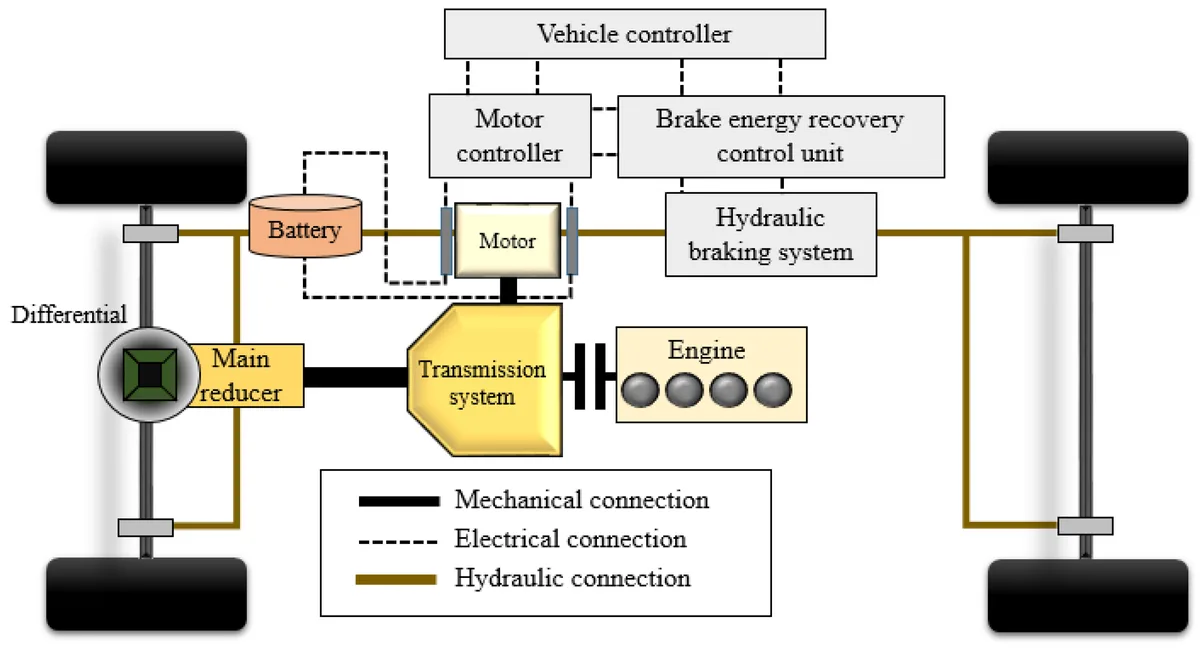
Image source: Web (Bing) / mdpi.com
Regenerative Braking: Where the Power Actually Comes From
Regenerative braking turns your electric motor into a generator whenever you slow down. Instead of wasting your momentum as brake heat, the car converts it into electricity and stores it in the high-voltage traction battery. Research from Department of Energy national labs shows regen can recover a large share of braking energy in stop-and-go driving.
That’s why hybrids post their best mileage in city traffic, not on the highway.
The gas engine pitches in too. In Toyota’s hybrid system, the engine spins a generator whenever the control computer asks for more charge. You’ll notice the battery gauge climbing during steady highway cruising, even though you never went near a plug.
It works on the same basic idea as an alternator keeping a starter battery topped up. If you’re curious how that plays out in a conventional car, we’ve covered whether driving recharges a battery in detail.
Why Hybrids Keep the Battery Between 40% and 80%
Hybrids never charge the pack to 100% or run it down to zero. The battery management system holds the state of charge, which is simply the battery’s fuel gauge, inside a shallow middle band. Manufacturers build that buffer in on purpose.

Image source: Web (Bing) / ebay.com
Shallow cycling is the secret to hybrid battery longevity. It’s a big reason packs routinely outlast 200,000 miles while a phone battery fades in three years. As of 2026, most new hybrids use lithium-ion chemistry, though plenty of older Toyotas still run nickel-metal-hydride packs.
If you want the full playbook, we’ve written up keeping a hybrid pack healthy in a separate guide.
There’s a bonus here too. Because regen handles most of the braking work, hybrid brake pads often last far longer than conventional ones. The car charges itself and saves you a brake job.
Key point: if there’s no charge port on your car, there is nothing to plug in, ever. The vehicle is its own charging station.
First, Figure Out Which Hybrid You Actually Own
Most charging confusion comes from sloppy terminology. Ads and dealers call every gas-electric car a “hybrid,” but the charging method splits them into distinct groups. One quick check settles it.
| Badge or name on the car | Type | Needs an outlet? |
|---|---|---|
| “Hybrid” or “HEV” (Prius, Accord Hybrid, CR-V Hybrid) | Standard | No |
| “Prime,” “PHEV,” “4xe,” “Recharge,” “e:” (RAV4 Prime, Wrangler 4xe, Volvo Recharge) | Plug-in | Yes |
| “Mild Hybrid” or 48V systems (many Audi, Mercedes, Ram models) | Mild | No |
That last row trips people up. A mild hybrid’s small 48V battery only assists the gas engine, so it never drives the car alone and can never be plugged in. Marketers also love the phrase “self-charging hybrid,” which just means a standard hybrid.
The 30-Second Identification Check (Badge, Charge Port, Manual)
- Read the badge. “Hybrid” by itself means standard. “Prime,” “PHEV,” “4xe,” “Recharge,” or a trailing “e” like BMW’s 330e means plug-in.
- Walk the car. Look for a small round door near the fuel filler or on a front fender. That’s the charge inlet, and standard hybrids don’t have one.
- Check the trunk. Plug-in hybrids ship with a charging cable in a storage bag. No cable usually means no plug.
- Still unsure? Search your owner’s manual index for “charging.”
Watch the near-miss models, because badges alone can fool you. The Kia Niro comes as a Hybrid, a PHEV, and a full EV, and the Toyota RAV4 comes as both a Hybrid and a RAV4 Prime. Same body, completely different charging story.
A used Chevy Volt muddies things further, since it’s a range-extended EV rather than a traditional plug-in hybrid.
One more thing worth knowing now. Every hybrid, plug-in or not, also carries a small 12V auxiliary battery that boots the computers and relays. That’s the battery that fades after weeks of sitting, and it causes far more no-start calls than the big pack ever does.
How to Charge a Plug-In Hybrid at Home: Level 1 vs. Level 2
If your hybrid plugs in, home charging will cover nearly every mile you drive. You have two options, and the difference is speed, not smarts. Both use the SAE J1772 connector standard in North America, so any plug-in hybrid works with any compliant station.
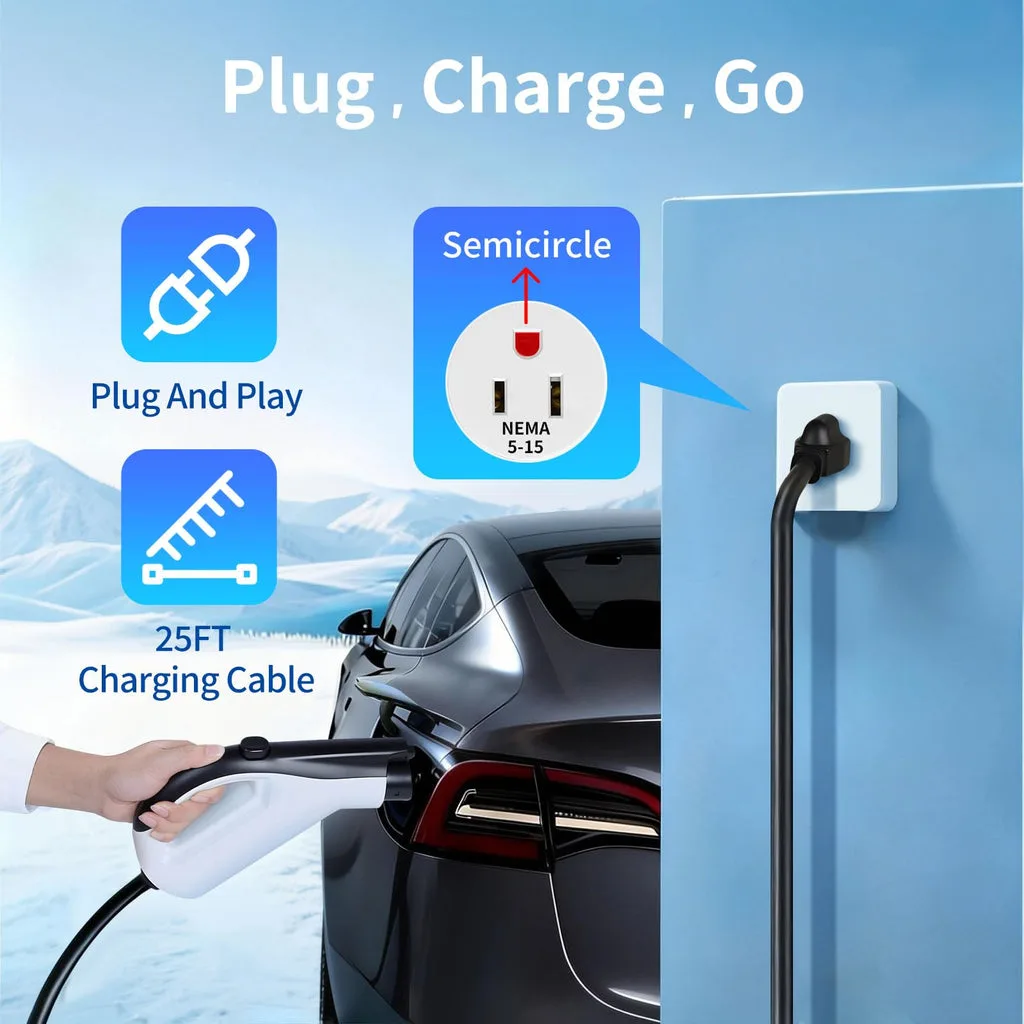
Image source: Web (Bing) / wenstormcharge.com
Level 1: The Included 120V Cord (Slower Than You Think, Often Enough)
Every plug-in hybrid comes with a portable cord set, technically called a mobile EVSE, that runs off a regular 120V household outlet. Manufacturer specifications put its output around 1.0 to 1.4 kW. At that rate, you add roughly 3 to 5 miles of electric range per hour of charging.
A full charge on the RAV4 Prime’s 18.1 kWh pack takes about 12 hours. An 8.8 kWh Prius Prime refills in around 5.5 hours. Plug in overnight, and you wake up full either way.
If you drive under 40 miles a day, Level 1 is honestly enough. The math only breaks when you drain the pack twice in one day.
Level 2: The 240V Upgrade (When It’s Worth the Electrician Visit)
Level 2 charging runs on 240 volts, the same circuit that feeds an electric dryer. Output climbs to 3.3 to 7.2 kW, capped by your car’s onboard charger. That component converts AC from the wall into the DC current the pack stores, since car batteries run on DC.
The speed jump is dramatic. Manufacturer specs show a RAV4 Prime that needs about 12 hours on Level 1 refills in roughly 2.5 hours on a 6.6 kW Level 2 unit. Most other plug-in hybrids land in that same 2.5 to 3.5 hour window.
| Level | Real output | 18 kWh pack, full charge | Range added per hour |
|---|---|---|---|
| Level 1 (120V) | 1.0 to 1.4 kW | about 12 hours | 3 to 5 miles |
| Level 2 (240V) | 3.3 to 7.2 kW | 2.5 to 5 hours | 10 to 25 miles |
So when is the upgrade worth it? If you drain the pack every day, Level 2 earns its keep. A dedicated circuit with a NEMA 14-50 outlet typically runs $500 to $1,500 installed, depending on your electrical panel and the cable run.
If you drive 20 miles a day and plug in nightly, Level 1 already covers you, and that money stays in your pocket.
The Plug-In Routine, Step by Step
The whole routine takes under a minute once you’ve done it twice. Here’s the sequence.
- Park within reach of your outlet and shift into Park.
- Open the charge port door. Most cars release it when you unlock the doors or press a fob button.
- Plug the cord into the wall or station first, then into the car until it clicks.
- Check the indicator light. Blinking means charging, solid green usually means full. Your manual lists the exact pattern.
- Set a charging schedule in the car’s menu or app so the pack fills during cheap off-peak hours.
- In the morning, unlock, unplug, coil the cable, and stow it in the trunk bag.
Two reassurances. Leaving the car plugged in overnight is completely safe, because the battery management system stops drawing power once the pack fills, the same principle we explain in our guide to charge times. And if you drive off with the cord still attached, the car cuts charging and warns you before the cable or port takes damage.
One bonus tip. Most plug-in hybrids let you precondition the cabin while plugged in, heating or cooling the interior on grid power instead of battery power. You leave with a full pack and a comfortable cabin.
Public Charging, Charge Mode, and Smarter Ways to Top Up
Home charging covers most plug-in hybrid miles, but two backup methods fill the gaps. One is public stations. The other is hiding under your hood.
Using Public Level 2 Stations Without Overpaying
Start with the surprise most new owners miss. Plug-in hybrids cannot use DC fast chargers, the 50 to 350 kW stations built for long-distance EV travel. Your onboard charger only accepts AC power at 3.3 to 7.2 kW, so those big stations don’t speak your car’s language.
That leaves public Level 2, and pricing is all over the map. Some stations bill $1 to $3 per hour, others charge per kilowatt-hour. At 3.3 kW, an hour of paid charging buys you 10 to 15 miles of range, so do the math before you plug in.
Workplace stalls, hotels, and free grocery-store chargers are the real wins.
To find stations, the Department of Energy’s Alternative Fuels Data Center maintains a national station locator, and apps like PlugShare crowdsource live status and pricing. Check the fee schedule in the app before you plug, not after.
Charge Mode: Charging the Battery With the Gas Engine (and When It Makes Sense)
Some plug-in hybrids include a Charge Mode button. Press it, and the gas engine spins a generator to refill the battery while you drive. The Toyota RAV4 Prime, Chrysler Pacifica Hybrid, Mitsubishi Outlander PHEV, and Jeep Wrangler 4xe all offer some version of it.
It works, but it’s the most expensive way to fill the pack. Converting gasoline into electricity wastes energy at every step, so a kilowatt-hour made this way costs far more than one from your garage. Treat it as a tool, not a habit.
The smart use case is banking electricity for later. Cruising on the interstate toward a low-emission zone or a quiet neighborhood? Charge Mode lets you arrive with EV miles in reserve.
Otherwise, leave the car in normal hybrid mode. The control computer juggles engine, motor, and battery better than any manual override does.
Charging Times and Real Costs, With Actual Numbers
Two numbers set your charging time: pack size and your car’s onboard charger rating. Manufacturer specifications list both, and they explain why two plug-in hybrids refill at wildly different speeds on the same outlet.
| Model | Pack size | Level 1 (120V) | Level 2 (240V) |
|---|---|---|---|
| Toyota Prius Prime | 13.6 kWh | about 11 hours | about 4 hours |
| Toyota RAV4 Prime | 18.1 kWh | about 12 hours | about 2.5 hours |
| Chrysler Pacifica Hybrid | 16.0 kWh | about 12 hours | about 2.5 hours |
| Jeep Wrangler 4xe | 17.3 kWh | about 12 hours | about 2 hours |
One note on the Prius Prime. The current model carries a 13.6 kWh pack, up from 8.8 kWh in the previous generation. That’s why older owner’s manuals quote shorter times.
Trust your own manual over a forum post.
Now the cost side. The US Energy Information Administration pegs average residential electricity near $0.17 per kWh. A full RAV4 Prime charge costs roughly $3 at that rate.
The per-mile math is where it gets interesting. A RAV4 Prime travels about 2.8 miles per kWh from the wall, so grid power runs around 6 cents per mile. Gasoline at $3.50 a gallon and 38 mpg costs about 9 cents for the same distance.
Time-of-use plans improve that further. Many utilities price overnight power between $0.08 and $0.12 per kWh, which drops your cost per mile to 3 or 4 cents. Set the charging schedule once in the car’s menu and the savings happen while you sleep.
For official figures on any model, the EPA’s fuel economy database lists charge times, pack specs, and MPGe for every plug-in hybrid on sale.
Charging Mistakes That Cost Money (and the 12V Battery Trap)
Most “hybrid battery” complaints aren’t about the hybrid battery at all. They’re about the small 12V battery sitting beside it. Mixing up the two leads to expensive wrong fixes, so let’s separate them.
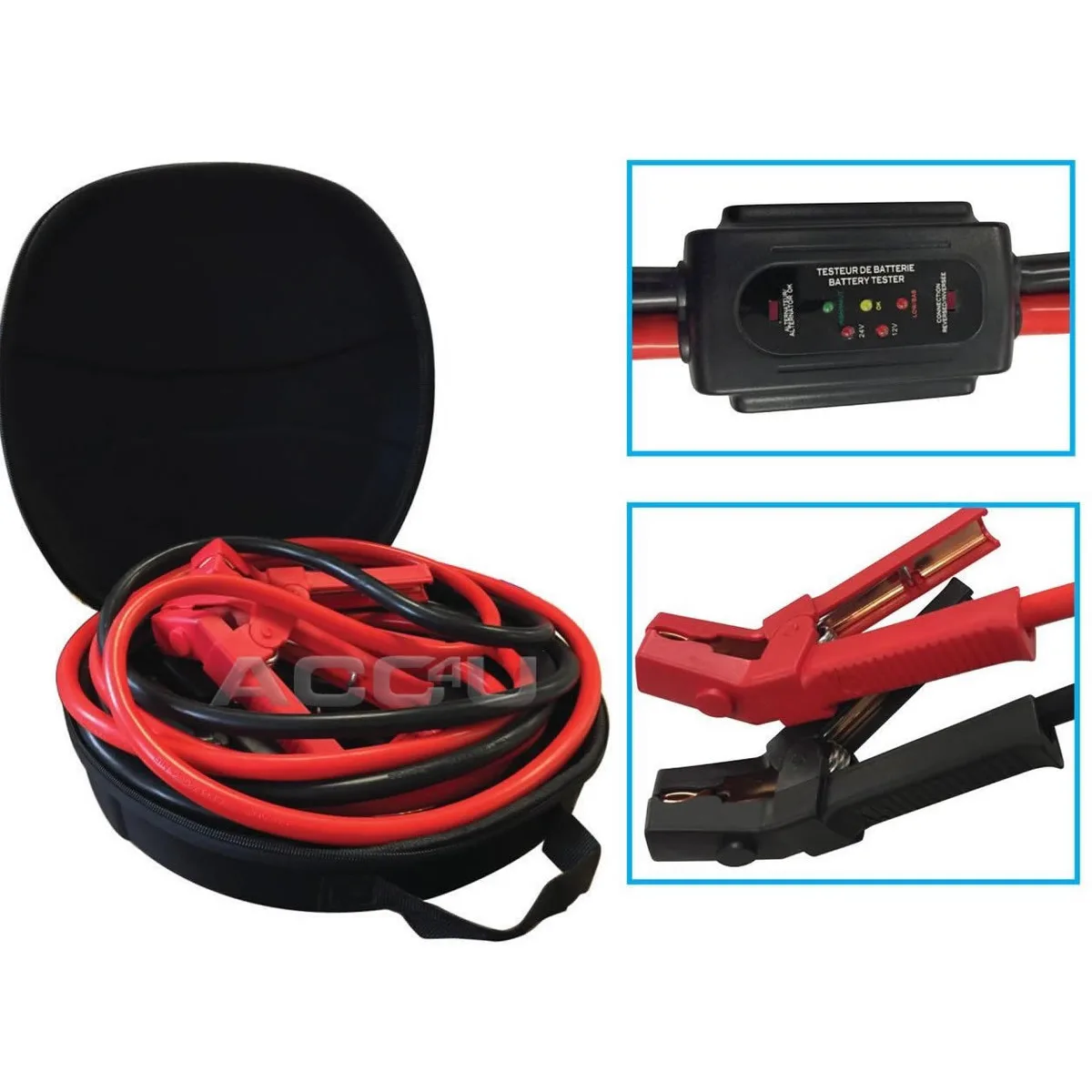
Image source: Bing (Web (fair-use with source credit))
The Dead 12V Battery Problem Nobody Warns You About
Every hybrid uses a small auxiliary 12V battery to boot the computers and close the relays connecting the big pack. It’s tiny, often half the size of a standard car battery. Leave the car parked two to four weeks and it can drain enough to strand you.
The symptom is distinctive. Dark dash, unresponsive fob, maybe one faint click. Our guide to spotting a battery that’s truly dead walks through the full diagnosis.
When you jump a hybrid, use only the under-hood jump terminal shown in your manual. Never clamp anything near the orange cables. Afterward, a simple multimeter test tells you whether the small battery is recovering or ready for replacement.
If the car sits for weeks regularly, a $30 trickle maintainer pays for itself in one avoided tow. NOCO and CTEK are the brands hybrid owners reach for most.
Extension Cords, Breaker Trips, and Other Level 1 Pitfalls
- Never charge through a power strip or daisy-chained cords. If you must extend the run, use a single 12-gauge cord, fully uncoiled, rated for a continuous 12-amp load.
- A breaker that trips at 2am usually means the charger shares a circuit with a fridge or freezer. Move to a dedicated circuit.
- Aging GFCI outlets often nuisance-trip under long continuous loads. An electrician can swap in a modern one in under an hour.
- Damaged cables get replaced, never taped. A cut EVSE cord carries real voltage when energized.
High-Voltage Safety: What You Should Never Touch
The orange cables and the traction pack carry 200 to 350 volts of DC, which is lethal. There is no safe DIY contact point anywhere in that system. NHTSA guidance is blunt about it: high-voltage service belongs to trained technicians with insulated tools.
Your safe jobs are the plug, the cable, and the 12V battery. That’s the complete list.
Two closing rules. Jump-start only from the labeled under-hood terminals, never from or to the high-voltage system. And if a hybrid takes flood water, have the pack inspected before anyone energizes it.
Hybrid Battery Charging FAQs
Can You Charge a Normal Hybrid by Plugging It In?
No. Standard hybrids such as the Prius and Accord Hybrid have no charge port at all. Their packs refill through regenerative braking and an engine-driven generator.
Plugging a trickle charger into the 12V battery won’t touch the high-voltage pack either. Only plug-in hybrids accept external charging.
How Long Does It Take to Charge a Plug-In Hybrid?
Between 2.5 and 12 hours, depending on pack size and outlet. A 120V household outlet adds 3 to 5 miles of range per hour, so most packs need 8 to 12 hours. A 240V Level 2 charger cuts that to roughly 2.5 to 5 hours.
Does a Hybrid Battery Charge While Idling?
Yes. The gas engine spins a generator that refills the pack even when the car is parked. It works, but every kilowatt-hour comes from burned gasoline, so it costs far more than plugging in.
Use it sparingly.
Should You Charge a Plug-In Hybrid Every Night?
Yes, if you’re using the electric range. Daily charging keeps you on grid power instead of gasoline, and the shallow charge window means a nightly fill doesn’t wear the pack. Schedule it for off-peak hours and stop thinking about it.
Can You Overcharge a Hybrid Battery?
No. The battery management system stops accepting current the moment the pack reaches full, whether you’re plugged in or braking. Leaving a plug-in hybrid connected overnight is safe by design.
The charge simply pauses and holds.
Which Charging Setup Fits Your Life: The Decision Guide
Everything above compresses into a few if/then calls. Find your situation below.
- If you own a standard hybrid: there’s nothing to plug in, ever. Your only job is protecting the 12V battery, and a maintainer during long storage covers it.
- If you own a plug-in hybrid and drive under 40 miles a day: the included Level 1 cord is your permanent setup. Plug in nightly, schedule off-peak, and skip the electrician.
- If you drain the pack daily or drive 40-plus electric miles: install Level 2. A NEMA 14-50 outlet costs $500 to $1,500 and refills any plug-in hybrid overnight.
- If you park on the street with no outlet: build your routine around free and workplace Level 2 chargers. Treat paid public charging like premium fuel, bought only when it still beats gasoline.
- If you road trip most weekends: don’t rush the home upgrade. Hybrid mode refills the pack as you drive, and gas stations aren’t disappearing.
- If the car sits for weeks at a time: the 12V maintainer matters more than any cable. That small battery strands hybrids, not the big one.
None of this needs babysitting. Standard hybrids are fully self-sufficient, and plug-in hybrids reward one simple routine: plug in at night, drive on electrons by day, and let the gas engine cover everything else.
The warranty backstops you, too. Federal rules require at least 8 years or 100,000 miles of coverage on hybrid components, and Toyota stretches to 10 years or 150,000. When a pack eventually needs replacing or reconditioning, you’ll have years of cheap electric miles behind you before that bill arrives.

Leave a Reply