
Your check engine light is on, the idle feels rough, or the car hesitated at a red light for no obvious reason. Someone told you to disconnect the battery to "reset the computer," and now you're wondering how long it actually needs to sit disconnected before it works — and whether 10 minutes is enough or if you need to wait overnight.
Here's the honest answer: there's no single magic number. It depends on what you're trying to fix, how new your car is, and which control modules need to forget what they've learned. Most quick guides say 10 to 15 minutes. In practice, that's often not enough for modern vehicles, because capacitors throughout the electrical system keep feeding small amounts of voltage to memory circuits long after the battery cable is off.
As a general rule for 2026-era vehicles:
- Older gas cars (roughly pre-2010): 15 minutes is usually enough
- Most modern gas cars: 30 to 60 minutes
- Cars with a battery management system (most European brands, many 2019+ models): a full hour minimum
- Hybrids and EVs: overnight is the only reliable home method
The rest of this guide breaks down exactly why the timing varies, how to match the wait time to your symptom, the correct disconnect procedure, and the mistakes that cause most DIY resets to fail.
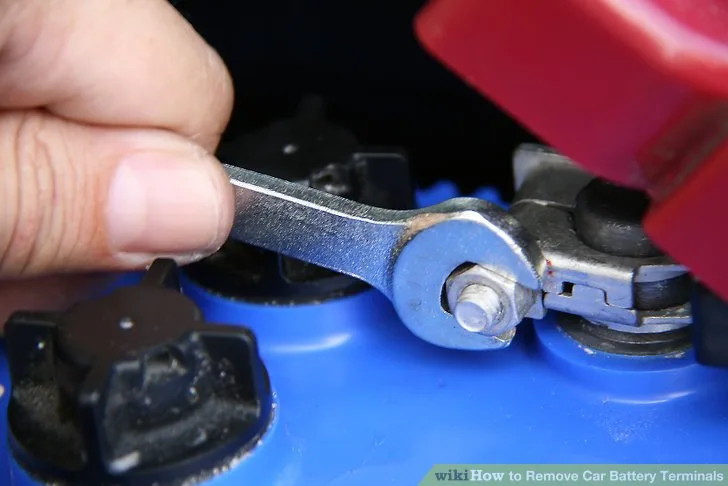
Disconnecting the negative terminal is the first step in a proper ECU reset.
Image source: Bing (Web (fair-use with source credit))
Why You're Disconnecting the Battery in the First Place
Modern cars aren't controlled by one computer — they're run by a network of modules that constantly adapt to how you drive. The engine control unit (ECU) stores what technicians call adaptive memory: fuel trim values, idle speed settings, and throttle position learned over weeks of driving.
When something goes wrong, that learned behavior can trap the car in a bad state. A vacuum leak, a dirty mass airflow sensor, or a failing oxygen sensor forces the ECU to compensate incorrectly. Even after you repair the underlying issue, the computer keeps applying those bad adjustments — which is why a car can still run poorly after a fix.
Disconnecting the battery wipes that adaptive memory, forcing the ECU to start from factory baselines and relearn from scratch.
There's also the simpler case: clearing a check engine light without paying a shop for a scan. A battery disconnect erases stored diagnostic trouble codes (DTCs) from the ECU's memory — but only soft codes, not hard failures:
- Soft codes are transient faults that happened once or twice — a momentary misfire, a single sensor blip. A reset clears these and they stay gone.
- Hard codes indicate an active, ongoing fault. The light will come right back, usually within a few miles, because the problem is physically still there.
Quick Answer: How Long Is Long Enough?
If you just want the number, here it is — with the reasoning behind each range.
| Vehicle Type | Minimum Wait | Safer Wait |
|---|---|---|
| Older gas car, no BMS | 15 minutes | 30 minutes |
| Modern gas car (2010–2018) | 30 minutes | 45–60 minutes |
| Car with battery management system | 1 hour | Overnight |
| Hybrid or electric vehicle | 1 hour | Overnight (8–12 hours) |
| After a routine battery swap | 10–15 minutes | The time the swap takes anyway |
The 30-minute disconnect is the safest default for standard vehicles. If the problem persists after that, move to an overnight disconnect before you assume something bigger is wrong. The extra time costs you nothing but a night's sleep.
What Resetting the ECU Actually Does
Understanding what happens when power is cut explains why the wait times differ so much between cars.
When you pull the negative terminal, you cut power to every electronic module — the ECU, body control module, transmission control module, and infotainment system. But power loss alone doesn't instantly erase everything, because modern ECUs use two different types of memory:
- Volatile memory (RAM) requires constant power to hold data. This is where adaptive fuel trims and idle settings live. Kill the power, and this data disappears within seconds.
- Non-volatile memory (EEPROM) holds permanent data — the VIN, immobilizer information, and emission-critical calibrations. A battery pull won't touch any of it, and you wouldn't want it to.
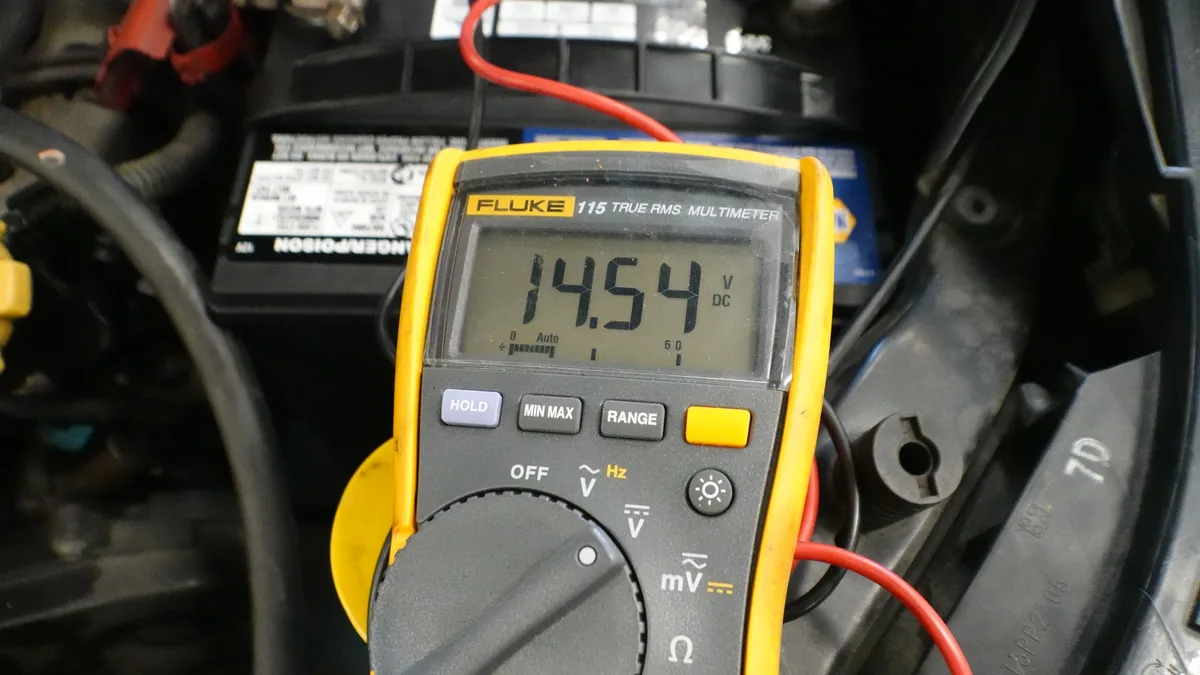
Residual voltage in capacitors is what makes short disconnects unreliable.
Image source: Web (Bing) / carbuzz.com (Web image (fair-use with source credit))
The complication is capacitors. These small components store an electrical charge and sit throughout the car's electrical system, slowly discharging after the battery is disconnected. While they still hold charge, they keep feeding voltage to the memory circuits — enough to preserve the learned data you're trying to erase. This is exactly why a 5-minute disconnect so often fails.
You can verify the drain instead of guessing. With the negative cable off, use a digital multimeter to measure between the positive battery post and a clean chassis ground point. When the reading drops to near zero (under about 1.5 volts), the residual charge is effectively gone. Most cars reach that point within 15 to 30 minutes. Based on what owners of European vehicles consistently report, BMW, Mercedes, and Volkswagen models tend to hold residual charge longer — 45 to 60 minutes is the more reliable window for those brands.
How to Choose the Right Disconnect Time for Your Car
Not every car needs the same approach. Narrow it down by symptom and vehicle type.
Symptom Check: What Are You Trying to Fix?
| Symptom | Recommended Disconnect Time |
|---|---|
| Rough idle or poor throttle response | 30–60 minutes |
| Check engine light with a soft code | 30–60 minutes |
| Transmission shift quality issues | 1 hour minimum |
| Hybrid battery management fault | Overnight |
| After replacing a dead battery | 10–15 minutes |
A routine battery swap is the exception — the brief power loss during the swap is usually all the ECU needs. But if you're chasing a persistent drivability problem, give the system real time to drain. Before you even start, it's worth confirming you're not chasing a weak battery itself; the warning signs of a failing battery can mimic the exact symptoms a reset is meant to fix.
Does Your Car Have a Battery Management System?
Late-model vehicles — especially BMW, Mercedes, Audi, and many 2019-and-newer models from other brands — use a battery management system (BMS). It monitors battery health, charge state, and temperature, and adapts the alternator's output based on your driving patterns.
Here's the critical part: a battery pull does not reset the BMS. It requires a registration procedure with a diagnostic tool to clear the old battery's data. If you skip that step after installing a new battery, you may see overcharging or undercharging afterward — one reason at-rest voltage readings can look odd after a DIY reset. If you've just replaced a battery in a BMS-equipped car, factor the registration step into your plan (and budget — it's one reason replacement batteries cost what they do).
Hybrid vs. Gas-Only: A Whole Different Rulebook
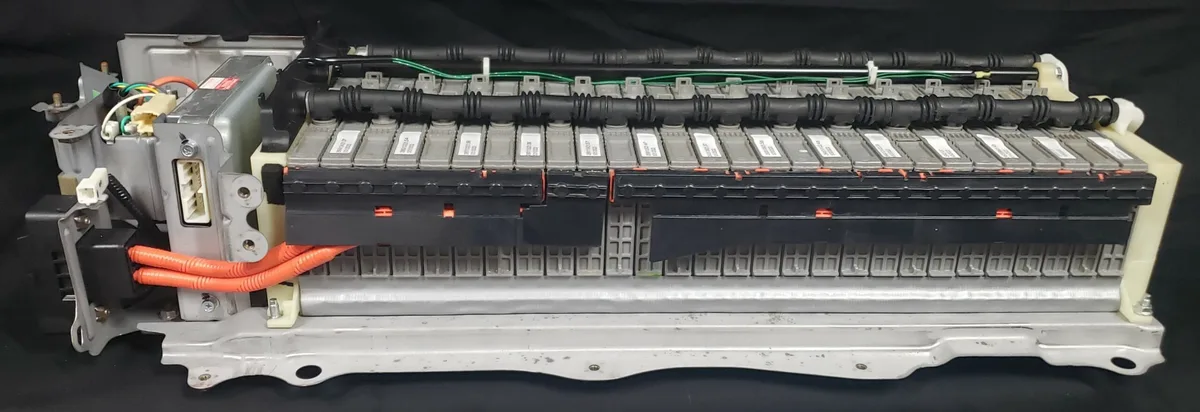
Hybrid systems hold memory independently of the 12-volt battery.
Image source: Web (Bing) / exclusivelyhybrid.com (Web image (fair-use with source credit))
Hybrids and EVs add a layer of complexity: the high-voltage battery pack stays energized even when the 12-volt auxiliary battery is disconnected. The hybrid battery management module has its own processor and non-volatile memory, and it takes several hours to fully de-energize.
On a Toyota Prius, a 15-minute disconnect of the 12-volt battery clears the engine control memory, but the hybrid management system holds its own learned parameters. Resetting that requires either a scan tool or an overnight disconnect — and even then, some hybrid-specific codes won't clear without dealer-level equipment.
It's also worth being honest about what a reset does for a hybrid: the lifespan of a hybrid battery pack depends on proper maintenance, not on clearing codes. If the warning keeps returning, the pack itself is telling you something.
Step-by-Step: The Battery Disconnect Procedure That Works
Grab a 10mm or 13mm wrench, safety glasses, and a clean rag. Here's the process that works for most cars:
- Park on flat ground and shut the car off completely. Remove the key from the ignition. With push-button start, make sure the car is fully powered down and the key fob is well away from the vehicle.
- Locate the battery. Usually in the engine bay, but some cars hide it in the trunk or under a rear seat. Check the owner's manual if you can't find it.
- Identify the negative terminal. Look for the black cable with a minus (–) sign or "NEG" on the case. Always disconnect negative first — removing the positive first is how you create a short circuit.
- Loosen the clamp bolt. Loosen the nut on the negative clamp just enough to wiggle it free. You don't need to remove the bolt entirely.
- Lift the clamp off the post. Pull straight up, twisting gently side to side if it's stuck. Move the cable well away so it can't spring back and touch the terminal.
- Wait for the capacitors to drain. Set a timer for your chosen interval. To verify rather than guess, measure between the positive post and a ground point with a multimeter until the residual voltage drops below about 1.5 volts.
- Reconnect the negative cable. Push the clamp back onto the post and tighten until snug — hand-tight plus a quarter turn. Overtightening cracks the clamp.
- Wait 30 seconds before starting. This lets the ECU power up cleanly without a voltage spike.
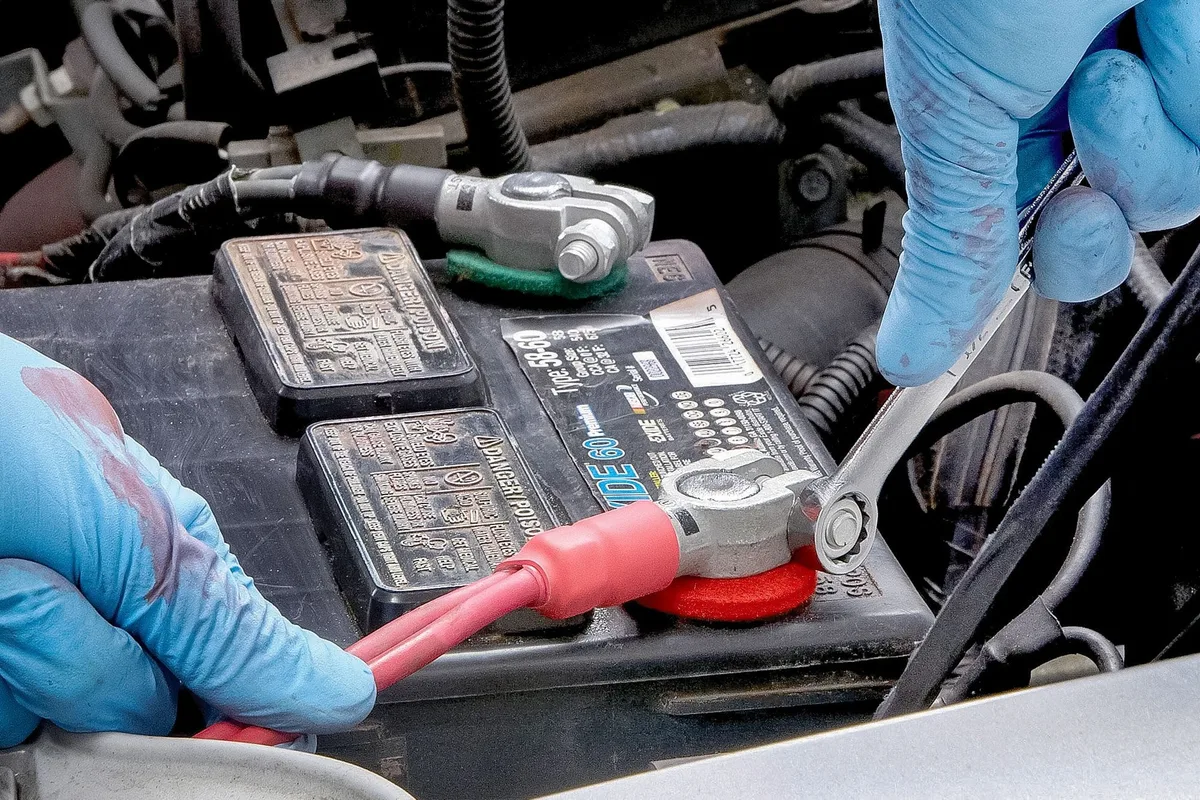
Loosen the negative clamp bolt before lifting the cable free.
Image source: Web (Bing) / ar.inspiredpencil.com (Web image (fair-use with source credit))
A common mistake is skipping the residual voltage check entirely — waiting 10 minutes, reconnecting, and then wondering why the light comes straight back. The capacitors still held enough charge to preserve the memory. Another frequent error is letting the wrench bridge the positive terminal while working near the battery, which creates a dead short that can weld the tool to the post and cause serious burns.
Inspect both terminals before you start. Heavy white or blue corrosion buildup should be cleaned off first. If you're doing this as part of a full battery replacement, the correct battery installation procedure covers terminal cleaning and torque specs in detail, and it helps to know how long a swap typically takes so you can plan around it.
The 15-Minute Reset: When It's Enough and When It's Not
The 15-minute window works best on older, simpler vehicles — roughly 2010 and earlier. Their ECUs dump volatile memory almost instantly, capacitors drain within a few minutes, and the relearn process is forgiving enough that minor leftover data doesn't matter. It also works fine for routine maintenance, since a battery swap creates its own power interruption.
But on late-model vehicles, 15 minutes is a gamble. The battery management system holds charge longer, and so do the capacitors feeding the ECU and transmission control module. Reconnect too early and you may clear the light only to watch it return after a short drive — the computer resumed with the same bad data it had before.
A quick decision guide:
- Pre-2010, no BMS: 15 minutes is usually fine
- 2010–2018, standard ECU: go 30 minutes to be safe
- 2019 and newer, or any European import: wait a full hour
- Hybrid or EV: skip the short waits entirely — go overnight
If a stubborn code survived your first 15-minute attempt, repeating the same timeline won't produce a different result. Move to the longer interval instead.
The Overnight Reset: Overkill or the Only Way?
Leaving the battery disconnected overnight isn't just about the ECU. It gives every module in the car — body control, audio, security system — time to fully discharge. Some modules hold error data and learned settings in a buffer that persists for a while after power loss, and a 30-minute disconnect doesn't always clear it. An 8-to-12-hour disconnect guarantees it's gone.
For hybrids, the overnight reset is the only dependable home method. Owners of Prius and Ford hybrid models routinely find that a night's rest clears codes a 30-minute disconnect wouldn't touch, because the hybrid management system takes hours to fully de-energize.
There are trade-offs, and you should know them going in:
- The clock, radio presets, and power window auto-up function reset
- Some cars lose the learned throttle body position
- On reconnect, the engine may idle high for a few minutes while it relearns — that's normal, not a new problem
One caution before committing to the overnight approach: check your battery's health first. Sitting disconnected doesn't hurt a healthy battery, but if you have a parasitic drain or a weak alternator, you might not have enough charge left to start in the morning. A quick voltage check with the engine running confirms the charging system is doing its job, and it's smart to rule out whether the car can sit that long without the battery draining if it already has a marginal battery.
Alternative Reset Methods: Fuse Pull, OBD-II Scanners, and the "Key Dance"
The battery disconnect is the classic method, but it isn't the only one — and sometimes another approach gets better results.
Pulling the ECU or IGN Fuse
This is the technician's shortcut. Instead of disconnecting the whole battery, pull the fuse that feeds the ECU and ignition system. Check the fuse box diagram in your owner's manual — the fuse is usually labeled "ECU," "PCM," "IGN," or "EFI." Pull it, wait 10 minutes, and reinsert.
The advantages: it's faster, and it doesn't reset the clock or trigger the radio lockout. The downside is that many vehicles use multiple fuses for the ECU, so you can miss one and get no reset at all.
OBD-II Scanners
A scan tool does more than read codes — most handheld units can clear stored DTCs directly from the ECU, which is faster and more precise than a battery pull. When you're plugged in, live data like real-time engine temperature readings also helps you confirm whether a sensor is actually misbehaving before you reset anything. Understanding terms like what VPWR means on a scanner display makes the data easier to interpret.
But here's the catch: clearing codes with a scanner doesn't reset the adaptive learning tables. It wipes the stored DTCs and freeze-frame data only. If your problem is rough idle or poor throttle response, the scanner alone won't fix it — the ECU still holds the bad fuel trims it learned. You'd need a tool with an "adaptation reset" function, or a dealership-level device, to clear those. For that kind of relearn, a battery disconnect remains the better DIY option.
The "Key Dance"
Some manufacturers publish manual reset procedures that require disconnecting nothing. Ford uses a brake-pedal sequence on certain models, GM uses an ignition-cycling pattern, and Toyota has pedal tricks for the maintenance light. These work reliably when performed exactly as written — but they're strictly model-specific. What works on an F-150 does nothing on a Civic, so find the exact procedure for your year, make, and model.
| Method | What It Clears | What It Doesn't Clear | Best For |
|---|---|---|---|
| Battery disconnect | Adaptive memory, soft codes | Hard codes, immobilizer data | General reset, drivability issues |
| Fuse pull | ECU volatile memory | BMS, body control module | Quick reset, no radio lockout |
| OBD-II scanner | DTCs, freeze-frame data | Adaptive fuel trims | Reading codes, quick clearing |
| Key dance | Varies by model | Usually little beyond reminders | Specific maintenance lights |
Signs the Reset Worked — and Signs It Didn't
Knowing the difference saves you from an unnecessary second attempt. A successful reset looks like this: the light stays off after several drives, the idle settles into a smooth rhythm within a few minutes of starting, and throttle response returns to normal. The car may feel slightly different for a day or two while the ECU relearns your driving style — that's expected.
A failed reset looks like this: the check engine light returns within a few miles, the same drivability issue reappears, or a code reader shows the identical DTC again. At that point, one of two things is true — the wait was too short, or the fault is physical and the code is a symptom, not the disease. Don't keep resetting on a loop. If the same code returns twice, scan it properly or have a shop read it. A reset is a tool for clearing stale data, not a diagnostic strategy, and old batteries that keep a car from sitting reliably are better replaced than nursed — the old battery can usually be recycled at most parts stores when the time comes.
Mistakes to Avoid: What Most DIYers Get Wrong
The most common mistake is not waiting long enough. The second is reconnecting incorrectly, which can send a voltage spike through sensitive electronics. Here are the big ones:
- Reconnecting with the ignition on. A guaranteed way to blow a fuse or damage a module. Key out, ignition off, before touching terminals.
- Bridging the terminals with a tool. Even briefly, this creates a dead short that can melt the battery case and start a fire.
- Forgetting the radio anti-theft lockout. Many Hondas and late-model Fords require a security code to reactivate the radio after power loss. Find the code — usually in the owner's manual or on a card in the glovebox — before you disconnect.
- Skipping the drive cycle. Starting the car and driving off hard can cause stalling or hesitation for a few blocks. Let it idle two to three minutes first.
- Expecting a reset to fix a mechanical problem. If the car misfires from a bad coil pack or a vacuum leak, the code will come straight back because the fault is physically present. Fix the part first, then reset.
If you're not sure the battery itself is healthy, a quick multimeter test before you start saves you from chasing the wrong problem entirely.
Safety First: Airbags, Immobilizers, and Voltage Spikes
Disconnecting a car battery isn't dangerous if you follow basic precautions — but carelessness creates real risks.
Airbag systems. Cutting power can cause the airbag control module to log a hard fault. In some cases, only a professional scan tool can clear it, meaning the airbag light stays on until then. The airbags won't deploy randomly, but the car may fail inspection and the airbag system may not function in a crash until the fault is cleared.
The immobilizer. Many vehicles use a chip in the key that communicates with an anti-theft module. A full disconnect can occasionally cause the immobilizer to lose the key's ID — the engine cranks but won't fire. This usually resolves after leaving the key in the ON position for several minutes, but some German vehicles require a dealer relearn.
Voltage spikes. Reconnecting a battery sends a power surge through the system. Dirty terminals or loose clamps make this worse and can damage CAN bus modules or the infotainment display. That's why terminal cleanliness and connection order matter: disconnect negative first, reconnect negative last.
The National Highway Traffic Safety Administration provides consumer guidance on battery service and jump-starting safety, and the fundamentals haven't changed: wear eye protection, keep sparks and open flames away from the battery, and never smoke while working near one — batteries can vent hydrogen gas. Following those simple rules prevents the most common injuries.
Yes, You Need a Drive Cycle After Reconnecting
Reconnecting the battery isn't the end of the process. The ECU needs to relearn your engine's baseline behavior, and that happens during a drive cycle — a specific sequence of driving that exercises the engine, transmission, and emissions systems.
For most cars, a proper drive cycle takes 15 to 20 minutes of mixed driving:
- Start with a cold start (car has sat for several hours)
- Add city driving with several stops and starts
- Include a steady highway cruise at moderate speed
- Finish with some deceleration off the highway without braking hard
Skip the drive cycle and you might see a high idle, stalling at stop signs, or even the light returning briefly. That's not a real failure — the computer is simply still in learning mode. In practice, most modern cars return to normal idle within 10 minutes of easy driving. The alternator handles the recharging during this time, which is why driving itself recharges the battery — a short drive cycle covers both jobs at once.
Real Scenarios: Timelines That Actually Worked
These are the situations reported most often by drivers who've been through this, along with what resolved them.
Scenario 1: 15 minutes and a harsh idle. A mid-2010s compact car with a rough idle after a throttle body cleaning. A 15-minute disconnect didn't help. Repeating the process with a 45-minute wait smoothed the idle out — the extra time let the capacitors drain fully.
Scenario 2: Overnight for a stubborn lean code. A late-2010s full-size truck with a recurring lean-condition code. A 30-minute reset cleared the light, but it returned within 50 miles. An overnight disconnect finally cleared the adaptive fuel trims behind the problem, and the code stayed gone.
Scenario 3: A hybrid with a management fault. A mid-2010s hybrid showing a battery system warning. A one-hour disconnect didn't clear it. After 12 hours disconnected, the warning was gone on the next start — the hybrid management system had finally lost its memory.
The pattern is consistent: short waits work on simple problems and simple cars; everything else rewards patience.
Expert Tips: How a Mechanic Would Do It
A professional doesn't wait and hope — they confirm the discharge. Three habits worth borrowing:
- Verify the drain with a meter. Measure between the positive post and a clean ground with the negative cable off, and don't reconnect until the residual voltage is effectively gone. Guessing is why most failed resets fail.
- Use the grounding trick to speed things up. After removing the negative cable, briefly touch the disconnected cable end to a bare metal point on the engine block for about 10 seconds. This bleeds the capacitors far faster and can turn a 30-minute wait into a much shorter job. A small spark is normal — just make sure you're not near fuel vapors.
- Know when not to bother. If the car has a hard code for a mechanical failure — a misfire, a dead sensor — skip the reset. Fix the part first, then clear the code. The battery pull can't fix what's physically broken.
Frequently Asked Questions
Will disconnecting the battery clear codes without a scanner?
Yes, for soft codes. A disconnect erases stored DTCs and freeze-frame data along with adaptive memory. Hard codes tied to an active mechanical failure will return almost immediately after reconnection.
How long does the radio lockout last?
Until you enter the correct security code. It's usually printed in the owner's manual or on a card in the glovebox. Without it, the radio stays locked until a dealer unlocks it — which is why you should locate the code before disconnecting anything.
Can a battery reset damage the alternator?
No. The alternator only produces power when the engine runs, and a brief power interruption is harmless to it. Just make sure both terminals are tight before starting so the charging system isn't working through a loose connection.
Will the ECU relearn bad habits from before?
No. After a reset, the ECU rebuilds its fuel trims and idle settings from current engine conditions. If you've fixed the underlying problem, the new learned values will be correct. If the fault is still present, the same code and symptoms will come back.
Do I need to register a new battery with the BMS?
On most late-model European vehicles and a growing number of Asian and American models, yes. A simple disconnect won't reset the battery management system — it needs a diagnostic tool or a dealer visit to register the new battery and clear the old data. Skipping it can cause long-term charging problems.
Conclusion
The short version: 30 minutes is the reliable minimum for most modern gas cars, one hour for anything with a battery management system or European electronics, and overnight for hybrids and EVs. Old cars forgive a 15-minute disconnect; new ones don't. The wait matters because capacitors keep memory circuits alive long after the cable comes off — and reconnecting too early is the single most common reason these resets fail.
Just as important: a battery reset clears stale data, but it can't fix a broken part. If a code comes back twice, stop resetting and scan it properly.
Your next step: before you touch a wrench, write down your car's year, make, and whether the light has come back before — then check your owner's manual for the radio code and BMS requirements. Those two minutes of prep determine whether this is a free 30-minute fix or a trip to the shop. If you want to go deeper on battery care, our main blog library covers everything from testing to replacement.

Leave a Reply